
A Guide to Building Dispute Resolution in Victoria
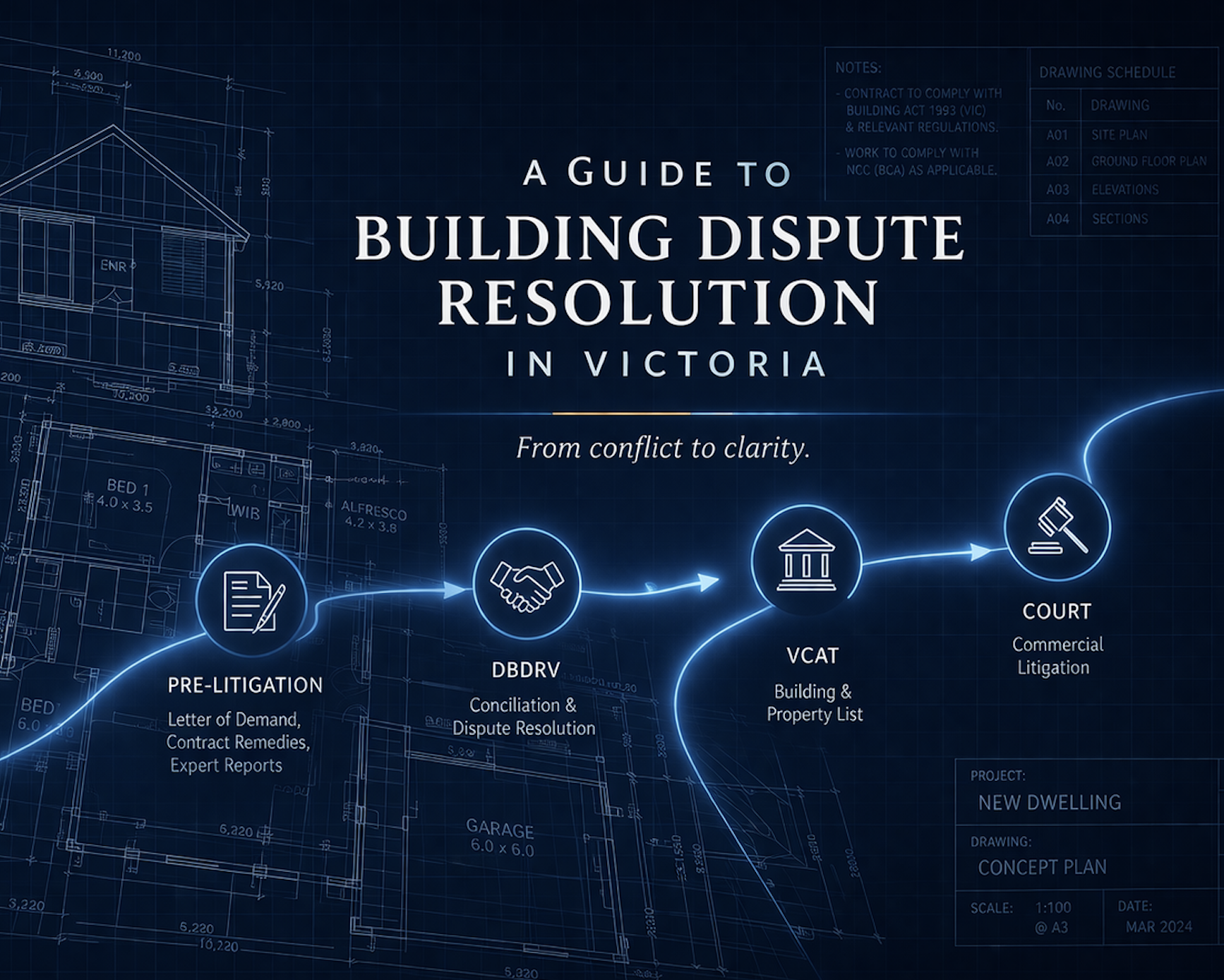
The following article is a guide to some of the fundamentals of building dispute resolution in Victoria, that will potentially allow you to better understand the structures and requirements of different avenues of dispute resolution and give some indication of what to expect.
This article will focus primarily on domestic building disputes, but with some advice on commercial litigation in the last part of the paper.
It is no substitute though for obtaining considered advice from a legal expert (in construction) tailored to your individual circumstances, which should provide you with specialised wisdom, and ideally, some comfort.
Pre-Litigation
(i) Consider initially a Letter of Demand from your lawyer: setting out the parties and contract particulars, and relevant breaches of contract (eg failure to pay, failure to rectify defects / progress the works); the letter allows a date for a positive response in writing, otherwise an intention to pursue VCAT or Court action and claim costs and interest.
(ii) Exercise Contract remedies, eg: Notice of Intention to Terminate Contract (MBA Contracts), or Notice to Remedy Breach of Contract (HIA Contracts): you must cite the provisions of the Contract it is served under, cite the breach(es), allow the contractual timeframe for remedy and warn of the intention to terminate if the breach is not remedied. Given the importance of getting these legal instruments correct, a lawyer should be engaged (ie, don’t “do it yourself”).
- The subsequent Notice of Termination is not mandatory, and a party must be fully appraised of the pros and cons of the next (termination) step. However, formal notice of default and intention will serve to apply pressure on the recipient party.
- In the commercial works Contracts, eg the Australian Standard 2124, or AS-4000, it is called a Show Cause Notice. If not complied with, it will allow for instance a Principal to take works out of the hands of the Contractor, or to terminate the Contract entirely.
- Commercial contracts, like domestic, allow for a formal notice of suspension prior to going down a termination path. They also often have dispute resolution sections (eg the ABIC Simple Works commercial contract), that allows for a notice of dispute followed by a meeting of the parties’ representatives, followed by a mediation, arbitration or expert adjudication process (prior to litigation).
(iii) Ensure that where required (eg for Owner clients who have defects, or for Builders who have been terminated from projects) that a building defect report, engineering report or a Quantity Surveyor (“QS”) report is obtained prior to commencing legal proceedings and often prior to any mediation or conciliation process.
- The case of Fasham Johnson Pty Ltd v Ware [2004] VCAT 1708 highlights the requirements of the two-step notice process in domestic building contracts.[1] It is very important lawyers draw up these documents and follow the form and service mandates under the Contract. Also, a party may not terminate the Contract when they are themselves in breach of the Contract.
Conciliation system in Victoria – the DBDRV
(i) Since late April 2017 it has not been possible to take an Owner vs Builder domestic building dispute to the VCAT without first attempting a conciliation application with Domestic Building Disputes Resolution Victoria (“the DBDRV”).
(ii) This is an easy application to fill out online via the DBDRV website and takes about an hour for an average complexity dispute, though for defect cases it may be necessary to type every defect item into a “list of matters in dispute” (a subsequent document), if you are an Owner.
(iii) Parties are usually able to complete the online DBDRV form themselves, or a lawyer can do it for them. One should have the building contract before you and key documents, e.g. disputed payment claims, the main expert report, before you start.
(iv) It is possible to upload key documents, eg a copy of the building contract, or an expert report, to the application form before it is submitted.
(v) There will be a Dispute Resolution Officer allocated within several weeks and expect about 3 months to get a conciliation date. This is similar to a mediation and can be held ‘in person’ but more often it is by Zoom, sometimes by phone.
(v) Parties can choose to have lawyers present at a conciliation but it is not compulsory and the DBDRV tend to encourage the parties to ‘self represent’ – but cannot bar parties having lawyers present. If there is agreement, there is a Record of Agreement signed, but this does not have the power of VCAT terms of settlement and the willingness of the DBDRV to enforce a breach is (seemingly) at their discretion.
(vi) The DBDRV powers to engage conciliation are under specific sections of the Domestic Building Contracts Act 1995 (Part 4, Sections 44-52).[2] Once a conciliation certificate is issued, e.g. if the conciliation reached no agreement or if the matter is deemed not suitable for conciliation (e.g, if it is too complex), either party can apply to the VCAT.
(vii) The DBDRV can also issue a Dispute Resolution Order (eg to compel the Builder to carry out certain works in a specific timeframe, or for an Owner to make a payment), but this can be reviewed at the VCAT. If not complied with there can be a Breach of Dispute Resolution Order issued, usually against a Builder, which can have misconduct consequences (eg suspension of registration) (Sec 49 of the DBCA).[3]
(viii) Soon there may be Rectification Orders available to be issued against Builders on behalf of Owners, from July 2026 under the new Building Legislation Amendment (Buyer Protections) Act 2025, but it is unclear currently:
- Whether the BPC will be inundated with a surge of applications;
- How many the BPC will be prepared to issue, at least initially;
- How in practice this will work, or whether the Government has “bitten off more than it can chew”;
- To what extent the Owners will be able to claim on the domestic builder warranty insurance if the Builder does not comply with the Rectification Order, as research suggests this will not be retrospective and will only apply to domestic builder insurance policies issued after July 2026.
(ix) Since July 2025, the DBDRV has been administered by the Building & Plumbing Commission (“the BPC”), as has the VMIA domestic builder insurance – this DB insurance is currently only available to Owners up to a limit of $300,000 if a builder has died, disappeared, become insolvent, or failed to comply with a judgment of the Tribunal.
Proceedings in the Building & Property List at VCAT
(i) Always ensure that the party you are suing, if it is a company, is the correct Respondent to be suing as per the Contract. If necessary, have regard to not only the contract schedule but other related documents like the Building Permit, Certificate of Currency for DB Insurance etc.
(ii) Always conduct a basic ASIC search to check a company that you are suing is still registered and solvent, before a legal proceeding is commenced. This record must be included with the Application package that is lodged with VCAT.
(iii) The Application form itself should take no more than about 40 minutes to prepare and can refer to Points of Claim to be attached with the Application package. Though it is a good idea to give a brief summary in the Application form of the parties, the Contract, the nature of the Works and a brief description of the contract breach and the claim. You don’t need to know the quantum of the claim before you file though.
(iv) You must include a copy of the DBDRV certificate of conciliation, the relevant filing fee (usually on a credit card payment form, available on the VCAT website) and your key Expert Report (if you rely on an Expert Report, usually for Owners).
(v) There can be a long delay for first directions, which are sometimes made in Chambers, otherwise the parties will be notified of a Directions Hearing date. For initial timetabling, the parties can agree on a minutes of consent orders and file them. This avoids the need for an appearance at a Directions Hearing.
(vi) For disputes over $100,000, they will generally be referred to a Compulsory Conference (“CC”) after the Respondent has had an opportunity to put in a Defence and any Counterclaim, and the parties have had a chance to file and serve Expert Reports.
(vii) For matters less than $100,000, they may be referred to a quicker mediation using an external mediator engaged by VCAT, which will be available quicker than a Compulsory Conference.
(viii) Currently all mediations, CCs and directions hearings are held by Zoom, though more basic directions hearings are by telephone.
(ix) Some Directions Hearings involve contested applications, eg over joinder of third parties, whether or not a preliminary hearing should be held, or compliance hearings where a party is late in filing a document. Others are more straightforward and involve timetabling only.
(x) There are currently long wait times at VCAT, not only in getting initial Orders, but also often between the date of the final CC and getting a Final Hearing date. This is due to a backlog of matters at the Tribunal.
(xi) Orders after the final CC usually involve filing and service of Witness Statements, and Witness Statements in Reply, the Tribunal Book, and the trial aid documents (agreed chronology, outline of issues in dispute, trial running sheet).
Multiple Party Proceedings
(i) Victoria like other States has a proportionate liability system, meaning that in multi respondent proceedings, a party will only be found liable for that proportion of the Owner’s total loss and damage that the Tribunal / Court finds to be just, having regard to the liability of other ‘concurrent wrongdoers’.
(ii) The regime is governed by the Wrongs Act 1958 (Vic) in Victoria, where respondents can be joined under “apportionment” or under “contribution”.[4] The former is where some of the liability of party A can instead be said to be apportionable to and payable by another party (party B), on the basis that party B owes a direct duty to the wronged party.
(iii) Contribution is where party B does not necessarily have a direct contract or duty nexus to the wronged party but it is found they should contribute to the loss and damage that party A is liable to the wronged party for.
(iv) While it is possible for a plaintiff / applicant to join all construction practitioners they say are liable at the outset of a proceeding, it is not always necessary to do this, as the First Respondent or other respondents may instead join concurrent wrongdoers after the proceeding has started. Case law suggests that the onus is on the First Respondent, not the Applicant, to join other relevant concurrent wrongdoers.
(v) The advantage for an Applicant / plaintiff for “joinder” is that there will be more parties to contribute to the ‘liability pie’ of their loss and damage, particularly at a mediation or CC. There is also obviously an advantage to the existing respondents / defendants to share the burden. The disadvantage is that the more parties that are added to an ongoing case, the lengthier the case can become and more expensive.
(vi) It is possible to make separate offers of settlement to individual parties to the proceeding. For instance, an individual Respondent / Defendant may choose to make its own separate and individual offer of settlement direct to the Applicant / Plaintiff, independently of the other parties. If a settlement offer is accepted by the Applicant with that individual Respondent, that party may be ‘let out of’ the case entirely and the litigation will continue as against the remaining Respondents only.
Commercial Building Disputes
(i) These are generally referred to the County Court (for disputes over $100,000) or to the Supreme Court if the claim exceeds the monetary limit of the County Court.
(ii) The practice is different in terms of case management. The claim is generally commenced by Writ and Statement of Claim (or an Originating Motion with Affidavit) and the Defendant must file and serve a Notice of Appearance within 10 business days. If no action is taken there could be a default judgment applied for against the Defendant.
(iii) The Defendant then generally has 28 days from lodgement of the Appearance to file a Defence, and any Counterclaim can be filed some time after that.
(iv) The parties will then be notified by the Court and asked to provide minutes of consent orders for the standard timetabling Orders, which will then be made by the Court registry (with or without amendment).
(v) While these first substantive timetable Orders will generally allow for a date for pleadings, expert reports, any joint expert reports, discovery (affidavits of documents) and other matters all the way up to trial, these Orders can be adjusted if other matters eventuate – eg if a new party is joined by third party notice.
(vi) There will be a date several months prior to Final Hearing by which time the parties must have held a mediation, which is to be arranged privately by the parties (sharing the expenses equally) and with the mediator reporting back to the Court once the mediation has been held.
(vii) The Plaintiff must pay the setting down fee for trial by a specific date and prepare the Court Book in consultation with the Defendant(s).
(viii) The relevant List at the County Court is the Building Cases List. At the moment, the Court’s preference is for a conclave of all the parties’ experts who come up with a joint report, identifying matters agreed and those matters remaining in dispute. (sometimes known colloquially as a “Hot Tub”).
Security of Payment Matters
(i) This relates to claims for payment, often by sub-contractors vs head contractors, or by head contractors vs Principals (Owners) for commercial building projects. For instance, a plumbing subcontractor against a Builder constructing a block of apartments, or by a head contractor / Builder against the Principal of a new medical centre project.
(ii) These claims cannot be brought against “mum and dad” owners in domestic building disputes and can only be brought in the domestic context if the Owner is a “developer”, eg in the business of building residences on land and then selling the land for profit.
(iii) The relevant legislation is the Building and Construction Industry Security of Payments Act 2002 (Vic). This Act (“the SOP Act”) is currently under review to clarify the scope of what can be claimed under this pathway and to simplify the process. Amended legislation is expected over the next year or so. In any case, it is seen as a parallel pathway to seek payment, but doesn’t displace contractual claims.
(iv) This legislative pathway is primarily intended to stop payment recipients from arguing “I’ll pay when paid” arguments and to speed up the flow of relatively non-controversial payments due under construction contracts. It is mainly for progress claims and the final claim under the contract scope and not for such ancillary claims as damages, late penalties and interest. Disputed variations can be claimed but only up to a certain amount.
(v) Claims under the SOP Act can be brought by an adjudication application made to an ANA to appoint an adjudicator, or to the County Court – by way of an Originating Motion and Affidavit in support. Or potentially by Writ and a Statement of Claim.
(vi) Under sections 15 to 16 of the SOP Act, a recipient of a payment claim under the Act has only 10 business days to submit a payment schedule under the Act, or the full amount can become due and owing and the claimant can potentially seek a default judgment at Court.[6].
(vii) Some relevant case decisions are as follows:
LH Blue Pty Ltdv AXF Constructions Pty Ltd [2010] VCC
- This is a case that the writer had conduct of. A judgment by default was sought by the plastering subcontractor because the Builder (AXF) submitted neither a payment schedule in response to the claim, nor a Notice of Appearance after being sued.
- The subcontractor was successful on a claim in excess of $350,000. It was held that the objections and defences that the Builder subsequently argued at Court in a hearing could and should have been raised in a payment schedule served under s15 of the Act within 10 business days.
Yuanda Vic Pty Ltd v Façade Designs International Pty Ltd [2021] VSCA 44
- This decision held that “excluded amounts” under the SOP Act, which cannot be claimed under the Act (eg for penalties (such as for delays to completion caused to the contractor), interest etc) cannot be awarded to the claimant, even if a payment schedule has not been submitted.
(viii) For SOP Act claims there are timeframes both under the Act and during the adjudication process, if a party forwards the claim to an adjudicator, that all parties need to be aware of and follow. Even the adjudicator is expected to submit their decision within a timeframe, though that can be extended in certain circumstances.
Disclaimer:
This article is intended to be for general information purposes only and should not be relied on as legal advice. For expert construction law guidance for your own individual circumstances, don’t hesitate to contact experienced construction lawyers to assist you with dispute resolution, contractual and regulatory advice and related matters.
Author Biography
Justin Cotton is a principal of Lovegrove & Cotton Construction & Planning Lawyers a Melbourne law firm specialising in construction and planning law since 1993, and Chair of HIA Industrial Relations & Legal Services Committee
Justin has more than two decades of experience in construction law and building regulatory matters. He regularly advises builders, developers, building surveyors and property owners on building disputes, regulatory compliance and risk management. He has extensive experience appearing before the Building Appeals Board, VCAT and the courts.
Footnotes
[1] Fasham Johnson Pty Ltd v Ware [2004] VCAT 1708.
[2] Domestic Building Contracts Act 1995 (Vic) (Part 4, s 44-52).
[3] Ibid section 49.
[4] Wrongs Act 1958 (Vic) Part IV-IVAA.
[5] Building and Construction Industry Security of Payments Act 2002 (Vic).
[6] Ibid s 15-16.
[7] LH Blue Pty Ltdv AXF Constructions Pty Ltd [2010] VCC.
[8] Yuanda Vic Pty Ltd v Façade Designs International Pty Ltd [2021] VSCA 44.
Image Acknowledgements:
The digital renders used in this article were developed collaboratively by Lovegrove & Cotton and ChatGPT.
