
How Final is an Occupancy Permit in Victoria?
The status of conditions on an Occupancy Permit, and what this means for Builders.
What is the validity or otherwise of a conditional Occupancy Permit issued when building works are at or nearing “Completion”, and how does this impact on Builders wishing to submit a final payment claim to Owners?
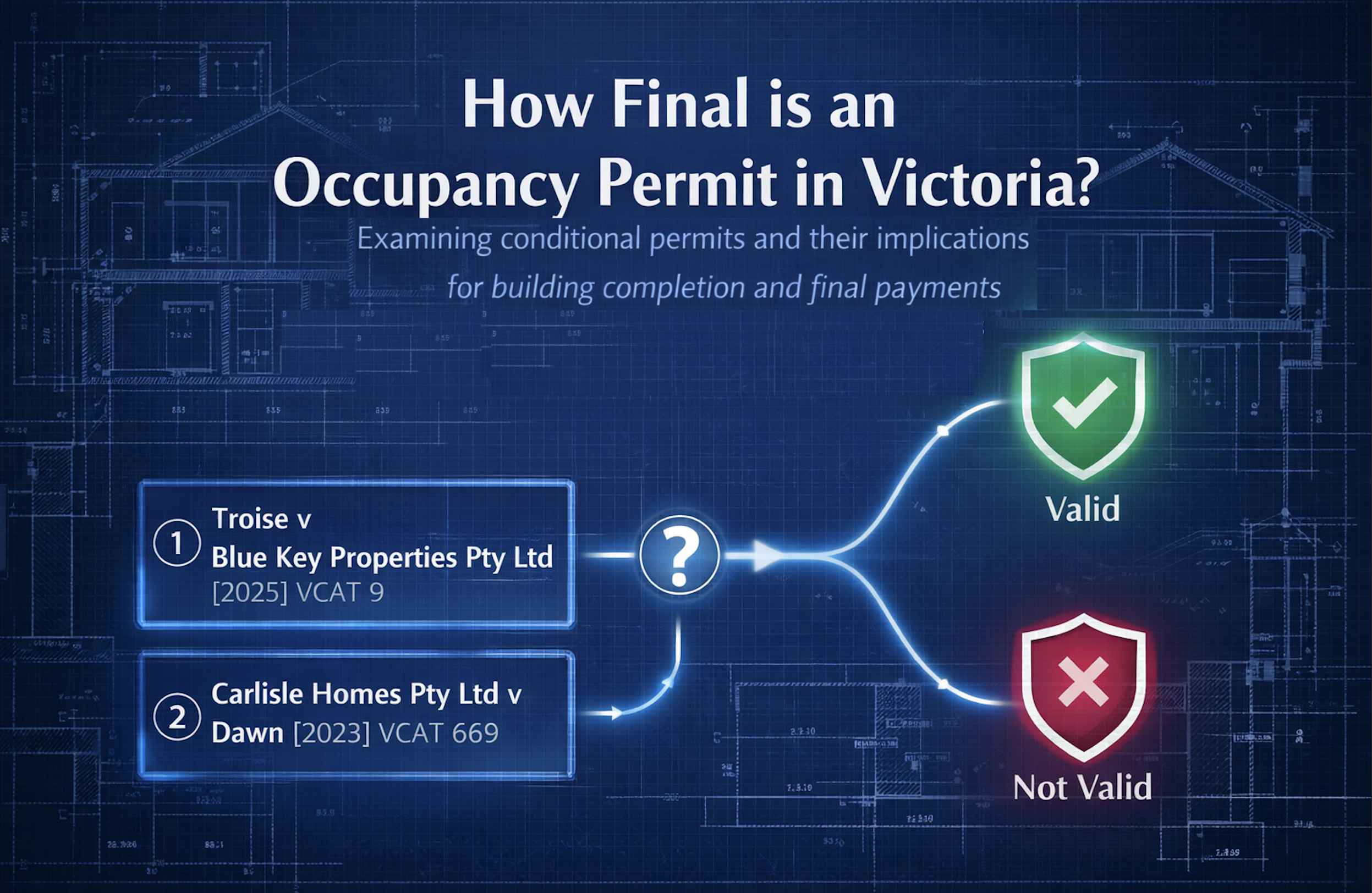
Two recent case decisions in Victoria have come up with different answers to the same question, being the findings in:
- Troise v Blue Key Properties Pty Ltd (Building and Property) [2025] VCAT 9 (“Troise”)[1]
- Carlisle Homes Pty Ltd v Dawn (Building and Property) [2023] VCAT 669 (“Carlisle”)[2]
In the later case of Troise, the conclusion was that an Occupancy Permit issued subject to conditions was not valid. The conditions included that all appliances and services necessary to the completed home’s use were to be fitted in position and commissioned later, but before actual physical occupation took place. (This suited the Builder who was wanting final payment earlier than this point in time, under the Contract).
The learned Tribunal Member in this case found that the issue of an Occupancy Permit is a statutory process under the Building Act 1993 and where essential services remain incomplete, this does not allow “conditional” statutory approvals.
On the other hand, the earlier 2023 case decision in Carlisle (another VCAT litigation) had held that conditional Occupancy Permits when issued by the Relevant Building Surveyor (“the RBS”) were perfectly valid and this meant that the Builder could require the final payment claim to be paid before kitchen or laundry appliances were installed.
Section 44 of the Building Act 1993 (“the Act”) states that the RBS must not issue an Occupancy Permit unless (among other things) the building or part of the building to which the Permit applies is suitable for occupation[3].
There is a prescribed timeframe in the Regulations by which the RBS must decide an application to issue an Occupancy Permit, and section 138 of the Act allows the right of appeal if the decision is not made within the prescribed timeframe, or if the applicant wants to review the RBS’ decision not to issue an Occupancy Permit.[4]
Section 46 provides that the Occupancy Permit is a specific and focussed legal instrument, and it is not certifying that the building is absolutely defect free and fully complete (ie, there could be relatively minor defects or items of incomplete works).[5]
This makes sense when one considers the specific statutory role of the Building Surveyor and that they are not a builder, designer, site supervisor or clerk of works (see the Victorian case of Lewis v Threadwell [2004] VCAT 547).[6].
Based on section 46 of the Act, the Occupancy Permit is evidence that the building or part of the building to which it applies is suitable for occupation, but it is not to be taken as evidence that the building works comply with the Building Act or the Building Regulations (including the Building Code that is incorporated into the Regulations).
It is accepted in the industry that the RBS when issuing an Occupancy Permit can include conditions in that certification. Where the RBS does specify conditions, these should clearly specify what building works are needed to satisfy the full requirements of an OP without conditions and when this should be done by.
It goes without saying that an RBS should keep proper and reliable records of any conditions imposed on a conditional Occupancy Permit and diarise dates for follow up inspections and so forth, so that eventually an “unconditional” Occupancy Permit can be approved.
Alternatively, given the contrasting decisions issued by the Tribunal between 2023 and 2025 about the status of conditions on an Occupancy Permit, an RBS may instead opt to play it conservatively and not issue conditional Permits at all.
This uncertainty does not help domestic builders, and casts doubt on the regular industry practice of builders to have appliances installed very late in the project, to coincide with owners taking full possession.
The reasons are obvious; no one wants the risk of stolen or damaged appliances prior to owners moving in. Often, as part of this industry practice, builders ask for the final payment claim before the appliances are installed and commissioned on site.
If domestic builders are forced to install appliances earlier than their current practice, it obviously may increase the risk of theft or property damage.
There is not much legislative guidance or help from the Domestic Building Contracts Act 1995. Section 42 of that Act does not set out definitively whether appliance installation is needed for “Completion” and this leaves room for varied interpretations.[7]
There is also potentially an argument that a residential home (or apartment) is not suitable for occupation, really, if for instance certain fundamental appliances have not been installed in a working condition. One example could be, if there is no oven cooktop in the kitchen, how can the home be suitable for occupation?
The regular definition of “Completion” in standard domestic building contracts is that it is presumed to be achieved when the Works are completed in accordance with the plans and specifications, and an Occupancy Permit has been issued, or where an OP is not needed, a Certificate of Final Inspection.
By convention, a new home construction requires an Occupancy Permit, while an alteration or renovation project culminates in a Certificate of Final Inspection. Whether or when these certifications are approved is at the professional discretion of the RBS and not the Builder.
In the absence of clear guidance from the building laws, the recommendation to builders has to be for them to include a special condition about this in their building contracts. For instance, a condition that allows for the Builder to include late provision of appliances and that this will not prevent the definition of “Completion” from being achieved under the law of contract. Where statute is not a clear guide, perhaps the Contract can fill the void.
Disclaimer:
This article is intended to be for general information purposes only and should not be relied on as legal advice. For expert construction law guidance for your own individual circumstances, don’t hesitate to contact experienced construction lawyers to assist you with dispute resolution, contractual and regulatory advice and related matters.
Author Biography
Justin Cotton is a principal of Lovegrove & Cotton Construction & Planning Lawyers a Melbourne law firm specialising in construction and planning law since 1993, and Chair of HIA Industrial Relations & Legal Services Committee
Justin has more than two decades of experience in construction law and building regulatory matters. He regularly advises builders, developers, building surveyors and property owners on building disputes, regulatory compliance and risk management. He has extensive experience appearing before the Building Appeals Board, VCAT and the courts.
Footnotes
[1] Troise v Blue Key Properties Pty Ltd (Building and Property) [2025] VCAT 9.
[2] Carlisle Homes Pty Ltd v Dawn (Building and Property) [2023] VCAT 669.
[3] Building Act 1993 (Vic) s 44.
[4] Ibid s 138.
[5] Ibid s 46.
[6] Lewis v Threadwell [2004] VCAT 547.
[7] Domestic Building Contracts Act 1995 (Vic) s 42.
Image Acknowledgements:
The digital renders used in this article were developed collaboratively by Lovegrove & Cotton and ChatGPT.
