
A 35-Year Reform Continuum: Certain Enduring Principles from the Australian Model Building Act to the IBQC International Framework
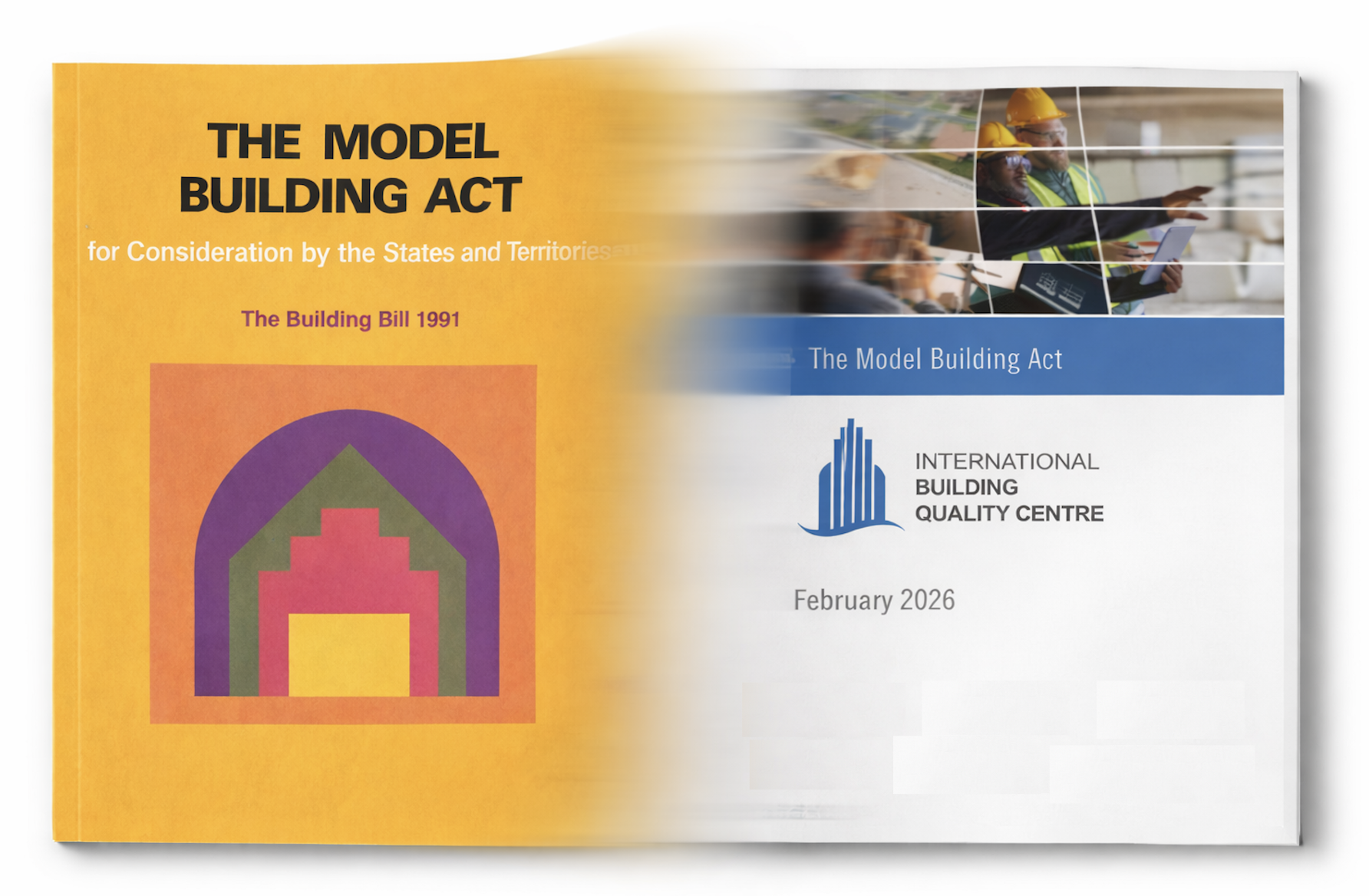
In February 2026, the International Building Quality Centre released the International Model Building Act (IMBA) — the first model building act developed at an international level to provide structured legislative scaffolding for the consideration of those tasked with the responsibility of building control reform. To access the IMBA, please click HERE.
Its publication marked a defining moment in international thought leadership with respect to building regulatory design.
Yet some aspects of the legislative lineage underpinning it began more than three decades earlier.
1991 – The Australian Model Building Act: Some Reform Blueprints
In 1991, the Australian Model Building Act was developed as a national law reform template for modernising building regulation.
Professor Kim Lovegrove served as:
- Project Director of the Model Building Act project
- An instructing Officer to Parliamentary Counsel
The 1991 Model Building Act was expressly conceived as an implementation-ready legislative template. It became the conceptual template for the Victorian Building Act 1993 and informed reforms in some other Australian jurisdictions.
He again served as an Instructing Officer to Parliamentary Counsel in Victoria during the enactment of the Victorian Building Act 1993.
The continuity between the 1991 Model Building Act and the 1993 Victorian statute was direct and intentional. The model articulated the reform architecture; the Victorian Act embedded that architecture in binding statutory form.
The 1991 Model Building Act introduced reform pillars that would shape modern Australian building regulation in a number of jurisdictions:
- Proportionate liability allocation
- Compulsory insurance frameworks
- Registration of building practitioners
- A 10-year statutory liability cap
- Mandatory inspection regimes
- Occupancy permit triggers issued by building officials
- Central regulatory oversight of building control
- Structured enforcement and compliance mechanisms
These were structural reforms, not incremental refinements as the model building act was built and drafted from ground up as an entirely new model act.
1993 – Implementation Through the Victorian Building Act
The Victorian Building Act 1993 operationalised the reform architecture established in the 1991 Model Building Act.
Kim Lovegrove again served as an Instructing Officer to Parliamentary Counsel during its development.
The drafting occurred within the Victorian Parliamentary Counsel’s Office. Gemma Varley — who would later serve as Chief Parliamentary Counsel of Victoria — was the Parliamentary Counsel responsible for drafting the Victorian Building Act during that reform period.
The statute embedded:
- A central government building control authority
- A central registration body — the Building Practitioners Board (which Kim Lovegrove later chaired during the latter part of the first decade of this century)
- A Building Commissioner
- Practitioner registration
- Mandatory insurance for key actors
- Proportionate liability
- A 10-year liability cap triggered by the issue of an occupancy permit by the relevant building surveyor
- Formal inspection regimes under the control of building surveyors
- Occupancy permit control mechanisms
The Act became one of Australia’s most influential building control statutes and demonstrated the practical durability of the 1991 reform model.
1997 – NSW Reform and Proportionate Liability
In 1997, Professor Lovegrove served as law reform consultant to the New South Wales Government on amendments to the Environmental Planning and Assessment Act 1979 (NSW).
Those amendments introduced:
- Proportionate liability
- A 10-year statutory liability cap
- Registration of private certifiers
- Compulsory insurance
- A central registration body for building professionals
Certain aspects of the model building act reform philosophy was adopted. A number of other Australian jurisdictions also adopted onsets such as proportionate liability and long-tail liability clarity.
2026 – The International Evolution
Thirty-five years after the 1991 Model Building Act, the International Building Quality Centre published the International Model Building Act.
The IMBA was drafted by former Chief Parliamentary Counsel Gemma Varley under instruction from Professor Lovegrove in his capacity as Chair of the IBQC.
The legislative arc is deliberate.
It reflects continuity of drafting discipline, reform architecture and institutional experience across three and a half decades.
Reform Concepts That Survived the Journey
Across 1991 → 1993 → 1997 → 2026, core concepts remained structurally durable:
- Proportionate liability allocation
- Mandatory insurance
- Registration of practitioners
- Statutory liability capping
- Building official-controlled occupancy certification
- Central regulatory oversight
- Enforcement and rectification mechanisms
The IMBA does not replicate the 1991 Act.
It internationalises some of the reform architecture first witnessed in Australia in 1991, implemented in 1993, and now adapted for international consideration.
It does not, however, include a privatised building approval process for permit delivery. Such models are not universally operable and depend upon deeply institutionalised regulatory oversight and robust building control enforcement mechanisms to function effectively.
Author Note
This article is published by Lovegrove & Cotton Construction & Planning Lawyers.
Professor Kim Lovegrove served as Project Director and principal policy architect of the 1991 Australian Model Building Act, Instructing Officer for the Victorian Building Act 1993, and law reform consultant to the NSW Government on 1997 proportionate liability reforms. He currently serves as Chair of the International Building Quality Centre and instructed former Chief Parliamentary Counsel Gemma Varley in the drafting of the 2026 International Model Building Act.
Lovegrove & Cotton is a construction and planning law firm operating across Australia and New Zealand.
Disclaimer: This piece is intended for informational and discussion purposes only and does not constitute legal advice or a definitive statement of law.
