Filed Under: Articles Tagged With: building codes, building law reform, building regulation, Building safety, Climate Adaptation, Climate Resilience, Climate-Resilient Cities, COP31, Existing Buildings, lovegrove and cotton

The International Building Quality Centre (IBQC) released guidelines titled “Principles for Good Practice Building Regulation” on April 30, 2021.
Regardless of jurisdiction, adopting best practices in building regulation design is essential. Well-constructed buildings, built according to sound regulations and robust codes, not only stand the test of time but also save lives, enhance quality of life, and maintain the value of building stock. Defect-free buildings reduce the risk of failures and litigation, forming a crucial foundation for a strong economy and an orderly society.
Many international jurisdictions have well-established building regulatory systems, but these often undergo repeated amendments due to inadequately conceived initial concepts. Best practice regulatory architecture minimizes the need for frequent amendments, reducing costs for both industry and consumers. It is far more effective to get it right from the outset, and the IBQC Principles for Good Practice Building Regulation are particularly instructive in achieving this.
Developed by a team of international experts in law, academia, engineering, and civil service—many of whom are founding IBQC board members—these guidelines emphasize the importance of building regulatory frameworks that prioritize public safety, efficiency, and innovation. They recognize that poorly designed regulations risk being unfit for purpose, compromising the regulatory ecosystem and leading to suboptimal construction outcomes.


Image Credit: IBQC


Image Credit: IBQC
The IBQC’s guidelines offer a comprehensive approach to improving building regulations. By following these principles, countries can create systems that improve safety and efficiency without inhibiting innovation in construction.
The guidelines call for a unified approach to legislation, ideally one building act and one building code that codifies technical standards, effective administration, and strong safety measures. They also emphasize the importance of education, thorough inspections, and adequate insurance.
Implementing these guidelines will depend on local conditions and may require a phased approach. For more details, you can access the full guidelines for building regulation here: IBQC Principles for Good Practice Building Regulation
This synopsis was prepared by Neil Savery and Adjunct Professor Kim Lovegrove MSE, RML both of whom are board members of the IBQC.
For further information on the IBQC’s guidelines for building regulation, visit IBQC Guidelines.
Disclaimer:
The information provided in this document is for general informational purposes only. It does not constitute legal advice. For specific legal advice related to building regulations and compliance, please consult a qualified construction lawyer.
Image Acknowledgements:
The digital renders used in this article were developed collaboratively by Lovegrove & Cotton and ChatGPT. The photo images that are not the digital renders are stock images sourced from Shutterstock.

The latest set of IBQC guidelines should be globally impactful for building regulatory designers as the logic that underpins the guidelines seems to me to be rather compelling.
Simply put the IBQC guidelines suggest that when you design a building classification system in a building code, then risk weight the classification.
Instead of risk the IBQC uses the term ‘potential consequence’ as it is the underlying potential risk that this writer considers prescient.

It is a fact that some buildings in light of their simplicity and non-controversiality, non-pernicious use and minimal human interaction in terms of numbers, types and frequency of human interactions pose little to no risk to life or limb in given scenarios.
It is also a fact that some buildings are at the oppostite end of the spectrum in that the size, more problem prone usage and the high level of human interaction pose significantly more risk to life and limb in given scenarios. This of course impacts upon the resilience and sustainability of built environs.
So it is not surprising that the IBQC has resolved that the best practice approach to building classifications is to further develop a risk weighting methodology. The logic to me seems to be to reiterate rather compelling and if I was a policy architect I would be giving it serious consideration.
Building inspectorate resources are finite, in many countries are at best stretched and in some emerging economies negligeable. I can say that as I was born in an emerging economy, Ethiopia.
So a risk based building classification system allows the responsible authorites be they the Crown, be they local government to concentrate and deploy the finite inspectoriate resources where they are most needed.
Why like in the case of the Australian jurisdiction Victoria adopt a one size fits all approach, where regardless of the risk profile of a building, regardless of whether it is a barn or an 80 story building does the legislature mandate 4 mandatory inspections for all and sundry? I just don’t get it.
The number of mandatory inspection interventions should calibrate with the risk profile of the building. This seems so incredibly obvious.

Speaking as an African and a construction lawyer that works predominantly in construction dispute resolution, I’m of the view that this risk based building classification methodology has particular application to Africa.
The reason for this is that in African economies inspectorial resources range from the stretched to the virtually non-existent. The on the ground reality is that economic restraints simply prevent the adequate resourcing of viable inspectorates.
Further in the vernacular or subsistence setting the majority of rural buildings do not come under the umbrella of building permits and are not built in accordance with building codes.
Building officials should be deployed where such deployment is most critical and it is submitted that it is very hard to resource a paradigm that does not operate in a codified environment.
Nevertheless that which makes a risk based codified approach increasingly important to an emerging economy is that where there is rapid urbanisation the preponderance of larger and more challenging building typology is increasing and these buildings will ‘house’ much larger numbers of citizens. So the potential for harm is greater in the numerical sense.
The IBQC guidelines are ‘green fields’ in that they cordon off the low potential consequence echelon. The medium to high consequence categories will sit well with the engineered solution paradigm in an emerging economy. If you look at cities like Addis Ababa, there are more and more tall buildings, be they commercial or multi-unit high rise and a risk based building classification system would have much to commend it in a rapidly urbanised setting such as this.

A setting where the building inspectorate can be deployed most intensively with the construction of buildings that on the one part should be built to code and on the other part will be involved with a very high level of human interaction in terms of numbers and frequency.
The latest set of guidelines in this writers` are best practice. Best practice not only for advanced economies but there are some important take outs for emerging economies. With regards to the latter such is the disparity between the engineered solution and the vernacular paradigms a one size fits all approach to codified building classifications is so unworkable that building regulations run the risk of being by passed in large scale.
The finite resources of building officialdom have to be used judiciously as they are as critical to the orderly workings of building ecology as they are precious. The potential consequence and mandatory inspection approach, may not be perfect but in my opinion is as good as it gets.
Tsigereda Lovegrove is a construction and planning lawyer at Lovegrove & Cotton Lawyers, Australia
Disclaimer
This article is not legal advice rather a discussion of the topic in only general terms. Should you be in
need of legal advice, please contact a construction law firm. Lovegrove & Cotton Lawyers and
our experienced team will assist you based on the facts and circumstances of your case.


The International Building Quality Centre (IBQC) has just released Risk-based Building Classification and Mandatory Inspection Guidelines.
18-months in preparation, a product of a tremendous amount of altruistic industry by a multinational coalition of experts, the names of which are identified in the guidelines.
Kim Lovegrove chaired the coalition and Lovegrove & Cotton provided the secretariat.
In the pre-covid era the writer and IBQC board member Alejandro Espinosa Wang, a senior private sector specialist with the World Bank were deployed in a law reform advisory capacity to a number of jurisdictions where they identified key elements that make for best practice building regulatory ecology.
In studying best practice building regulatory regimes this writer recognised that there are a great deal of very good building codes on the planet but very few have embraced a risk-based design classification methodology, let alone one that is calibrated with a mandatory inspection regime.
The World Bank has extolled the virtues of risk-based building inspections in a paper ‘What role should risk-based inspections play in construction’, which stated:
“Since 2005, 18 economies have incorporated elements of risk-based building inspections… Risk-based inspections, as opposed to random untargeted inspections, allow governments to allocate resources where they are most needed without compromising worker and public safety… Risk-based inspections have become more popular in the past decade, resolving some of the issues from random and phased inspections. Though many risk-based inspections systems include a minimum number of phased inspections for all buildings, they typically give priority to buildings with high risks – such as environmental ones and optimize the process…. Risk-based inspections are conducted to ensure a buildings structural safety, fire safety, worker safety, and public safety but in a more efficient manner. Having fewer inspections for less risky buildings lowers costs without compromising safety, in increasing flexibility and enabling inspections move away from random and phased inspections.” [1]

It is the IBQC`s contention that for there to be an effective risk-based building inspection building control system there should be a risk-based or potential based consequence regime that underpins the architecture of the building code.
These guidelines do that as they provide a conceptual framework for building codes that classify buildings according to their risk/consequence weighted profile. The introduction to the guidelines states:
“These guidelines represent a likelihood and consequence methodology as the basis for classifying buildings with a commensurate scaling of building inspections by competent practitioners. The risk posed by intended occupation of the building, associated with a range of other criteria such as height, size and efficiency, enables a proportionate inspection regime to apply in parallel which promotes safety, efficiency and innovation.” [2]
The guidelines use a term ‘potential consequence’ in lieu of risk or consequence.
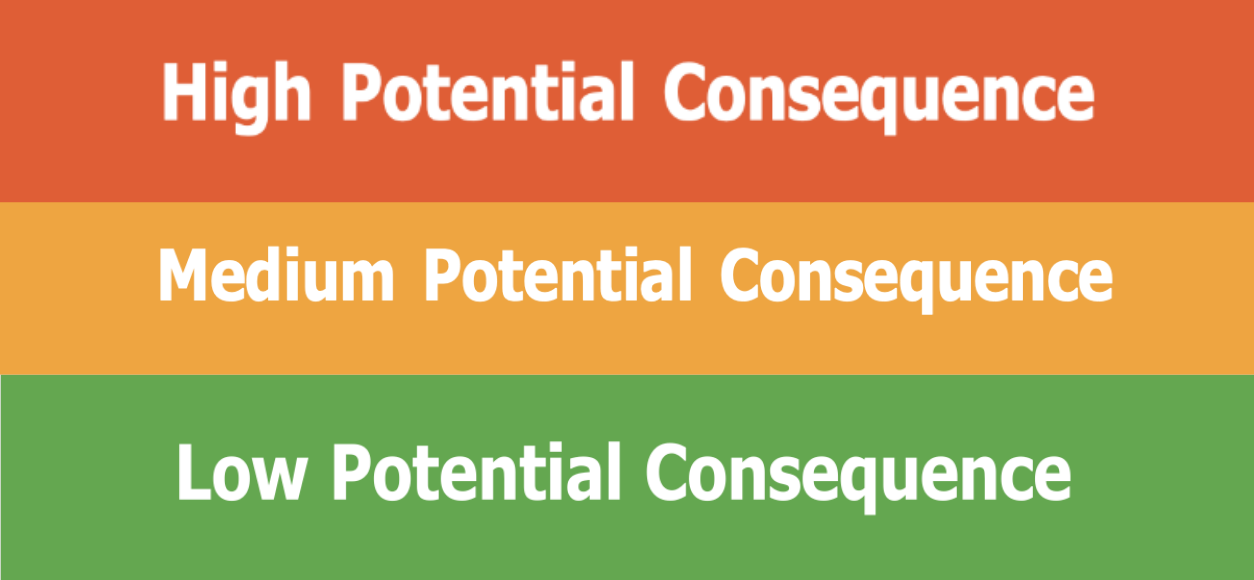
The term potential consequence is coined. It is used in lieu of risk or consequence, words that are well known in the construction risk management sector. To say that a code is a risk-based building code or a consequence-based building code is not entirely accurate for it is the potential for risk or the potential consequence that is the key consideration, so the coupling of the word consequence potential is more precise.
The guidelines define potential consequence:
“Refers to the magnitude of prejudice to life, limb and economic impacts that are likely to flow from compromised construction outcomes, the potential consequences-based mechanism is designed from the outset to be read and operate in conjunction with mandated inspection regimes. It follows that its promulgation as a codified regulatory classification system would not occur until statutory regulations are amended and promulgated simultaneously.” [3]
And the guidelines in keeping with best practice contemplate a mandatory calibrated inspection regime.
The IBQC is on record as stating that best practice building regulatory ‘ecosystems’ embrace mandatory inspection regimes.

The IBQC best practice guidelines for the design of building regulations emphasises that.
Mandatory inspection regimes however are not universally in vogue. Some jurisdictions have ad-hoc inspection protocols, others allow for more self-certification and others have adopted a ‘one size fits’ all approach.
The one size fits all approach provides that regardless of the risk or consequence weighting of the building`s codified classification there will be the same number of mandatory inspection interventions.


Matt Farrell, President of ACBOA, the Alliance of Canadian Building Officials Association and one of the members of the IBQC drafting coalition that prepared the guidelines stated that:
“Currently in North America, authorities having jurisdiction are facing a shortage of experienced building official and constantly challenged to utilize their limited resources more efficiently. The concepts presented by IBQC in the Risk-Based Building Classification and Inspection Guidelines may serve as a valuable tool for establishing procedures to address these challenges.” [4]

A potential consequence-based building classification system that allows for calibrated mandatory inspection interventions allows a jurisdiction to go ‘right weight’ with the correlation of mandatory interventions where there exists construction stages or junctures that have the potential to occasion harm.

There is little logic in going overweight on inspection intervention and the deployment of finite inspectorial resources to simple structures and going underweight on mandatory inspection interventions for buildings that pose a much greater threat to life and limb both individually and in aggregation.

For as ACBOA president Matt Farrell poignantly states inspectorial resources are finite and vary depending upon the states capacity to underwrite same so these finite and sometimes underfunded paramount resources must be deployed in the most utilitarian way.
This writer submits that these guidelines are a manifestation of some of the best thinking on the planet at this time with respect to the conceptual architecture that makes up a risk-based building codified classification system that marries with a calibrated mandatory inspection regime.
And as chair of the drafting coalition, it is fitting that the members of the coalition are mentioned and thanked.
Footnote:
[1] World Bank, ‘What role should risk-based inspections play in construction.’
This piece is written by Adjunct professor Kim Lovegrove, the chair of the IBQC. The writer has 3 decades in law reform, is a past senior law reform consultant to the World Bank and founder of Lovegrove and Cotton Construction and Planning Lawyers. He is also a past Ethiopian Honorary Consul to Ethiopia and is the recipient of honours for humanitarian services to Ethiopia.
Disclaimer
This article is not legal advice rather a discussion of the topic in only general terms. Should you be in
need of legal advice, please contact a construction law firm. Lovegrove & Cotton Lawyers and
our experienced team will assist you based on the facts and circumstances of your case.
Written by Justin Cotton, Director, Lovegrove & Cotton.
Written by Justin Cotton, Director, Lovegrove & Cotton.
Written by Adjunct Professor Kim Lovegrove MSE, RML, Lovegrove & Cotton.
Published by Tsigereda Lovegrove
Published by Tsigereda Lovegrove
Our construction lawyers and senior construction and planning lawyers personally prepare articles and journals on a variety of construction and planning law matters. We invite you to submit your name and email address below to receive our regular eBulletin updates.