
A builder in Wodonga can cross the bridge into Albury, and one in Queanbeyan can drive ten minutes into Canberra. On the other side of each border is a different regulator, a different tribunal and a different set of rules about how defective work is ordered to be fixed.
Many builders who work across the Victoria–NSW–ACT borders assume one set of rules travels with them. It doesn’t. In all three jurisdictions, the regulator can now order a builder to rectify work. But who issues the order, where you challenge it, how fast you must move and who else is exposed are all different.
We act for building practitioners in all three jurisdictions. This is what cross-border builders need to know.
Rectification orders: same idea, three different regimes
Victoria: The Building and Plumbing Commission (BPC) can issue rectification orders requiring persons responsible for building work to remedy incomplete, defective or non-compliant work, including work completed before 1 July 2026, subject to the applicable statutory requirements. Before issuing an order, the BPC will generally provide notice and an opportunity to respond. An application for VCAT review must generally be made within 28 days of receiving notice of the decision. The order remains operative during the review. Rectification orders may be published on the Register of Building Practitioners.
NSW: Building Commission NSW issues rectification orders to contractors under s 49B of the Home Building Act 1989 (NSW). A contractor may appeal to NCAT, and failing to comply is an offence under s 49E. Contractors are given notice of an intended order, and the Building Commission’s guidance refers to an appeal period of 30 days. The Commission publishes its orders online, naming the builder and the address.
ACT: The Construction Occupations Registrar (Access Canberra) can make rectification orders under Part 4 of the Construction Occupations (Licensing) Act 2004. It must first give notice of its intention, and the order can be challenged at ACAT. The Registrar issued 12 rectification orders against registered builders in 2024–25, up from 8 in 2021–22.
At a glance
| Victoria | NSW | ACT | |
| Regulator | Building and Plumbing Commission | Building Commission NSW | Construction Occupations Registrar (Access Canberra) |
| Power | Building Act 1993, Part 5A | Home Building Act 1989, s 49B | Construction Occupations (Licensing) Act 2004, Part 4 |
| Warning before an order | Generally, notice and an opportunity to respond | Notice of intention to issue | Notice of intention to make the order |
| Where you challenge it | VCAT – generally within 28 days of notice of the decision | NCAT | ACAT |
| Does the order pause while you challenge it? | No – the order remains operative during VCAT review | Seek advice immediately on whether to apply for a stay | Seek advice immediately on whether to apply for a stay |
| Public record | Rectification orders may be published on the Register of Building Practitioners | Orders published online | — |
The practical lesson is the same everywhere: the window between the first notice and the order is where a builder has the most influence. Use it.
Liability and personal exposure: where the differences bite
NSW: Limits on proportionate liability. Limits on proportionate liability. Under the statutory duty of care in the Design and Building Practitioners Act 2020 (NSW), the High Court held in Pafburn Pty Ltd v The Owners – Strata Plan No 84674[2024] HCA 49 that a builder or developer cannot reduce its liability by attributing responsibility to subcontractors and consultants to whom it entrusted the relevant work. However, liability must first be established, and the builder or developer remains free to pursue appropriate cross-claims against other responsible parties. A Victorian builder accustomed to arguing over each party’s share of responsibility should be aware that a proportionate liability defence may not be available in equivalent NSW statutory duty of care proceedings.
Victoria: Proportionate liability and increased regulatory exposure. The proportionate liability regime under the Wrongs Act 1958 (Vic) may apply to certain building defect claims, depending on the cause of action and applicable statutory provisions. Separately, the BPC’s rectification powers, home warranty insurance reforms and minimum financial requirements increase the regulatory and financial obligations imposed on building practitioners.
ACT: Directors’ personal liability. In the ACT, the Registrar can pursue the directors of a building company that has been wound up. In Victoria, new laws commencing no later than 1 December 2027 bring civil penalties and wider personal liability for directors in the most serious cases. A director who runs companies on both sides of a border can face both.
Directors. In the ACT, the Registrar can pursue the directors of a building company that has been wound up. In Victoria, new laws commencing no later than 1 December 2027 bring civil penalties and wider personal liability for directors in the most serious cases. A director who runs companies on both sides of a border can face both.
What’s coming in NSW
The Building (Approvals and Practitioners) Act 2026 (NSW) received assent on 14 August 2026. It establishes a new framework for building approvals, regulatory oversight and the registration of building professionals. Its commencement and transitional provisions will determine when particular requirements take effect, including changes affecting the existing Design and Building Practitioners Act 2020 (NSW) framework.
What to do on day one
Whichever side of the border the notice comes from:
- Call a construction lawyer the day it arrives. The notice of an intended order is your best chance to shape the outcome.
- Identify the jurisdiction and the deadline. The tribunal, the time limits and whether the order pauses all depend on where the work is.
- Obtain advice before undertaking rectification work or making admissions. Ensure that any steps taken are consistent with your statutory obligations and applicable compliance deadlines.
- Preserve the evidence. Keep site records, inspection reports, variations, photos and all correspondence.
- Think about your other jurisdictions. An order or disciplinary finding in one place can follow you into the others.
Lovegrove & Cotton acts for builders and building practitioners in Victoria, NSW and the ACT. If a notice or order arrives, call us on (03) 9600 4077 or email enquiries@lclawyers.com.au the day it lands.
Read more: Rectification Orders – What Builders and Developers Need to Know · Building Directors in the Firing Line for Rectification Orders in the ACT
About the authors
Justin Cotton is a Director of Lovegrove & Cotton and heads the firm’s practitioner advocacy practice. For nearly 20 years he has represented builders, building surveyors and building certifiers in disciplinary proceedings, and he appears at VCAT and NCAT. His practice is cross-jurisdictional: he is instructed by building practitioners and small to medium enterprises in NSW, Victoria, the ACT and Queensland. He chairs the HIA Victorian Industrial Relations and Legal Services Committee, is admitted in Australia and New Zealand, and was named in Global Law Experts 2024 for construction law in Australia.
Tsigereda Lovegrove is a Construction and Planning Lawyer and Manager at Lovegrove & Cotton. She conducts matters in VCAT, NCAT, the County Court and Supreme Court, and the Building Appeals Board. She is a Board Member of the International Building Quality Centre and Secretary of its Dispute Resolution Coalition, and an Adjunct Fellow at Southern Cross University. She was named in Global Law Experts 2024 for construction law in Australia, and advises in English and Amharic.
Disclaimer
This article is general information only and is not legal advice. It reflects the law and regulator guidance in Victoria, NSW and the ACT as at October 2026. Obtain advice specific to your situation before acting.
Image Acknowledgements:
The digital renders used in this article were developed collaboratively by Lovegrove & Cotton and ChatGPT
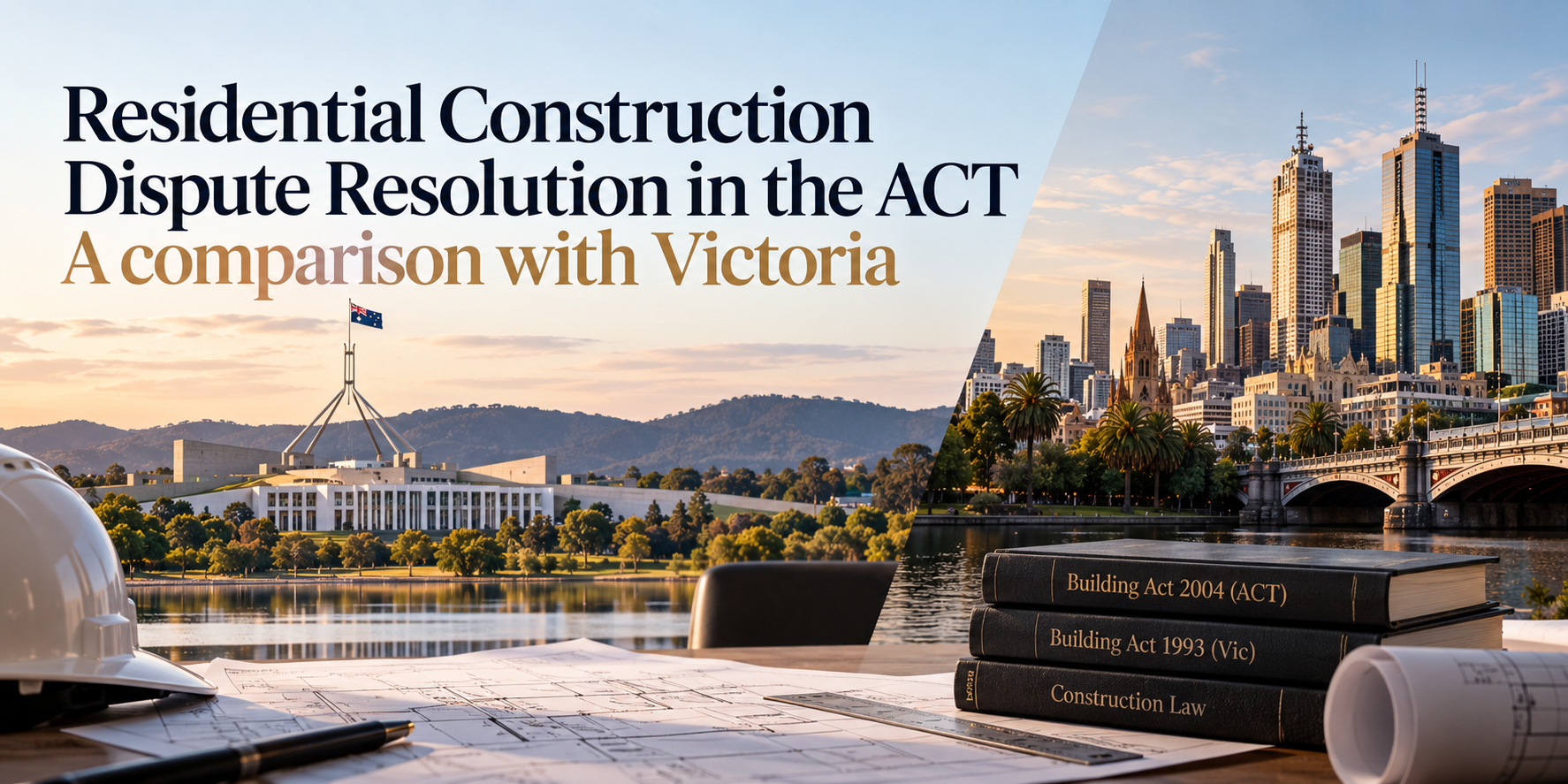
Residential building disputes require more than an assessment of defective workmanship. An owner must identify the correct respondent, the appropriate forum, the applicable time limits and the prospects of recovering the cost of rectification. A regulatory complaint, an insurance claim and civil proceedings serve different purposes. Sometimes all three require attention.
The ACT has avenues for resolving these disputes, but they should not be described simply by importing Victoria’s institutional arrangements. Nor is it accurate to assume that the ACT has neither enforcement powers nor a statutory residential dispute framework. The differences are more specific, and some have significant consequences for litigation strategy.
Comparison with Victoria
Victoria has a specialist domestic building dispute pathway. The Building and Plumbing Commission (BPC) now administers the conciliation service formerly known as Domestic Building Dispute Resolution Victoria. Eligible disputes may proceed through conciliation, with binding dispute resolution orders or a certificate available where appropriate. VCAT’s specialist building jurisdiction continues, although its former Building and Property List is now described as the Land and Environment Division.
The legislative foundation is Part 5 of the Domestic Building Contracts Act 1995 (Vic). Section 56 generally requires a certificate of conciliation before a domestic building work dispute is brought to VCAT, subject to exceptions, including specified urgent applications. Section 57 makes VCAT chiefly responsible for domestic building disputes and provides for a stay of qualifying court proceedings on a party’s application. That rule is subject to qualifications, including federal subject matter that VCAT cannot determine.
Victoria also has a Building Cases List in the County Court. Its existence does not make the County Court and VCAT interchangeable destinations for every homeowner. Jurisdiction, the pleaded causes of action and the statutory stay provisions must be considered before proceedings are issued.
The ACT’s published pathways instead direct ordinary civil claims to ACAT, the Magistrates Court or the Supreme Court, depending on jurisdiction and the amount claimed. They do not identify a counterpart to Victoria’s specialist building list structure. That is a difference in the organisation of dispute resolution, rather than an absence of remedies.
Where does an ACT homeowner go to resolve a residential building dispute?
The practical starting point is to distinguish a request for regulatory intervention from a claim for a private remedy.
For building or planning compliance concerns, the ACT Government directs owners to their building certifier and Access Canberra. For contractual disagreements, it identifies negotiation, the Conflict Resolution Service, ACAT and Access Canberra’s fair trading service as potential avenues. The owner should first put the complaint to the builder in writing, identifying the work, the alleged problem and the response sought.
For an unresolved civil claim, the usual monetary pathways are:
- ACAT: civil claims of $25,000 or less. A larger claim may be heard with the parties’ written agreement, or an applicant may abandon the excess. ACAT expressly recognises building defect disputes and may require a Scott schedule setting out the disputed items.
- ACT Magistrates Court: ordinarily claims above $25,000 and up to $250,000. The Court identifies ss 257 and 266A of the Magistrates Court Act 1930 as relevant to its monetary jurisdiction. [6]
- ACT Supreme Court: unlimited civil monetary jurisdiction, making it the ordinary court destination for claims exceeding the Magistrates Court ceiling.
These amounts are a starting point. The relief sought and any special statutory jurisdiction must also be checked. An owners corporation’s dispute with a builder, for example, should not automatically be treated as an internal unit titles dispute merely because apartments are involved.
Abandoning part of a claim deserves particular care: the convenience of a lower-value forum must be weighed against the recovery being surrendered. Equally, the contract price is not necessarily the amount of the claim. A properly supported assessment of rectification costs and other recoverable loss is needed before choosing the forum.
The ACT’s statutory residential dispute framework
Part 6A of the Building Act 2004 (ACT) provides a residential building dispute framework, including an administrator and dispute resolution processes. It is therefore incorrect to say that the ACT has never legislated a dedicated scheme.
However, legislation and an operational service are different things. ACT Government reform reporting has described work to operationalise the framework, while its public complaints guidance directs owners to the existing pathways discussed above. Those sources do not establish that a generally available Part 6A intake service is operating as at this article’s research date. Access Canberra should confirm availability before an owner relies on that route.
The sound comparison is that Victoria has an identifiable operational conciliation and specialist tribunal determination pathway; the ACT’s statutory framework must be distinguished from the remedies and services an owner can presently access.
Does the ACT Government have enforcement powers?
Yes. The Construction Occupations Registrar has substantive powers under the Construction Occupations (Licensing) Act 2004 (ACT).
Ss 34-38 govern rectification orders. Section 38 permits orders requiring rectification, demolition and the provision of compliant construction services, or the commencement or completion of specified work. Section 39 provides for emergency rectification orders. Ss 40-42 address non-compliance and further action. In appropriate circumstances, the regime also reaches directors and other specified persons: see ss 35(3), 39A and 39B. These powers have statutory preconditions and are not automatic upon a complaint.
A regulator’s enforcement decision does not itself determine every contractual entitlement or compensate an owner for every loss. The practical question is whether the owner needs compliance action, damages, completion of work, or a combination. Regulatory engagement should not be treated as a substitute for assessing a civil claim and its deadline.
Building certifiers and occupancy certification
Victoria uses the statutory expression relevant building surveyor. The building surveyor performs the project’s statutory building surveying functions and ordinarily issues the occupancy permit or certificate of final inspection. Section 43 of the Building Act 1993 (Vic) deals with the decision on an occupancy permit application.
In the ACT, the comparable project role is the certifier, commonly called the building certifier; the practitioner is a licensed building surveyor. ACT Government guidance identifies the certifier’s functions as issuing building approval and the commencement notice, conducting certification inspections and issuing the certificate of completion.
The subsequent occupancy decision is distinct. Section 69 of the Building Act 2004 places the certificate of occupancy function with the Construction Occupations Registrar. The certifier’s completion certificate under section 48 is a separate document.
Owners should therefore obtain both the certification records and the occupancy documentation. They should not assume that the officer who inspected the work also issued the final occupancy authorisation. Nor should occupancy certification be confused with a contractual assurance that every aspect of the work is defect-free. Victoria expressly distinguishes suitability for occupation from proof of full statutory compliance in section 46.
Limitation periods
Victoria
Section 134(1) of the Building Act 1993 generally prevents a building action being brought more than ten years after the occupancy permit, or, if none was issued, the certificate of final inspection. Ss 129-130 define the relevant scope.
The cladding extension is conditional. Section 134(2) allows qualifying cladding building actions more than ten but less than fifteen years after the relevant certificate, where the ordinary bar fell on or after 16 July 2019 and before 1 December 2023. Those are expiry dates, not a window for issuing occupancy permits. Section 134(2A) also recognises extensions under section 77 of the VCAT Act.
ACT
Section 142 of the Building Act 2004 (ACT) sets a ten-year building-action limit, measured first from the completion certificate; failing that, the last certifier inspection; failing both, first occupation or use. Subsection (2) adds a separate trigger associated with the end of a certifier’s appointment. Subsection (3) preserves shorter limitation periods under other Territory laws.
Section 11 of the Limitation Act 1985 (ACT) ordinarily provides six years from accrual of the cause of action. Accrual requires analysis of the particular claim: breach of contract and negligence should not simply be assumed to share the same starting date. Section 40 provides a discretionary extension mechanism for latent property damage and associated economic loss. It is not a general promise of fifteen years to sue, nor should an owner assume it displaces a separate Building Act bar.
There is also the statutory warranty period. Section 88(4) of the Building Act 2004 (ACT) read with regulation 38 of the Building (General) Regulation 2008 (ACT), provides six years for structural elements and two years for non-structural elements, measured from the statutory completion day. The regulation’s “structural” definition includes external wall components, including weatherproofing. These warranty periods must be distinguished from the limitation period for commencing a particular cause of action.
The ACT therefore requires several dates to be checked together. A ten-year building-action provision does not necessarily leave an owner ten years to bring every claim. A complaints process should not be assumed to stop any relevant clock.
Proportionate liability: are ACT consumers exempt?
Under section 107B(3)(b) of the Civil Law (Wrongs) Act 2002 (ACT), a consumer claim is excluded from Chapter 7A. Section 107C principally requires a claim by an individual concerning goods or services supplied for personal, domestic or household use, subject to its exclusions. An owners corporation or company should not assume it meets that definition.
But there is a separate building-action apportionment regime in ss 140-141 of the Building Act 2004.
The judicial treatment of that regime is critical. In Hyblewski v Bellerive Homes Pty Ltd [2019] ACTSC 44 at [123]-[124], the Supreme Court explained, following Dunn v Hanson Australasia Pty Ltd [2017] ACTSC 169, that section 141 permits apportionment between defendants. After the proceedings against the builder had been discontinued, only one defendant remained against whom the relevant finding could be made; section 141 apportionment was consequently unavailable.
The ACT consumer exclusion therefore cannot safely be presented as a blanket exemption from all proportionate liability in residential construction litigation. The applicable regime must be identified before advising an owner about recovery or a defendant about joinder.
How does an owner navigate the consumer exemption?
The analysis should proceed claim by claim. First, identify the claimant and the purpose for which the goods or services were supplied. A residential address alone does not establish a consumer claim under section 107C. An individual homeowner, an investor, a company and an owners corporation cannot simply be placed in the same category. The facts must support the statutory definition and address its exclusions.
Second, identify each cause of action, the loss claimed and the basis on which each proposed defendant is said to be liable. If the claim is a consumer claim, record why Chapter 7A is excluded by section 107B(3)(b). Then separately ask whether the damages claim is a building action within section 140 and whether section 141 applies. Passing the consumer test answers the Chapter 7A question; it does not answer the Building Act question.
Third, assess the parties and recovery before joining, settling with or discontinuing against anyone. Hyblewski demonstrates why the defendants remaining in the proceedings matter under section 141. It is not a universal instruction to sue only one participant: liability must still be proved, and settlement terms, releases, costs and the remaining defendant’s ability to satisfy a judgment require separate attention. Where Chapter 7A applies, its treatment of absent concurrent wrongdoers and its notice provisions must instead be considered on their own terms.
The practical result should be a written assessment identifying the regime applicable to each claim, the parties required for the proposed relief and the risk that part of the loss will remain unrecovered. The consumer exemption is a point for legal analysis, not an assurance of full recovery.
In Victoria, Part IVAA of the Wrongs Act 1958 (Vic) contains no equivalent general consumer-claim exemption. Ss 24AF-24AI govern apportionable claims, including specified reasonable-care and misleading-conduct claims. This does not mean every contractual or statutory warranty claim is automatically apportionable.
Must every concurrent wrongdoer be joined?
The ACT’s general regime permits consideration of an absent concurrent wrongdoer: ss 107F(2)(b) and 107F(4). That proposition must not be transferred uncritically to the separate Building Act regime discussed above.
Victoria’s section 24AI(3) generally prohibits consideration of a non-party’s comparative responsibility, unless the person is absent because they have died or, for a corporation, have been wound up. Mere insolvency is not the stated exception. Section 24AL addresses joinder; section 24AE defines defendant broadly enough to include another party joined otherwise than as plaintiff.
This is more precise than saying that every conceivable participant must be joined before apportionment can operate. The issue is whose comparative responsibility the decision-maker is legally permitted to consider. In either jurisdiction, a litigation strategy needs to distinguish a defendant, a third party and a person who remains outside the proceedings.
Must a defendant identify other potential wrongdoers?
ACT section 107G concerns a defendant with reasonable grounds to believe another person may be a concurrent wrongdoer. Failure to provide prompt written particulars of identity and involvement can attract costs, including indemnity costs, where the claimant unnecessarily incurs costs through ignorance of that person’s possible responsibility. It is not a duty to identify every imaginable defendant in every building claim.
Victoria’s Part IVAA has no direct counterpart to section 107G. That does not dispense with pleading, disclosure or procedural obligations arising elsewhere. The sound comparison concerns this particular statutory notice-and-costs mechanism.
Is residential building insurance mandatory?
ACT
Yes, for qualifying insurable residential building work. The framework includes ss 37(4), 84, 87 and 90 of the Building Act and regulation 37 of the Building (General) Regulation. The regulation excludes work costing less than $12,000 from Part 6.
The ACT Government describes mandatory cover for houses and apartment buildings of no more than three storeys, excluding a car park, through an authorised insurer or approved fidelity fund. The builder obtains the cover before the commencement process, and the certifier checks it. This is not universal cover for all residential development, particularly higher-rise buildings.
For current settings, regulation ss 39-41 specify $200,000 minimum insurance cover, a five-year insurance period and a 180-day claim period. The relevant statutory triggers and the particular policy or fidelity certificate must also be checked. The Government explains that the claim-notification period starts when the owner becomes aware of the builder’s insolvency, death or disappearance. Mandatory cover should not be mistaken for insurance responding to every defect while a builder remains trading.
Victoria
The comparison must now distinguish older DBI policies from the Home Warranty scheme operating from 1 July 2026.
BPC guidance states that older DBI generally applied to eligible domestic work over $16,000 and responded to specified builder events, commonly death, disappearance or insolvency. Existing DBI policies do not convert into Home Warranty. For eligible contracts signed on or after 1 July 2026, Home Warranty applies to eligible work exceeding $20,000 and provides broader assistance where a builder fails or refuses to complete or rectify work the subject of a Rectification Order, subject to the scheme’s requirements. The stated maximum assistance is $400,000 per home.
The new statutory scheme is in Part 9A of the Building Act 1993, including section 137O concerning payment of premiums. Contract dates, building eligibility and transitional arrangements must therefore be checked before selecting the insurance route.
Preparing an ACT building claim
A useful first file contains the contract and variations, approved plans, certifier appointment and inspection records, completion and occupancy certificates, insurance documents, correspondence and dated photographs. Technical advice should identify the defect, its cause, an appropriate rectification method and a supported cost.
Before proceedings, the owner and adviser should then settle four questions: who has the right to claim; against whom; for what relief; and by when. This is particularly important for common property, multiple responsible practitioners and claims involving an insolvent builder.
Conclusion: limitation and apportionment require particular care
An ACT homeowner has avenues for regulatory intervention, negotiation, court or tribunal proceedings and, for eligible claims, insurance or fidelity fund assistance. But identifying an available forum is only the beginning. The published ACT pathways do not identify a dedicated building list equivalent to Victoria’s specialist arrangements, and the owner must navigate several interacting statutory regimes.
In our view, the limitation provisions present a particularly dangerous trap for an owner who assumes that “ten years” is the time available to sue. The ACT position cannot safely be reduced to one period running from one certificate. Section 142 has alternative and additional triggers and expressly preserves shorter periods under other Territory laws. Accrual under the Limitation Act, the statutory warranty periods and any available extension require separate examination. The apparent simplicity of a ten-year provision can conceal an earlier deadline.
The practical response is an early, documented limitation analysis for every proposed claim and defendant. Obtain the completion certificate, inspection history, occupation records and any notice ending a certifier’s appointment; establish the relevant breach and damage dates; and distinguish warranty duration from the deadline for commencing proceedings. Where a date or legal characterisation remains uncertain, investigate it urgently and plan around the earliest reasonably arguable deadline while that uncertainty is resolved. Negotiations, a regulatory complaint or an insurance inquiry should never be assumed to preserve the right to sue.
The consumer exemption presents a second trap. An owner may correctly establish that Chapter 7A of the Civil Law (Wrongs) Act does not apply, yet still confront the Building Act’s separate apportionment provisions. Advice that stops at “consumers are exempt” is therefore incomplete. The necessary sequence is to establish consumer status, classify each claim, examine ss 140-141 independently, and assess the consequences of joinder, settlement and discontinuance before those decisions are made.
For the homeowner, these are questions about whether a claim survives and how much of a proven loss can actually be recovered. Careful analysis of time limits and apportionment belongs at the start of an ACT residential building dispute, before procedural or settlement choices narrow the available remedies.
About the authors
Justin Cotton is a Director of Lovegrove & Cotton and heads the firm’s practitioner advocacy practice. For nearly 20 years he has represented builders, building surveyors and building certifiers in disciplinary proceedings, and he appears at VCAT and NCAT. His practice is cross-jurisdictional: he is instructed by building practitioners and small to medium enterprises in NSW, Victoria, the ACT and Queensland. He chairs the HIA Victorian Industrial Relations and Legal Services Committee, is admitted in Australia and New Zealand, and was named in Global Law Experts 2024 for construction law in Australia.
Tsigereda Lovegrove is a Construction and Planning Lawyer and Manager at Lovegrove & Cotton. She conducts matters in VCAT, NCAT, the County Court and Supreme Court, and the Building Appeals Board. She is a Board Member of the International Building Quality Centre and Secretary of its Dispute Resolution Coalition, and an Adjunct Fellow at Southern Cross University. She was named in Global Law Experts 2024 for construction law in Australia, and advises in English and Amharic.
Disclaimer
This article is general information only and is not legal advice. It reflects the law and regulator guidance in Victoria and the ACT as at October 2026. Obtain advice specific to your situation before acting.
Image Acknowledgements:
The digital renders used in this article were developed collaboratively by Lovegrove & Cotton and ChatGPT

The Building Appeals Board (‘BAB’) of Victoria is an independent specialist merits review tribunal established under Part 10 of the Building Act 1993 (VIC) (‘the Act’). The BAB is tasked with making determinations about building control matters under the Act. The BAB serves an important function as a review avenue for decisions made by statutory authorities under the Act, for certain disputes, for modifications in relation to certain regulations, and for certain determinations.
It is bespoke to the building industry and the fact that it is expert-led tribunal with board members usually either builders, building surveyors, fire safety engineers, quantity surveyors, structural and services engineers, access consultants, architects, town planners, construction lawyers, or consumer planners.[2]
1. Review of Decisions by Statutory Authorities
Under Part 10, Division 1, the Building Act outlines several grounds for application for review to the Building Appeals Board of a decision by a statutory Authority.
2. Review of Decisions in Relation to Building and Occupancy Permits
Section 138 provides that appeals may be brought to the BAB by either owners and purchasers of land[3] or reporting bodies[4] (such as the Metropolitan Fire Brigade) for certain decisions or actions taken by statutory authorities in relation to building and occupancy permits – this appeal mechanism is therefore relevant at stages prior to occupation.
Under Section 138, specifically, subsection 1, an appeal may be brought to the BAB for a decision to refuse, impose conditions on, amend or cancel, refuse an application to amend or cancel, a building permit, or a failure to make a decision to amend or cancel a permit within a reasonable time.[5] It follows that the BAB has jurisdiction with regard to building and occupancy permit-related decisions by a private or municipal building surveyor.
Subsection 2 concerns requests by building surveyors or reporting bodies to amend a permit application or to provide more information in regards to a permit. This provision would be relevant in cases where an RBS or reporting body considered the existing permit application fell short in some regard. An example would be adequate access for the Metropolitan Fire Brigade or the positioning of fire hydrants in multi-residential complexes.
3. Reviews of Directions to Fix Building Work
Under Division 2 of Part 4 of the Act, an RBS or the VBA may issue a direction to fix building work on the grounds there is failure to comply with the Act, Regulations or Building Code of Australia. A failure to comply with a direction gives rise to a pecuniary penalty. Such a direction is reviewable by the Building Appeals Board pursuant to Section 138A of the Act.
This review avenue would be of relevance where a builder has been served with a direction to fix but considers on reasonable grounds that the works are compliant and there has not been a breach of the Act, regulations, or code.
4. Reviews of Termination of RBS
As noted in an earlier article, which also discussed transfer of functions, a decision in regards to the termination of private building surveyor functions by the VBA under the Building Act 1993 is a reviewable decision pursuant to Section 140 of the Building Act 1993. The Building Appeals Board has jurisdiction in the event of a refusal, and an RBS or the relevant owner may apply for review of a refusal or failure of the VBA to allow the termination of RBS functions.
5. Protection Works Appeals
A common form of appeal at the BAB is in relation to protection works determinations by building surveyors regarding protection works or emergency protection works, or requests for further information by adjoining owners. An appeal made under Section 141 may be made by either an owner or adjoining owner.
6. Building Notices and Orders, and Emergency Orders

Another prevalent appeal is in regards to the service by either an RBS or MBS of a building notice or building order in relation to building works or an existing already complete building.[6] Review is also available in regards to Emergency Orders issued by Municipal Building Surveyors.
In the current environment with the proliferation of building compliance-related building notices and orders, including those concerning cladding, these appeals may be made in tandem with applications such as those under Section 160A for determinations in respect to building design, although often a cladding notice will contain a clause that it will not be enforced whilst a s160A application is on foot (without that clause, prudence would dictate a combination of a s142 appeal [so as to stay the effect of the BN or BO] and s160A application for determination).
7. Building Regulation
Section 144 of the Building Act provides that where the Building Regulations 2018 leave a matter to be determined by, or confer discretion on, a body or a person, an owner of a building or land may appeal to the Building Appeals Board in regards to the exercise of that discretion or the making of that determination.
For example, the Building Regulations provide that a report and consent is required from a relevant council in the event components of a building are proposed to project beyond street alignment[7] or a septic tank is proposed or building is proposed in an area prone to flooding,[8] or from a service authority (such as a water supply authority) if a building is proposed to be constructed over an easement,[9] and so forth. All of these determinations under the regulations are reviewable by the BAB pursuant to Section 144 of the Act.
8. Other Appeals
Other reviews include the refusal by an RBS or MBS for a person to be able to temporarily occupy a building, and the refusal of the VBA to appoint an adjudicator for purposes of the Building and Construction Industry Security of Payment 2002 (VIC).
9. Appeals Generally
BAB appeals are, according to the Act, “in the nature of a re-hearing.” This essentially means that the BAB is at liberty to “step into the shoes of the original decision maker” and consider matters not originally brought before the original decision maker.
A decision which is subject to a right of appeal to the BAB does not take effect until an appeal is heard and the decision is affirmed or until the end of the appeal period if there is no appeal made.[10]
There is also an option pursuant to Section 147 of the Building Act for a fast-track appeal, where one making an appeal may apply to the BAB, where urgency dictates, for the board to hear the matter within 2 days of application for fast-track. The BAB may refuse a fast-track application.
The BAB also has jurisdiction to hear matters in relation to disputes as between certain parties. The kind of disputes in which the BAB has jurisdiction are outlined in Part 10 Division 3, and include:
- Disputes between owners and building surveyors in regards to the exercise by the RBS of inspection powers and powers of entry;[11]
- Disputes between an owner and adjoining owner regarding the carrying out of emergency protection work;[12]
- Disputes between an owner and adjoining owner regarding protection works insurance cover;[13]
- Disputes between an owner and adjoining owner regarding a survey of the adjoining property (what is often referred to as a dilapidation report);[14]
- Disputes between an owner and adjoining owner regarding expenses for the supervision of protection works;[15]
- Any other disputes between an owner and adjoining owner in regards to the protection works regime under Part 7 of the Building Act 1993;[16]
- Disputes between an owner and a relevant building surveyor as regards the building surveyor’s estimate of the cost of the work for which the permit is sought (building permit levy);[17]
- Disputes concerning building works and the application and/or effect of building regulations as between owners, builders, building surveyors, and/or the authority;[18] and
- Disputes between adjoining owners in regards to the construction and/or costs of party walls.[19]
It follows there are a range of disputes for which the BAB has jurisdiction to resolve, with many of them related to disputes as between adjoining owners especially with respect to protection works.
10. Determinations that May be Made by the BAB
There are other more miscellaneous kinds of proceedings under the BAB’s jurisdictions for which the BAB may make a determination and these include:
- Determinations for compensation for loss or inconvenience suffered by an adjoining owner in regards to protection works (this is a discretional power and compensation is often a contentious matter);[20]
- Determinations concerning modifications of building regulations or local laws (such as overshadowing, height restrictions etc.), which essentially are applications that certain regulations do not apply, or only apply with modifications, to the subject building;[21]
- Determinations concerning modifications of access building regulations for persons with disabilities;[22] and
- Determinations concerning building design compliance, on the application of an owner, purchaser, RBS, or the VBA (which are often relevant in terms of alternative solutions under the BCA).[23]
11. Types of Orders the BAB May Make
The BAB is not so confined in the kinds of orders it may make by virtue of the fact that it is able to ‘step into the shoes of the original decision maker.’ It is essentially given all of the powers of the original decision maker. Importantly, Section 161 provides that the BAB may “make any order that it considers appropriate in the circumstances.”
12. Appeals from the BAB

A decision or determination by the BAB is final and has legal effect. It is subject only to the inherent jurisdiction of the Victorian Supreme Court for review on an issue or question of law. Essentially this means if the BAB erred in law such that it acted outside of jurisdiction, the Victorian Supreme Court would upon application be able to quash the decision of the BAB, require it act in accordance with law, prohibit it from acting contrary to law, issue an injunction, or make a declaration, depending on the circumstances of the appeal.
Conclusion
It follows there are a range of decisions and disputes that give rise to the BAB having jurisdiction, alongside certain matters for determination under the Building Act 1993 (VIC). It is a unique jurisdiction that serves a very important regulatory oversight function in Victoria and is playing a great part in the state’s efforts to address the cladding crisis.
Lawyers within the firm have many years of experience with matters at the Building Appeals Board in a range of different matters including multiple noteworthy cladding determinations, building order and notice matters, protection works matters, building and occupancy permit disputes, and reviews of council decisions in regard to building regulation dispensations. In the emerging paradigm of a weaker economy and issues concerning building surveyor insurability, there is potential for reviews under Section 140 regarding RBS terminations to become more common.
If you are concerned about your options for review of decisions, like those discussed briefly in this piece, or if you are engaged in a building dispute, it is worthwhile discussing your options with an experienced construction lawyer. It is critical to be mindful of relevant time limits for applications for reviews to ensure one avoids prejudice flowing from a failure to respond to the likes of Building Orders and Notices.
Disclaimer
The information provided in this article is for general informational purposes only. It does not constitute legal advice. For specific legal advice related to building regulations and compliance, please consult a qualified construction lawyer.
Image Acknowledgements:
The digital renders used in this article were developed collaboratively by Lovegrove & Cotton and ChatGPT. The photo images that are not the digital renders are stock images sourced from Shutterstock.
Footnotes:
Source Article: https://lclawyers.com.au/users-guide-building-appeals-board/
[2] Building Appeals Board, About Us, accessed at https://www.buildingappeals.vic.gov.au/about
[3] Building Act 1993 (VIC), s 138(4).
[4] Ibid, s 138(5).
[5] Building Act 1993 (VIC), s 138(1).
[6] Building Act 1993 (VIC), s 142.
[7] See Building Regulations 2018, reg 109.
[8] Ibid, reg 153.
[9] Ibid, reg 130.
[10] Building Act 1993 (VIC), s 146.
[11] Ibid, s 150.
[12] Ibid, s 151.
[13] Ibid, s 152.
[14] Ibid, s 153.
[15] Ibid, s 154.
[16] Ibid, s 155.
[17] Ibid, s 156.
[18] Ibid, s 157.
[19] Ibid, s 158.
[20] Ibid, s 159.
[21] Ibid, s 160.
[22] Ibid, s 160B.
[23] Ibid, s 160A.

A typical building contract outlines the agreement between the parties, including timelines, payment schedules, and ways to end the contract. Often, one party will send a “Notice of Intention to Terminate” to the other party if there has been a serious breach. This notice gives the other party a chance to fix the breach within a certain timeframe. If the problem is not addressed or the response is unsatisfactory, the contract may be terminated.
Important Note: Wrongfully terminating a contract can have serious legal consequences, so it is crucial to get legal advice to confirm whether you have valid grounds for termination. Even if the grounds are lawful, failing to follow the correct contractual procedure might still lead to a claim for wrongful termination.
Common issues like delays or cost overruns are often reasons for issuing a Notice of Intention to Terminate. However, in some cases, an owner may terminate a contract with just one notice under Section 41 of the Domestic Building Contracts Act 1995 (Vic) (the Act). This can apply in situations such as:
- The contract price increasing by 15% or more since it was signed.
- The contract not being completed within 1.5 times the agreed period.
- The delay or cost increase was due to unforeseen circumstances that the builder could not have anticipated when the contract was made.
To end the contract under Section 41 of the Act, the owner must provide a signed notice to the builder explaining the reason for termination.
What Can Be Claimed After Termination?
Payment disputes are common in construction when a contract is terminated. The builder may claim payment for any unpaid work, while the owner might seek damages for delays or defects in the work. After termination, a builder is entitled to be paid for the work completed up to that point. This is known as quantum meruit, meaning “as much as they have earned.”
In the case of Mann v Paterson Constructions Pty Ltd [2019] HCA 32[5], the Court clarified that a builder may claim under quantum meruit but cannot recover more than the contract price for the work done. The decision limits how much builders can claim when a contract is terminated and ensures the agreed pricing mechanisms in the contract are not undermined.
Section 38 of the Act also requires a proper paper trail for variations to plans and specifications that affect the price. The Court found that under this section, builders could not claim for unpaid variations, even if the owner had repudiated the contract (this may not always be the case though).
Difference Between Termination Under Section 41 of the Act and Contractual Termination
As outlined in Section 41(7) of the Act, Section 39 of the Act does not apply to terminations under Section 41. While this is similar to the ruling in Mann v Patterson, Section 41 applies specifically to time or cost overruns due to unforeseen circumstances. It is often described as a “no-fault” provision, meaning the owner may not be able to claim additional costs that could be recovered through a standard contractual termination.
This can include extra costs for hiring another builder, increased insurance costs, or other expenses that result from the builder’s faults in a standard termination.
Delays and Contributing Factors
In Mardell Constructions Pty Ltd v Singha [2009] VCAT 1532 [8], the Tribunal showed that Section 41 of the Act does not operate independently of the contract. In that case, the contract allowed the builder 10 days to fix a substantial breach before termination. However, the owner had also contributed to the delay by withholding payment, which led the builder to suspend work. The Tribunal found the owner wrongfully terminated the contract, leading to its repudiation.
Section 41(5) entitles the builder to a fair price for the work done up until termination. However, the builder cannot claim more than they would have under the original contract.
Reasonable Costs and Recent Discussions
Recent discussions about the meaning of “reasonable costs” have been highlighted in the 2024 Victorian Department of Government Services Review of the Domestic Building Contracts Act 1995. The review suggests expanding the definition of “reasonable price” under Section 41 of the Act and recommends a monthly payment model based on completion estimates from an independent contract administrator, such as an architect.
Determining a total settlement under Section 41 of the Act can be complicated due to varying opinions on the value of defects or variations.
Damages for Defective Work
In Wenli Shao v AG Advanced Construction Pty Ltd [2019] VSCA 93[11], the Court addressed whether termination under Section 41 of the Act cancels out claims for damages due to defective work. The ruling stated that the cost of fixing defects must be considered when calculating the reasonable price owed to the builder under Section 41(5). In this case, the owner terminated the contract and sought damages for defects through VCAT.
The court ruled that the builder was entitled to a reasonable price for the completed work, but this amount was reduced by the cost to fix the defects. On appeal, the Supreme Court agreed that the builder could not be penalized twice for the same defects.
Conclusion
Section 41 terminations may seem attractive in the current environment of fluctuating material costs and availability issues, but they can reduce the amount an owner can claim due to the “no-fault” element. Owners should carefully consider other contract termination options before making a decision and seek professional advice to ensure they can maximize their claim so far as they are by law entitled to.
Disclaimer:
The information provided in this article is for general informational purposes only. It does not constitute legal advice. For specific legal advice related to building regulations and compliance, please consult a qualified construction lawyer.
Image Acknowledgements:
The digital renders used in this article were developed collaboratively by Lovegrove & Cotton and ChatGPT. The photo images that are not the digital renders are stock images sourced from Shutterstock.