
On 3 February 2025, the Building Appeals Board (matter: 455647) found in favour of the Applicant in a section 160 (2) (b) Building Act 1993 application to modify the regulations which dictated the minimum rear setback of the subject property. The Applicant was represented by Lovegrove and Cotton Construction and Planning Lawyers, and the decision was made on the following.
Circumstances:
On 14 November 2019 Amendment C125 to the Monash Planning Scheme was legislated, which had the effect of changing the zoning of the property into a General Residential Zone, schedule 3 (GRZ3).
This meant that the rear setback was now imposed with a 5-meter minimum, a considerable difference to the previous 1-meter allowance.
The Building Surveyor issued a Building Permit based on the original plans on 23 November 2022, which essentially endorsed plans for the rear setback of 4.73m at one rear corner and 3.0m at the closet point to the rear boundary. Construction commenced, and continued until the dwelling was approximately 80% completed.
On 5 October 2023 a Building Notice and a Building Order to Stop Building Works were issued on the Property following the PBSs realisation of the non-compliant rear setbacks.
The owner, who was not at fault in relation to the non-compliance, sought permission from the City of Monash (Council) via a report and consent application, which was rejected due to the inability for the Council to issue report and consent on an as-built structure. Often, applicants may seek this permission via a ‘Report Only’ application, but in this instance this option was not provided by the Council.
Due to this, on 19 January 2024, the Owner made a section 160(2) (b) of the Building Act (Vic) 1993 application to modify regulation 79 of the Building Regulations 2018.
Section 160 (2) (b) Building Act 1993 reads:
An application may be made to the Building Appeals Board for the determination that a provision of the Building Regulations-
a) Does not apply; or
b) Applies with modifications or variations specified in the application –
To a building or land specified in the application.
Regulation 79 of the Building Regulations 2018 reads:
Side and rear setbacks
(1) If—
(a) an allotment is in a zone of a planning scheme specified in Schedule 6; and
(b) rear boundaries—
a schedule to that zone in the planning scheme specifies minimum setbacks from side and a building on the allotment must be set back from a side or rear boundary not less than the relevant setback specified in that schedule.
The Monash Planning Scheme for General Residential Zone 3 reads:
• A new wall not on or within 200mm of a rear boundary should be set back at least 5 metres.1
• Rear setback – 5 metres.
The issue to the owner then, was a restrictive planning scheme being in effect while construction of the dwelling was nearing completion. As stated in the Building Order, the Owner had the options of showing representations to the PBS to ‘Show Cause’ as to why the as built structure should remain, or appeal/make and application for review to the Building Appeals Board. Should this show cause response or the Building Appeals Board review be rejected, the building was facing demolition or modification to the extent that it was brought back into compliance.
Building Appels Board section 160 Building Act 1993 application

A section 160 Building Act 1993 review means you request the Board to find that the relevant regulation which is in breach does not apply to the specified building or land. The Building Appeals Board will hear the arguments of the applicant, the Council and any ‘interested partes’; generally the immediate neighbours of the subject dwelling.
A section 160 application is part of and subject to the conditions within division 5 of the Building Act (Vic) 1993, especially in the case of modification being sought:
Section 162 (3) – Special powers – modification of regulations.
(3) The Building Appeals Board must not determine that a provision of the building regulations applies to a building or land in a modified or varied form unless satisfied that to do so is reasonable and not detrimental to the public interest.
The application of what is ‘reasonable and not detrimental to the public interest’ can have regard to the Ministers Guidelines MG-12. The Ministers Guidelines MG-12 provide several considerations/hurdles, four which must be satisfied (if applicable) and at least one of the remaining five which must be satisfied:
Ministers Guidelines MG-12- Siting and design of single dwellings
Objective
To ensure that the height and setback of a building from a boundary respects the existing or preferred character and limits the impact on the amenity of existing dwellings.
Decision Guidelines
The reporting authority may give its consent to an application for a building permit for a principal single dwelling or a small second dwelling (as applicable) that does not comply with regulation 79 (Side and rear setbacks) of the Regulations if— all of the following criteria apply (a-d):
a. the setback will not result in a significant impact on the amenity of the secluded private open space and habitable room windows of existing dwellings on nearby allotments; and
b. the setback is consistent with a building envelope, if one has been approved under a planning scheme or planning permit and or specified in an agreement under section 173 of the Planning and Environment Act 1987; and
c. the setback will not result in a disruption of the streetscape; and
d. the setback is consistent with any relevant neighbourhood character objective, policy or statement set out in the relevant planning scheme, and at least one of the following criteria apply (e-i):
e. the setback will be more appropriate taking into account the prevailing setback of existing buildings on nearby allotments; or
f. the setback will be more appropriate taking into account the preferred character of the area, where it has been identified in the relevant planning scheme; or
g. the slope of the allotment and or existing retaining walls or fences reduce the effective height of the building; or
h. the building abuts a side or rear lane; or
i. the building is opposite an existing wall built to or within 150mm of the boundary.
As discussed in the decision of the s160 Building Act 1993 BAB application regarding the Mount Waverley applicant:
Amenity:
The BAB accepted the submission that the wording ‘significant’ impact on amenity, and that the submissions made by the RBS that the question to be answered is whether there is a ‘significant’ impact on amenity, not whether there is any impact at all. The impact that is to be assessed is not the impact of the Dwelling itself; it is the impact of the reduction in the setback from what is otherwise allowed as-of-right.
The BAB also took into consideration the:
– The Property is not parallel to the rear boundary.
– The boundary angels away from the second rear neighbour (who was an interested party to the proceedings).
– The Property is considerably lower (at 7.5 metres) than the maximum building height
allowance of 11 metres.
– A rear wall could have been built on the boundary, without requiring report and consent from the Council.
This contrasted with the Council and MBS submitting that there was significant visual bulk to the neighbours at the rear of the Property. The BAB found in favour of the applicant in this regard, following the opinion provided by the expert planning consultant and legal representatives.
Neighbourhood character:
The relevant Neighbourhood character objective reads as follows:
To support new development that contributes to the preferred garden city character through well landscaped and spacious gardens that include canopy trees.
To promote the preferred garden city character by minimising hard paving throughout the site by limiting the length and width of accessways and limiting paving within open space areas.
To support new development that minimises building mass and visual bulk in the streetscape through generous front and side setbacks, landscaping in the front setback and breaks and recesses in the built form.
The developer submitted that the only reference to setbacks was the front and side setbacks.
The Council and the MBS submitted that the reduction in the rear setback is not consistent with the preferred garden city neighbourhood character identified for the GRZ3.
The Board stated: “Having regard to the overall design of the Dwelling, and its compliance with remaining siting regulations (including, in particular, those relating to the front setback, site coverage and permeability), we find that the Dwelling is consistent with the adopted neighbourhood character objectives.” Essentially, the block was of a restrictive shape, which meant that although there was a breach in the regulations, sufficient space was still provided for the encroachment to satisfy the ‘garden city’ character prioritised by Amendment C125 of the Monash Housing Strategy.
Prevailing setback
The Applicant and the RBS relied on the fact that there are several buildings within the area which encroach into the five-metre rear setback and the Council and the MBS submitted that little weight should be given to these buildings as they were constructed before the Scheme was amended by Amendment C125.
The Board decided that MG-12 does not suggest the word ‘prevailing’ should be qualified by when the ‘prevailing’ buildings were constructed, and that comparisons can only be made to other buildings that encroach, with regard also to the size of the setbacks on the opposite side.
Conclusion
The Board stated that a determination does not turn on the Board making a positive finding that modification is in the public interest, only that it is not detrimental. The Board stated: “having formed the view that the modification sought is reasonable, we may now grant the relief sought unless we form the view that it would be detrimental to the public interest for us to modify or vary the provision of the building regulations that would permit that relief sought.”
The finding of the BAB in these circumstances meant that demolition was not required of the dwelling, and that construction work could continue.
While there was an extremely prejudicial alternative to the owner of demolishing a nearly completed property, section 160 applications can still be difficult. For this reason, this favourable Building Appeals Board finding resolved the situation for the owner and avoided a costly demolition order.
Disclaimer
This article is for general informational purposes only and does not constitute legal advice. For advice specific to Owners Corporations, building defects, or dispute resolution, please contact Lovegrove & Cotton at enquiries@lclawyers.com.au or call (03) 9600 4077.
Image Acknowledgements:
The digital renders used in this article were developed collaboratively by Lovegrove & Cotton and ChatGPT. The photo images that are not the digital renders are stock images sourced from Shutterstock.
Footnotes

When is a settlement following a legal mediation not really a settlement? And if a party or parties choose to ‘back out’ of what was ostensibly agreed by all participants on the day, how do other parties try to salvage what they thought was a binding settlement?
The courts and tribunals deciding these matters have often applied the objective, reasonable third party test, where such disputes arise. This ‘reasonable bystander’ test asks whether an objective third party standing in the shoes of any of the active participants to the mediation would have concluded, on the known facts, that a final and binding settlement had been reached by the close of the mediation.
In deciding that point, regard can be had to not only the communications at the mediation on the day but also statements made in the intervening period after the mediation, and any communications between the parties, up until that time when a dispute first arose on whether there was a binding settlement (or not).
The principles as to whether the parties have entered into a binding contract are well settled and not controversial.[1]A summary of those principles was adopted by the Court of Appeal in Sully v Englisch [2022] VSCA 184 at [62]. A mediation had been “left open” by the Mediator and no written terms of settlement had been executed, however the Court of Appeal held that Ms Sully had discharged her onus of proving that the parties had intended to be immediately bound by the agreement they reached on the day of the mediation. The Builder claimed that there was no binding settlement.
Amongst other things, the Court of Appeal confirmed the position that where the parties agreed that they would prepare a written document later on, setting out terms of agreement, the Court may consider the three categories of contract set out by the High Court in Masters v Cameron [1954] HCA 72. These categories describe circumstances in which:
- the parties intend to be bound immediately, though expressing a desire to draw up their agreement in a more formal document at a later stage;
- the parties intend to be bound immediately, but may wish the operation of a particular clause or term to be delayed pending the drawing up of a more formal document; or
- the parties intend to postpone the creation of contractual relations until a formal contract is drawn up and executed.
Since Masters v Cameron was decided, Courts have recognised a fourth category – that being where the parties intend to be bound immediately by terms which they have agreed upon, while expecting to make a further contract in substitution for the first contract containing, by consent, additional terms.
The question in Sully v Englisch was whether the parties had agreed to be immediately bound by an agreement they reached on the day of mediation, even though no terms of settlement were signed on the day of mediation or in the subsequent weeks. The trial judge had said that the relevant legal questions included (at paragraph 62):
- What each party, by its words or conduct, would have led a reasonable person to believe; and
- Whether, in all the circumstances, the parties objectively intended to reach a binding agreement.
The Court of Appeal said (at paragraph 63 of the decision) that the overarching question was “whether Ms Sully discharged her onus of demonstrating, on the balance of probabilities, that she and Mr Englisch intended the agreement they reached at the mediation to be immediately binding on them”.
The Court of Appeal concluded, following a review of the facts, that by the end of the mediation the parties had agreed to enter into a legally binding settlement, even though it was later to be reflected in a written document (being a signed agreement that in fact never eventuated).
Ms Sully had therefore discharged her onus of proof in arguing that there was a binding settlement agreement. (See paragraph 67 of the decision). The Court found further (at paragraph 76) that: “…a reasonable person observing the mediation would have concluded that, by the end of the mediation, the parties had made a binding agreement”.
The Court also approved of Ms Sully’s reliance on the observation made in the decision of Delaney v Delaney [2002] VSCA 48 (McLeish, Kennedy and Macaulay JJA) at [87] to [88] and [99] to [100], that in relation to whether there is a binding settlement, “where all or nearly all of the important matters are addressed, the conclusion that the parties intended to be immediately bound will be difficult to resist.” (Refer to paragraph 78).
In Sully the Court found, as had the trial judge, that at the mediation the parties had in fact reached agreement on the key terms of their settlement, leaving only the “machinery” for implementation of those terms to be worked out (see paragraph 78).
It is implied from this that the Court believed that the fundamental and substantive terms that comprised the settlement agreement had been agreed on by both parties, even though they were not contained in terms of settlement signed by the parties.
Finally, the Court found also:
(i) If a mediator states that the mediation was left ‘open’, this does not require a conclusion that that the parties did not intend to be immediately bound by the “settlement” (paragraph 85);
(ii) The existence of a common practice amongst lawyers of reducing any agreement reached at a mediation to writing does not compel a conclusion that, at a mediation where the parties do not reduce their agreement to writing, they do not intend to immediately bound (paragraph 88); and
(iii) The Court concluded that “Ms Sully had discharged her onus of proving that the parties intended to be immediately bound by the agreement they reached on the day of the mediation; and the trial judge erred in concluding otherwise” (paragraph 102).
Having said this of course, it is always wiser for legal advocates and parties at a mediation to do their level best to ensure that all parties sign terms of settlement by the conclusion of the day of mediation, if it is any way logistically possible to do so.
Only that way can one be sure that no party to the controversy does not try to resile from the agreement ostensibly reached after the day of mediation, or later refuse to sign terms of settlement, or only agree to terms which the other party / parties believe are fundamentally different to what was agreed on the day.
That is fine in theory and most definitely best practice, but the ‘fly in the ointment’ is where there are a multitude of parties to a mediation on the day and where, for instance with Owners Corporation parties, it is stated by the Owners Corporation that time is needed to confirm the agreement with lot owner members following the day of mediation. An alternative argument though is that the Owners Corporation representative should have the requisite authority to reach an agreement that binds the Owners Corporation on the day of the mediation.
In Sully, there had been some post-mediation communications between the parties about an agreement or settlement that had been reached “in principle”. Historically, the courts have not found the reference to “in principle” to be conducive to a conclusion that a binding settlement has been reached. However, this was not fatal to Ms Sully’s case that there was a binding settlement in this case, and other factors, including in particular what had been decided or communicated on the day of mediation were seen as more determinative of the final result.
The reasonable person test and what such a person would decide objectively on whether a settlement has been reached, sounds nice in theory, but disputation can evolve around whether all that was notionally agreed were fundamental terms, and no fundamental terms were left out. And also, whether any terms not yet decided were no more than “machinery” conditions to put a settlement into effect.
All cases are different on their facts of course, and therefore a reasonable person test is not the full answer to every situation and it is little more than a guiding principle or starting point. Each fact situation must be analysed on its own merits and in context.
This article is intended to be general commentary only and should not be relied on as legal advice. For expert legal advice in relation to all construction law matters, do not hesitate to contact expert construction lawyers to seek assistance tailored to your specific needs.
By Justin Cotton, Director of Lovegrove & Cotton Pty Ltd
[1] See the summary in Sully v Englisch t/a Alpine Property [2022] VSCA 184 at [62]
Disclaimer
This article is for general informational purposes only and does not constitute legal advice. For advice specific to Owners Corporations, building defects, or dispute resolution, please contact Lovegrove & Cotton at enquiries@lclawyers.com.au or call (03) 9600 4077.
Image Acknowledgements:
The digital renders used in this article were developed collaboratively by Lovegrove & Cotton and ChatGPT. The photo images that are not the digital renders are stock images sourced from Shutterstock.
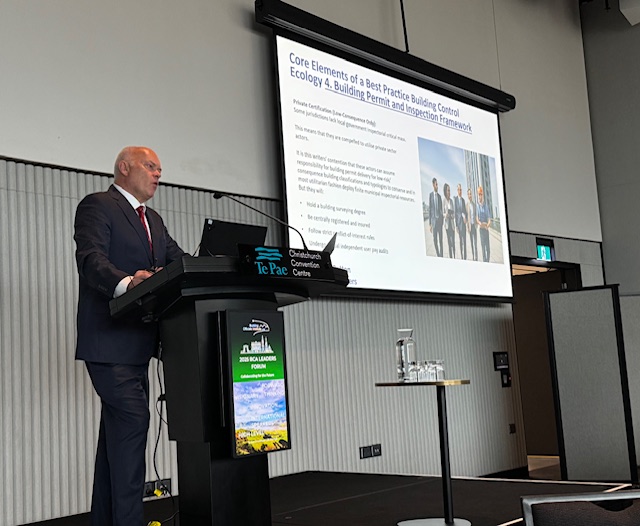
Adj. Prof. Kim Lovegrove addressing the 2025 BOINZ Annual Symposium & BCA Leaders Forum at Te Pae Christchurch Convention Centre.
Download and view Powerpoint below

What Sort of Impact Will the Reforms Have on Building Standards in Victoria?
The introduction of Rectification Orders (ROs) under the Building Legislation Amendment (Buyer Protections) Bill 2025 (Vic) (the Bill) represents a significant regulatory innovation. The Bill shifts the burden of defect enforcement from private litigants to the Victorian Building Authority (VBA).
The critical question is whether this reform will lead to a meaningful and sustained improvement in the quality of construction in Victoria.
This analysis explores both the intended and unintended consequences of the RO regime on construction standards, market behaviour, and systemic stability.
Mechanisms Potentially Enhancing Quality
At a structural level, several features of the Rectification Order regime are conducive to improving construction quality:
- Regulator-led enforcement: By removing reliance on private litigation and enabling regulatory intervention early, the VBA can compel rectification before defects worsen or become systemic.
As the state will fund enforcement, there will be a robust financial facility. One of the challenges of plaintiff litigation is that the cost can be prohibitive for many. Further, in the case of body corporate litigation, financial capacity to fund proceedings often waxes and wanes. The ability of the state to fund enforcement will be a paradigm shift, enhancing the ability to intervene earlier and more consistently. - Shortened feedback loops: Builders and developers may face earlier exposure to defects, reducing opportunities for tactical delay and incentivising better quality assurance at the outset of construction.
- Public accountability: ROs, being administrative actions by a regulator, carry reputational consequences that may encourage a more cautious and compliant approach among industry actors.
- Simplified rectification pathway: The ability to rectify defects without requiring a new building permit under section 75E(6) removes bureaucratic impediments, reducing the risk of defects being left unresolved due to administrative inertia.
However, this could also open up a “can of worms” in relation to non-permitted work, lack of insurance cover for rectification, and variable quality control in rectification processes.
Each of these mechanisms, if applied consistently and efficiently, has the potential to drive incremental improvements in construction quality, particularly in the volume-built residential sector and multi-residential developments.
The deterrent effect associated with early intervention and public accountability may also, as a corollary, lead to an uplift in construction standards more broadly by instilling a higher baseline of diligence across the industry. However, this is speculative, and only time will tell whether a sustained deterrent effect emerges.
Countervailing Risks and Structural Weaknesses
Despite these positive attributes, several systemic risks may constrain or neutralise the potential for quality uplift:
1 Regulatory Bandwidth Constraints
The VBA will inherit a significant enforcement burden historically distributed across private litigants, class actions, and Owners Corporations.
If resourcing and staffing levels are not materially expanded, there is a risk that enforcement will become reactive and selective, undermining the intended deterrent and improvement effects.
2 Minimum Compliance Behaviour
In the absence of traditional Permit based works and staged inspection for rectification work, respondents may be incentivised to achieve the minimum standard necessary to comply with an RO, rather than pursue optimal or lasting quality outcomes.
This could entrench a culture of minimal viable rectification rather than holistic and full-some remediation.
3 Deferred and Retrospective Liability Risks – Ten Years Plus Infinity
The extension mechanism under section 75C, allowing VCAT to extend the 10-year limitation period, creates a material risk that builders, engineers, certifiers, and consultants are drawn into rectification obligations decades after project completion.
Given the natural attrition of businesses—particularly among smaller firms—many original actors may have retired, deregistered, merged into other entities, or become insolvent. After all, ten-plus years is a long time.
Professional indemnity insurance policies may have lapsed, leading to a mismatch between enforcement obligations and available financial capacity or backup.
Critically, true 10-year run-off cover is largely unavailable in the current Australian insurance market, leaving many practitioners exposed to enforcement without a corresponding insurance backstop.
This instability risks driving contraction in the certifier and consulting sectors.
4 No-Man’s-Land in Non-Permitted Rectification
The exemption from requiring a building permit for RO work expedites rectification but also removes formal third-party scrutiny at key construction milestones.
This creates a regulatory lacuna that could undermine consumer confidence and create evidentiary gaps concerning the standard and completeness of rectified works.
Build Better, Not Build Back Better

While the RO regime focuses on rectifying defective work after it occurs, a deeper philosophical question arises: Should the legislative focus shift towards preventing defective work before it happens?
The current model implicitly accepts that a certain volume of defective construction will occur and seeks to intervene reactively. A prevention-based model would instead aim to eliminate defects at the source, thereby reducing:
- The cost to the state of enforcing rectification responsibilities;
- The financial burden on builders and consultants undertaking remedial work; and
- The risks of insolvency triggered by retrospective liability obligations.
A sustainable pivot towards building better could be achieved by embedding proactive quality assurance mechanisms at the construction phase itself, including:
- A risk-based building code aligned with the IBQC’s Risk-Based Building Classification Guidelines, providing for increased inspection frequency for higher-risk building types.
However, this would require significant amendments to the National Construction Code, which is not presently a risk-based regulatory framework. - Mandatory peer-review inspections at critical construction junctures, undertaken by independent, accredited professionals (e.g., fire engineers, structural specialists).
This is particularly vital for higher-risk buildings such as high-rise residential, where the current protections (developer bonds of 2%) are insufficient compared to potential remediation costs. The priority should be quality assurance during construction, not afterwards. - Mandatory independent annual auditing of building surveyors and certifiers on a user-pays basis to maintain oversight integrity. This would create an early warning system capable of identifying systemic defects early in the construction pathway, embodying a prevention-first philosophy.
- Final independent peer-review inspection before issuance of occupancy permits. This would involve a final joint inspection by building surveyors, engineers, owners, and other key actors, similar to certification models used in Chinese regulatory systems.
Such measures would materially lessen the incidence of defective work, reduce the risk in the broader construction eco-system, and reinforce professional accountability.
By preventing defects at the outset, the state could significantly reduce future enforcement burdens, better protect consumers, and support a more sustainable construction sector.
Accordingly, a pressing question arises: Should further amendments be made to embed preventive, risk-mitigating mechanisms into the Act, consistent with IBQC best practice frameworks?
While reactive intervention will always be necessary, its frequency—and the attendant cost—could be materially reduced through a prevention-driven regulatory model.
Likely Net Outcome: Measured Improvement, Conditional on Execution
In the immediate to medium term, the RO reforms may deliver measurable improvement in construction quality, particularly through:
- Earlier regulatory intervention;
- Increased reputational risk for non-compliance; and
- Shortened feedback loops between defect detection and rectification.
However, without strong regulatory resourcing and complementary preventive reforms, long-term gains could be compromised.
There is also a material risk that rectification work becomes purely transactional, addressing symptoms rather than root causes.
Moreover, without viable insurance protections, the regime may contribute to instability in the building surveying, design, and consulting professions, and may accelerate the loss of skilled personnel from the sector.
Conclusion
The Rectification Order regime has the potential to positively impact construction quality in Victoria—but the effect will be qualified and contingent.
Its success will depend on:
- The VBA’s operational capacity to manage expanded enforcement demands;
- The construction sector’s willingness to adapt to heightened accountability settings; and
- The preservation of critical professional ecosystems.
In short, the RO framework is a significant step forward, but improving standards sustainably will require more than enhanced rectification mechanisms.
It will require a broader shift towards building better, not merely building back better—ie moving from a reactive culture to a systemic prevention model.
Authors and Acknowledgments
Authored by Justin Cotton and Tsigereda Lovegrove, with co-authorship, editorial assistance, and formatting support provided by ChatGPT-4 (OpenAI), operating under the direction and instruction of the human authors.
Disclaimer
The information provided in this article is for general informational purposes only. It does not constitute legal advice. For specific legal advice, please contact us via enquirers@lclawyers.com.au or 0396004077
Image Acknowledgements:
The digital renders used in this article were developed collaboratively by Lovegrove & Cotton and ChatGPT. The photo images that are not the digital renders are stock images sourced from Shutterstock.
- 1
- 2
- 3
- …
- 9
- Next Page »