
Rectification Orders – What Builders and Developers Need to Know

Introduction
Victoria’s rectification order regime represents one of the most significant changes to the building regulatory landscape in recent decades. The Building Legislation Amendment (Buyer Protections) Act 2025 (Vic) inserted a new Part 5A – Orders for the rectification of incomplete, non-compliant or defective building work into the Building Act 1993 (Vic), creating a statutory framework empowering the regulator to direct the rectification of incomplete, defective or non-compliant building work.[1]
Historically, defect disputes in the domestic building sector were most commonly initiated by private parties (owners, owners corporations or developers) through proceedings in the Victorian Civil and Administrative Tribunal (VCAT) or the courts. The rectification order regime introduces a different sequence. The regulator may now intervene at the outset by issuing a rectification order requiring work to be completed or corrected.
In practical terms, the regulator may therefore become the initiating enforcement actor in a defect dispute. While the State does not become a plaintiff in the strict legal sense, the statutory architecture means that regulatory enforcement may precede and shape any later litigation.
The Statutory Trigger
The statutory trigger is contained in s 75B of the Building Act 1993 (Vic).
Under that provision, the Authority (which will be the Building & Plumbing Commission) may issue a rectification order to a person who carried out the building work and, in the case of residential apartment building work, to a developer of the work, where the Authority is satisfied that the building work is:
- incomplete;
- non-compliant with the Building Act or Regulations; or
- defective.[2]
The section also establishes a general temporal boundary: subject to extension under the Act, the Authority must not issue a rectification order if more than 10 years have elapsed since the relevant completion trigger specified in the section.[2]
Importantly, the statute does not require a complaint by a homeowner or purchaser as a prerequisite. The power is framed broadly and is capable of being exercised whenever the Authority forms the requisite state of satisfaction following investigation.
Extension of Time
Although the regime is generally bounded by the 10-year period in s 75B, the Act allows the regulator to apply to VCAT for an extension of time.
Under s 75C, VCAT may extend the period within which a rectification order may be issued if satisfied that the reasons justify doing so.[3]
For builders and developers, this means that the rectification order jurisdiction is not necessarily confined to a rigid limitation period cut-off.
Matters the Authority May Consider
Before issuing a rectification order, the Authority may have regard to a range of matters listed in s 75D, including:
- the terms of the contract for the building work;
- decisions of other qualified inspectors;
- any direction to fix;
- any emergency order or building order;
- any undertaking under the Act; and
- any other matter the Authority considers relevant.[4]
The breadth of this evaluative discretion indicates that the regime is designed to give the regulator flexibility when determining whether rectification action is required.
What a Rectification Order Can Require
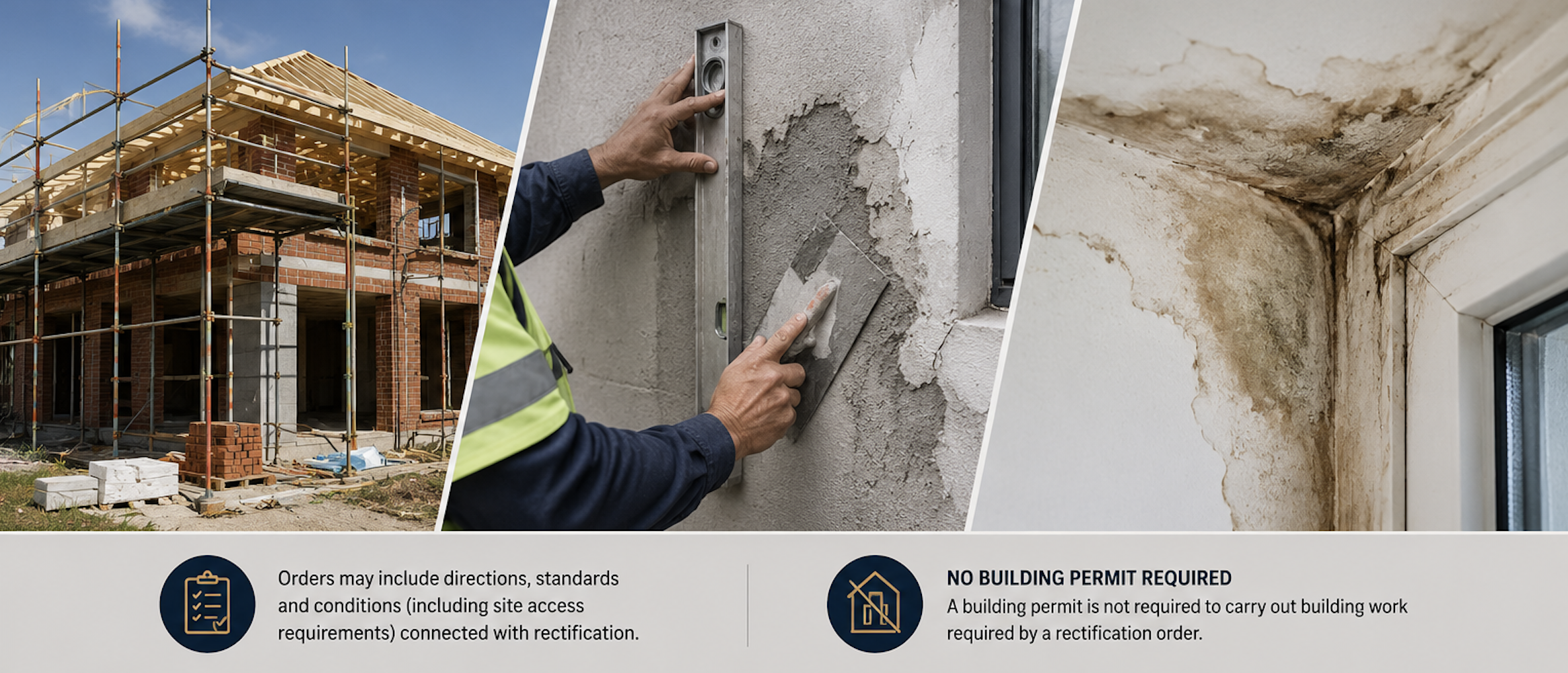
The operative scope of a rectification order is set out in s 75E.
A rectification order may require the person to whom it is issued to:
- complete the building work;
- rectify non-compliant or defective building work;
- rectify damage caused by the building work or by defective work.[5]
The section also permits the Authority to require the recipient to follow directions or meet standards connected with the rectification, and to do other things connected with that action.[6]
In addition, the order may specify conditions to be satisfied by another person before the recipient is required to comply, including conditions relating to site access.[7]
The Act further clarifies that “damage caused in the carrying out of the building work or by the non-compliant or defective building work” includes matters such as impaired drainage, undermining of structures, water penetration or termite infestation.[8]
No Building Permit Required
One practical feature of the regime is especially important.
Section 75E(6) provides that a building permit is not required to carry out building work required by a rectification order, despite anything to the contrary in the Building Act or Regulations.[9]
For builders, this provision removes the need to obtain a fresh building permit before carrying out rectification work mandated by the order.
Evidentiary Findings
Under s 75F, a rectification order may include a finding by the Authority that building work is incomplete, non-compliant or defective.
Such a finding is evidence and, in the absence of evidence to the contrary, proof of that finding.[10]
This feature gives the order evidentiary weight and may influence the dynamics of later disputes.
Joint and Several Responsibility
Where a rectification order is issued to more than one person, s 75B(4) provides that the recipients are jointly and severally liable to comply with the order.[11]
This means that each person named in the order may be exposed to the full obligation as imposed by the Authority.
Review Rights
Persons affected by rectification order decisions have statutory review rights.
Under s 75S, an affected person may apply to VCAT for review of a decision to issue a rectification order, a decision not to issue a rectification order, or to issue a rectification costs order.[12]
In most cases the application must be made within 28 days after the person receives notice of the decision.[13]
Consequences of Non-Compliance
Failure to comply with a rectification order without reasonable excuse constitutes an offence under s 75M. [14]
Maximum penalties are:
- 500 penalty units for an individual; and
- 2,500 penalty units for a corporation.
In addition, amendments introduced by the 2025 Act mean that failure to comply with a rectification order may constitute a ground for disciplinary action or immediate suspension of registration.[15]
Rectification Costs Orders
The regime also empowers the Authority to recover its costs.
Under s 75O, the Authority may issue a rectification costs order requiring payment of amounts incurred in investigating the work, issuing the rectification order, monitoring compliance and taking action connected with the rectification process.[16]
Where such an order is issued to both the person who carried out the work and the developer, they are jointly and severally liable to comply with that order.[17]
How the Regime May Change the Face of Litigation
The rectification order regime is likely to re-sequence defect litigation rather than eliminate it.
Previously, defect disputes were often initiated through plaintiff-driven claims. Under the new regime, the first formal step may instead be a regulatory order requiring rectification.
The immediate issue becomes compliance with the order, rather than the determination of ultimate liability.
Litigation may therefore occur later, in the form of contribution to costs or recovery proceedings between builders, developers and other project participants.
Impact on Builders
For builders, the regime introduces a new layer of regulatory risk.
A builder served with a rectification order must decide quickly whether to comply or seek a review. The statutory deadlines are short, and the consequences of non-compliance are significant.
At the same time, the regime does not necessarily resolve all downstream disputes between project participants. A builder may still pursue recovery proceedings against others where rectification work is attributable to defective design, consultant advice or other causes.
The practical reality is that builders may now be required to address the rectification issue first, with the allocation of ultimate liability becoming a later dispute.
Conclusion
The rectification order regime represents a structural shift in Victoria’s building regulatory system.
It strengthens the regulator’s ability to compel rectification of defective building work and alters the sequence in which many disputes will unfold. Instead of beginning with plaintiff litigation, disputes may now begin with a regulatory rectification order.
For builders and developers, this means that early legal and technical advice will be essential whenever a rectification order is issued. The capacity to respond quickly and to protect downstream recovery rights may become a decisive factor in managing building risk in the years ahead.
Disclaimer
This article is for general informational purposes only and does not constitute legal advice. For advice specific to Owners Corporations, building defects, or dispute resolution, please contact Lovegrove & Cotton at enquiries@lclawyers.com.auor call (03) 9600 4077.
Author
Justin Cotton is a principal of Lovegrove & Cotton Construction & Planning Lawyers, a Melbourne law firm who have been experts in construction and planning law since 1993. He is also Chair of the HIA Industrial Relations & Legal Services Committee.
Justin has more than two decades of experience in construction law and building regulatory matters. He regularly advises builders, developers, building surveyors and property owners on building disputes, regulatory compliance and risk management. He has extensive experience appearing before the Building Appeals Board, VCAT and the courts.
Footnotes
- Building Legislation Amendment (Buyer Protections) Act 2025 (Vic) inserting “Part 5A – Orders for the rectification of incomplete, non-compliant or defective building work” into the Building Act 1993 (Vic).
- Building Act 1993 (Vic) s 75B.
- Building Act 1993 (Vic) s 75C.
- Building Act 1993 (Vic) s 75D.
- Building Act 1993 (Vic) s 75E(1)(a).
- Building Act 1993 (Vic) s 75E(1)(b).
- Building Act 1993 (Vic) s 75E(2).
- Building Act 1993 (Vic) s 75E(4).
- Building Act 1993 (Vic) s 75E(6).
- Building Act 1993 (Vic) s 75F.
- Building Act 1993 (Vic) s 75B(4).
- Building Act 1993 (Vic) s 75S.
- Building Act 1993 (Vic) s 75S(2).
- Building Act 1993 (Vic) s 75M.
- Building Act 1993 (Vic) s 85-86.
- Building Act 1993 (Vic) s 75O.
- Building Act 1993 (Vic) s 75O(5).
Image Acknowledgements:
The digital renders used in this article were developed collaboratively by Lovegrove & Cotton and ChatGPT.
