
The IBQC Model Building Act’s Final Joint Inspection Protocol: A Practical Amendment for Jurisdictions Pursuing Best Practice
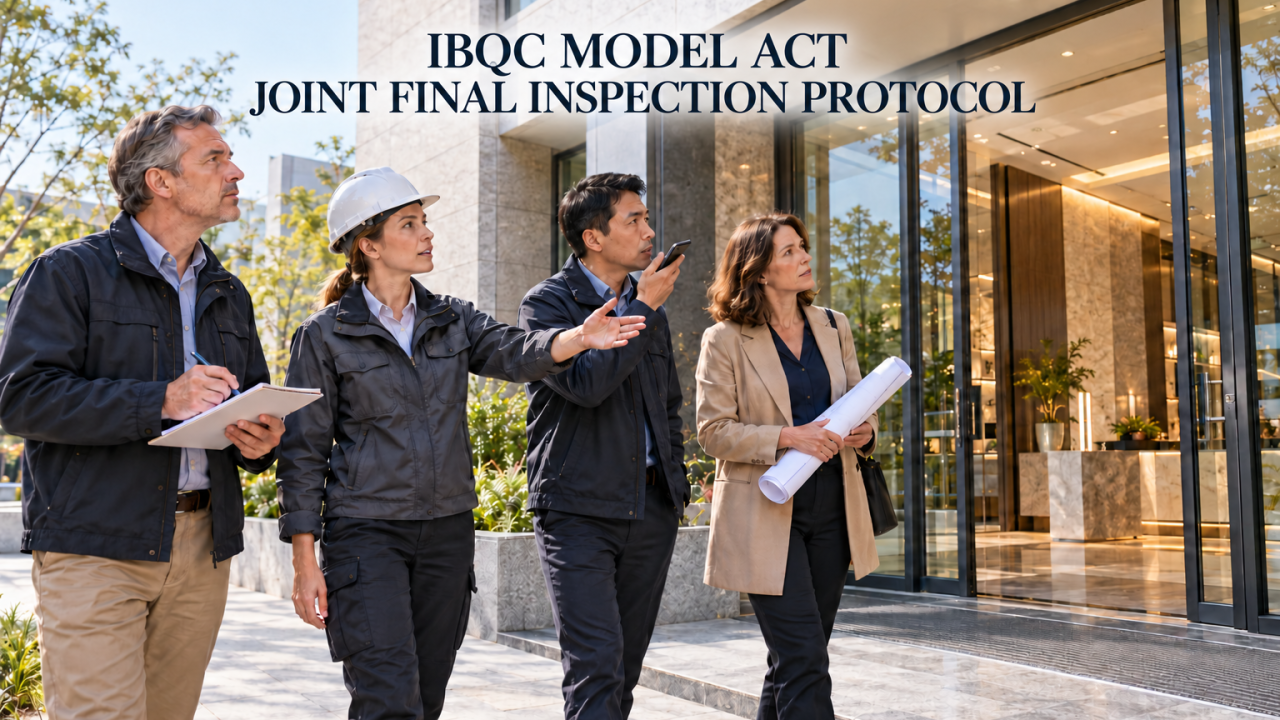
What is the final joint inspection protocol?
The International Building Quality Centre’s Model Building Act, provides a practical mechanism for bringing the principal participants in a building project together before occupation.
Section 4.24, headed “Joint final inspection”, applies to medium-risk and high-risk buildings. Unless exempted by the Model Building Regulations, an occupancy permit cannot be issued until the completed work has undergone a final joint inspection. The owner, builder, relevant engineer, architect and building official must participate.[1]
The owner gives written notice that the work is complete, and the building official convenes an on-site, in-person inspection. Identified faults must be rectified by the relevant practitioner and a further joint inspection held. When the inspection shows no faults, the official issues the final joint inspection certificate. Section 4.27 connects that certificate and the final inspection report to the occupancy permit application.[1]
The proposition is readily understood: bring those responsible for the building together to inspect the completed result, address faults and document the outcome before occupation is authorised.
Its significance extends beyond attendance. It creates an occasion for structured peer scrutiny: the people responsible for different aspects of the building examine the same completed work, ask questions of one another and explain how their respective contributions have been delivered.
What informed the protocol, and why does it support best practice?
The documented inspiration came from Chinese building-control practice encountered by IBQC Chair Kim Lovegrove during his work as a World Bank law-reform adviser.
In his account of the development of the Model Building Act, Lovegrove expressly connects the protocol with his advisory work in Chinese jurisdictions, including Beijing, Shanghai, Guangzhou and Chongqing.[2]
An earlier record appears in Tsigereda Lovegrove’s 2023 presentation, Building Regulations Future Directions. Slides 22–25 describe the Chinese joint inspection process, explain its connection to Kim Lovegrove’s World Bank experience, and reproduce a proposed protocol from draft IBQC inspection and classification guidelines.[3]
The best-practice rationale is compelling. Design, engineering, construction and statutory oversight each bring different knowledge to the inspection. Bringing those disciplines together allows participants to question assumptions, examine interfaces and consider whether the completed building gives effect to the approved design.
An engineer may identify an issue requiring an explanation from the builder. An architect may recognise a departure whose significance needs to be assessed with the engineer. The building official can pursue those questions with the responsible participants present. Discussion can move immediately from the drawing, to the physical work, to the explanation and the required response.
This is peer review in a practical, multidisciplinary sense. The participants bring their knowledge of the project and expose their respective contributions to informed scrutiny.
That scrutiny may sometimes be uncomfortable. A participant may have to explain a decision, defend an assumption or acknowledge that something requires correction in front of professional colleagues. Better to experience that discomfort on site, while the problem can be addressed, than face a demand to explain it in a disciplinary inquiry or under the forensic scrutiny of cross-examination at trial.
The prospect of mutual scrutiny encourages preparation, vigilance and circumspection. It creates a collective focus of attention at the point when the building is being presented as complete.
Why is it worthy of consideration?
The protocol’s practical attraction is that it draws on people who are already involved in the project.
On major projects, the builder, designers, engineers and owner’s team would ordinarily already be involved in delivery, commissioning and completion. The building official also has an established regulatory role. A joint inspection brings that existing knowledge together.
Their involvement does not mean they would otherwise inspect the building together. That is the additional value of the requirement: it makes their collective presence deliberate and consequential.
There are three particular reasons to consider it.
First, mutual scrutiny encourages preparation. Knowing that professional colleagues will examine the completed work and ask questions gives each participant a reason to check their contribution and resolve outstanding matters beforehand.
Second, discussion can expose problems between disciplines. A question about fire separation, a structural alteration or a commissioned service may require several participants to explain how the completed arrangement works. Joint inspection allows those explanations to be tested against what has actually been built.
Third, a shared examination creates a collective focus on resolution. Once an issue is identified in the presence of the relevant participants, it can be recorded, responsibility clarified and the response understood.
There is a valuable element of collective endeavour here. Each participant retains their own responsibilities, while contributing to a common examination of the completed building. The building official retains independent statutory judgment.
The inspection should be a searching professional exercise, with room for questions, discussion and debate. A concept that appeared satisfactory on paper may require closer interrogation when viewed in its completed setting. The presence of the relevant practitioners makes that interrogation possible.
Coordinating attendance will require planning, but on major projects it can be built into the completion programme. Clear notice arrangements and practical implementation rules would help make the process predictable.
A joint final inspection does not replace inspections during construction or reveal every concealed defect. It adds a concentrated, multidisciplinary examination at completion, when the principal participants can still address what they find.
How could the protocol be introduced?
Reforming jurisdictions could look directly to section 4.24 of the Model Building Act and adapt it to their legislation.
The requirement is simple: for the buildings covered, the owner notifies completion; the building official convenes an on-site inspection with the owner, builder, engineer and architect; faults are rectified and the building reinspected; and a certificate is issued when the inspection shows no faults. Subject to the prescribed exemptions, the joint inspection must take place before an occupancy permit is issued.[1]
For major projects, these are already the key participants. The amendment would require them to come together at completion.
The extent of legislative change will depend on the existing system. Victoria offers a relatively contained amendment pathway. New Zealand could introduce the inspection mechanism within its certification system, with broader reform considered alongside it.
Case study 1: Victoria’s Building Act 1993
Victoria already has the statutory foundations.
Part 4 of the Building Act 1993 deals with inspections. Part 5 deals with occupancy permits, and section 44 prevents the issue of a permit unless the building or relevant part is suitable for occupation.[4]
A targeted amendment could introduce the joint final inspection requirement into Part 4 and link its certificate to the occupancy permit provisions in Part 5.
For the major projects contemplated here, the builder, relevant design professionals and building surveyor are already involved. The reform would bring them together for a final examination before occupation is authorised.
The relevant building surveyor would continue to make the statutory decision. The joint inspection would provide the benefit of direct discussion and mutual scrutiny by those responsible for delivering the building.
The legislative task is therefore relatively contained: adapt the Model Act’s provision to Victoria’s terminology and prescribed building categories, and connect it to the existing occupancy permit process.
Case study 2: New Zealand’s Building Act 2004
New Zealand also has an established inspection and code compliance certification system into which the joint inspection requirement could be introduced.[5]
For the buildings covered, the amendment could require the principal participants to undertake the joint final inspection and resolve identified faults before a code compliance certificate, or CCC, is issued.
There is also a case for broader reform. For newly completed buildings requiring consent, the CCC should be mandatory before occupation, and occupation without it should be unlawful. Its issue could also provide a clear starting point for a ten-year liability long-stop concerning the original building work.
The reason for requiring official sign-off before occupation is fundamentally one of life and safety. Allowing people to occupy before the required checks are completed can expose them to unresolved risks. Victoria’s occupancy permit framework recognises the importance of verifying suitability for occupation.[4] The proposed New Zealand reform would give completion certification a similarly clear protective role: the required verification should precede occupation.
These are proposed policy changes. They would require more legislative work than introducing joint inspection alone, but their purpose is straightforward: connect inspection, certification, occupation and accountability around a clearly recorded completion event.
New Zealand could adopt the joint inspection protocol while considering those wider changes. The immediate opportunity is to bring the responsible participants together and make their collective scrutiny part of the completion process.
Conclusion
The IBQC final joint inspection protocol deserves serious consideration by jurisdictions seeking practical improvements in building regulation.
Its central advantage is straightforward: on major projects, the principal participants and their expertise are already there. Bringing them together creates a heightened opportunity for scrutiny, discussion and resolution.
The collective focus matters. Each participant knows that their contribution may be questioned by others who understand the building. Assumptions can be tested, explanations sought and unresolved matters brought into view.
A searching discussion on site may be uncomfortable. It is nevertheless a far better setting in which to identify and correct a problem than a subsequent disciplinary inquiry or trial.
Victoria could introduce the mechanism through a relatively contained amendment. New Zealand could adopt it within its certification framework while considering broader improvements to occupation and liability arrangements. In each case, the Model Act supplies a clear starting point.
The objective is to build better from the outset, using the expertise already available to get the completed building right before occupation.
In rounding up, Tsigereda stated.
“To be frank, I do not see why a reforming jurisdiction with an established inspection system would not adopt this approach. On major projects, the key people are already involved. Bring them together, ask the questions and subject the completed work to mutual scrutiny. In my view, the benefits substantially outweigh the practical hurdles of arranging the inspection, which sensible implementation can address. Yes, it requires legislative amendment. But that is what reform is for. This is about the IBQC concept of building better—getting it right in the first place.”
About Tsigereda Lovegrove
Tsigereda Lovegrove – Building Lawyer – Adj Fellow SCU is a construction and planning lawyer with Lovegrove and Cotton, a Board Member of the International Building Quality Centre and an Adjunct Fellow at Southern Cross University. She also serves as Secretary of the IBQC Dispute Resolution Coalition.[6]
Tsigereda was part of the consulting team engaged by New Zealand’s Ministry of Business, Innovation and Employment to advise on liability reform pathways associated with the Building Act amendment bill. Her work in building disputes, regulatory compliance and international reform informs her interest in identifying and resolving problems before they become disputes.
Her 2023 presentation, Building Regulations Future Directions, discussed the joint final inspection approach while the relevant IBQC guidelines were being developed.[3]
Disclaimer: This article provides general information only and does not constitute legal advice. Seek advice specific to your circumstances.
Image Acknowledgements:
The digital renders used in this article were developed collaboratively by Lovegrove & Cotton and ChatGPT
Footnotes
[1] International Building Quality Centre, Model Building Act, ss 4.24 and 4.27(3)(d)(i), printed pp 16–18.
[2] Kim Lovegrove, Strata Impact Conference 2026 – The Story Behind 2 Model Building Acts, particularly “What the International Instrument Adds”.
[3] Tsigereda Lovegrove, Building Regulations Future Directions (2023), slides 22–25.
[4] Building Act 1993 (Vic), authorised version 152, Parts 4 and 5, particularly s 44.
[5] Ministry of Business, Innovation and Employment, Issuing code compliance certificates, guidance on completion certification under New Zealand’s Building Act 2004.
[6] International Building Quality Centre, Mrs Tsigereda (“Ziggy”) Lovegrove, Adjunct Fellow SCU, leadership profile.
