
Strata Impact Conference 2026 – The Story Behind 2 Model Building Acts presentation byAdjunct Professor Kim Lovegrove
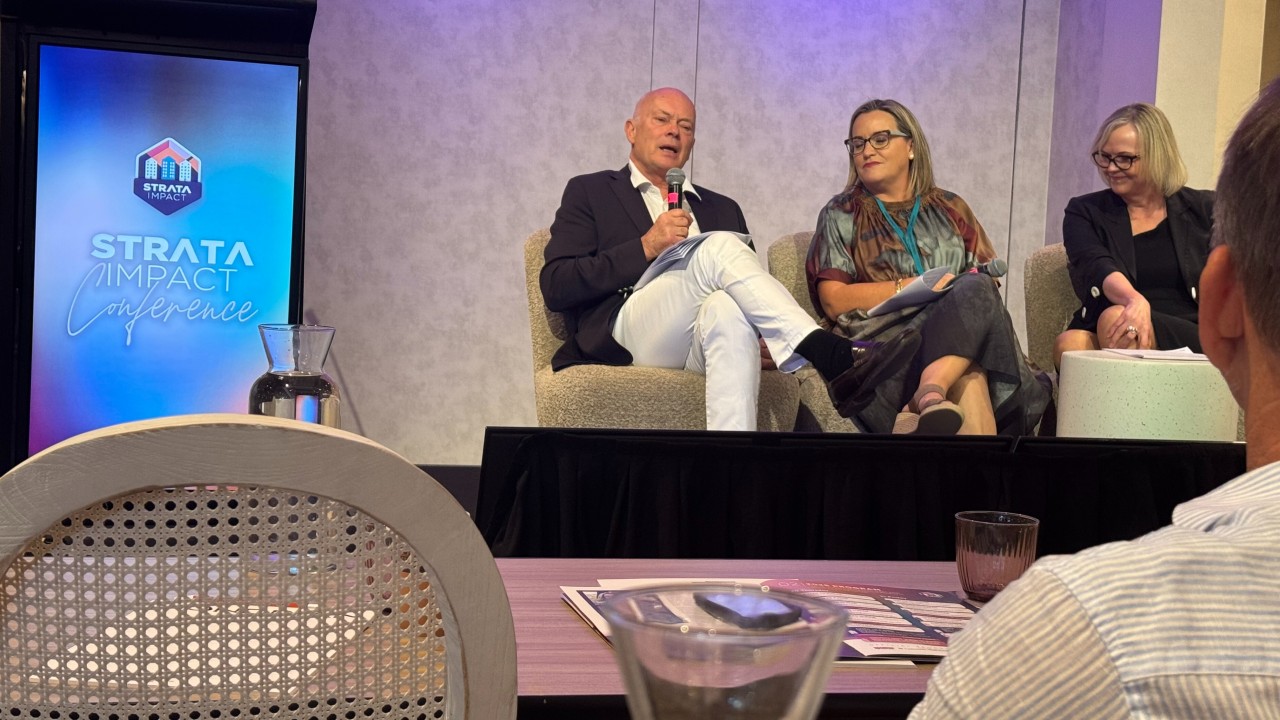
Two model acts frame this presentation. In the early 1990s, Australia produced a National Model Building Act—a blueprint for state and territory reform. More than three decades later, the IBQC International Building Quality Centre produced the first-ever International Model Building Act for adaptation across different legal, economic and institutional settings.
This is the inside story of their making.
Both began with a blank sheet, not a preordained statute waiting to be copied. Both used deep-dive international comparative analysis to identify the best available mechanisms and assemble them into one coherent system. And both depended on a disciplined drafting coalition committed to the purity of the idea rather than the interests of a jurisdiction, profession or sector.
Today, however, I want to discuss how, not what.
How does a model act actually get made? How do you decide what to adopt? How do you distinguish a durable regulatory mechanism from a local policy preference?
Those questions matter in themselves—and because the panel that follows asks whether the same method can be applied to strata, community title and multi-owned property governance.
1990: Commissioning a Blueprint
In 1990, the Australian Uniform Building Regulations Co-ordinating Council—AUBRCC, predecessor of the Australian Building Codes Board —commissioned a consultancy to produce a National Model Building Act. The presented was project director of the law-reform team.
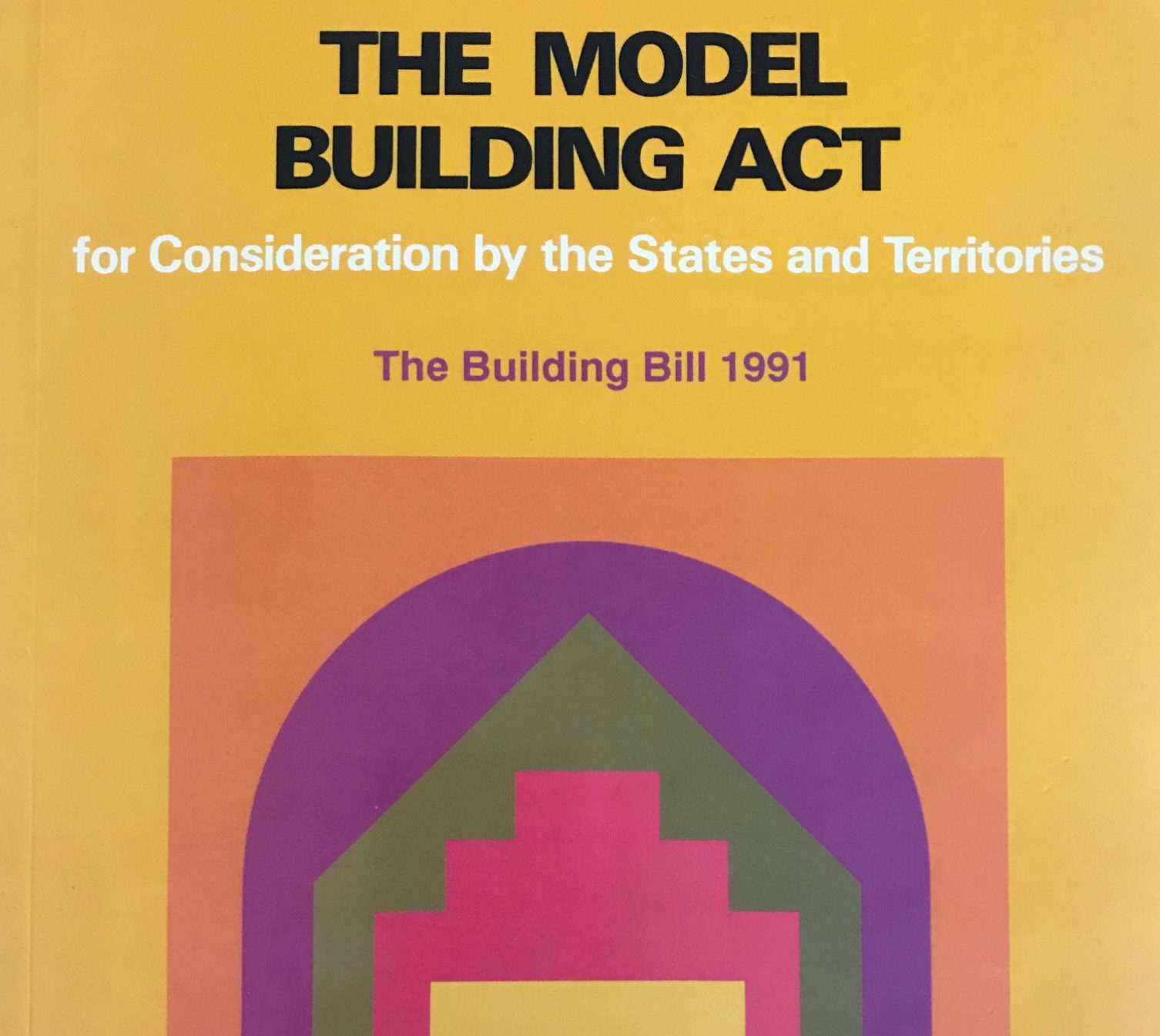
We began with a blank canvas.
The project arose from a practical national problem: Australia had one construction industry but eight state and territory statutes. Approval, dispute resolution, liability, registration and permit pathways differed. Businesses carried the cost; consumers and regulators inherited the gaps. The Bob Hawke-era Special Premiers’ Conferences had also created momentum for cooperative federalism and national microeconomic reform.
The brief was not a uniform law for word-for-word enactment. That would have been political folly. It was to research, select and integrate the strongest mechanisms into a template each jurisdiction could adapt to its constitutional arrangements, institutions and drafting conventions: a Model Building Act for the Consideration of the States and Territories.
That distinction—a template, not a mandate—was the most important design decision in the entire project.
A mandate says: we have already answered your questions. A model says: we have done the comparative work and identified the most persuasive mechanisms.
That is the first lesson of model law. Authority comes not from pretending jurisdictions are identical, but from showing which problems recur, which solutions travel and which settings must remain local.
Nothing quite like the AUBRCC exercise has happened in Australia before or since. It depended on political will, institutional capacity—and a hand-picked team whose members brought strong subject-matter expertise but checked professional ownership at the door. The alchemy mattered. People could contest an idea robustly while still rowing in the same direction. Today, jurisdictions guard their autonomy closely. That does not defeat another model act; it changes the route by which one must be made.
What Went Into the First Blueprint
The National Model Building Act answered identifiable legal failures with researched mechanisms designed to work together.
1. Proportionate liability
Under joint and several liability, a solvent defendant could be held liable for loss caused by absent wrongdoers—the marginally responsible party indemnifying the whole loss because it was the last one standing. The model aligned liability with contribution. Yet a consumer might still succeed against a party unable to pay. Proportionate liability was therefore coupled with registration and compulsory insurance.
2. A ten-year long-stop
Alongside it sat a ten-year long-stop. Because of uncertainty about when time began to run in legal proceedings, practitioners described exposure as “infinity plus six”: an indeterminate period until damage became discoverable, followed by the ordinary limitation window. Ten years from the issue of an occupancy permit captured a very high proportion of post-construction defects while giving practitioners and insurers a knowable horizon against which to price risk.
The period also resonated with the French garantie décennale, rooted in the Napoleonic Code. We recognised that another mature tradition treated ten years as a meaningful period of responsibility for serious defects. Comparative reform borrows the idea and adapts it to the local system.
3. Registration and compulsory insurance
The model required key practitioners—builders, engineers, architects, building surveyors and inspectors—to be registered and insured. Registration identifies who may perform safety-critical work; competency controls entry; discipline creates consequences beyond litigation; and insurance makes liability financially accountable.
The insight was simple: legal responsibility requires an identifiable, competent and financially answerable person to bear it.
That insight applies directly to strata. A model act must decide who may manage other people’s homes and money, what competence is required, which duties cannot be delegated and what protection follows misconduct or insolvency. Titles do not create accountability, and duties without records are difficult to prove.
4. Private certification—with safeguards
The Act opened functions historically performed by local government to private building surveyors. The case rested on capacity, timeliness and specialisation—but the lesson was never that privatisation is intrinsically virtuous.
Independence, registration, insurance, auditing, conflict management, enforcement and review are the price of entrusting statutory decisions to private actors. Be wary of any proposal that promises greater efficiency without setting out the controls needed to ensure that private actors exercise statutory powers properly.
5. Specialist and expedited review
The model also put technical appeals before a forum able to decide them promptly and expertly. A right vindicated only after years of generalist litigation is not effective. Dispute resolution belongs in the architecture, not as an afterthought.
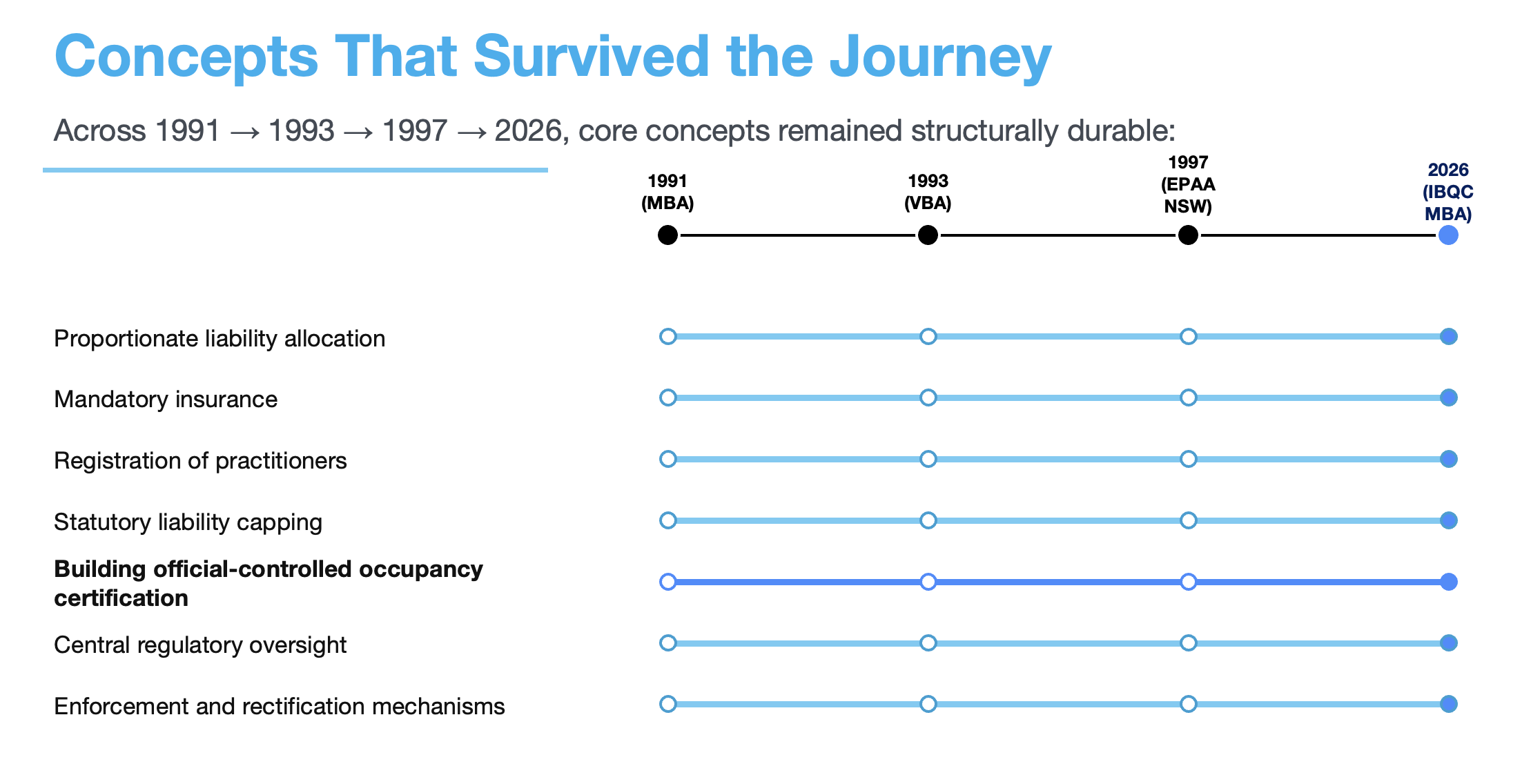
Together, these reforms recast liability, competence, insurance, permit delivery and review as one system. The concepts did not remain on benign pieces of paper. In different combinations, they found their way into laws in Victoria, New South Wales, the Northern Territory and elsewhere. Victoria’s Building Act 1993 adopted proportionate liability, a ten-year limitation period, practitioner registration and permits issued by private and municipal surveyors. New South Wales later did likewise.
The presenter served as instructing officer to parliamentary counsel on the Victorian Act. This year, New Zealand introduced a bill proposing proportionate liability and mandatory insurance, informed by a law-reform roadmap prepared by my firm, Lovegrove & Cotton.
The lasting lesson is that a model act succeeds not when it reaches a shelf—or a time capsule—but when its architecture survives disciplined translation into law. Once an act is promulgated, it gains licence to regulate human and corporate affairs. In other words, it becomes very, very powerful.
From a National Template to an International One
Over subsequent decades, as a senior law-reform adviser to the World Bank, I worked on building-regulatory reform in Mumbai, Shanghai, Beijing, Chongqing and Malawi. On two occasions, I also participated in think-tank engagements with the Japanese government. That work expanded the comparative evidence base: not a catalogue of foreign laws, but years of observing which regulatory mechanisms endured under different legal traditions and institutional conditions.

Legal traditions and institutional capacity differed, but the same questions recurred:
- Who is accountable when a building fails, and how is that accountability made real?
- Who verifies compliance before occupation?
- How should regulatory intensity scale with risk?
- How are records preserved across the building’s life?
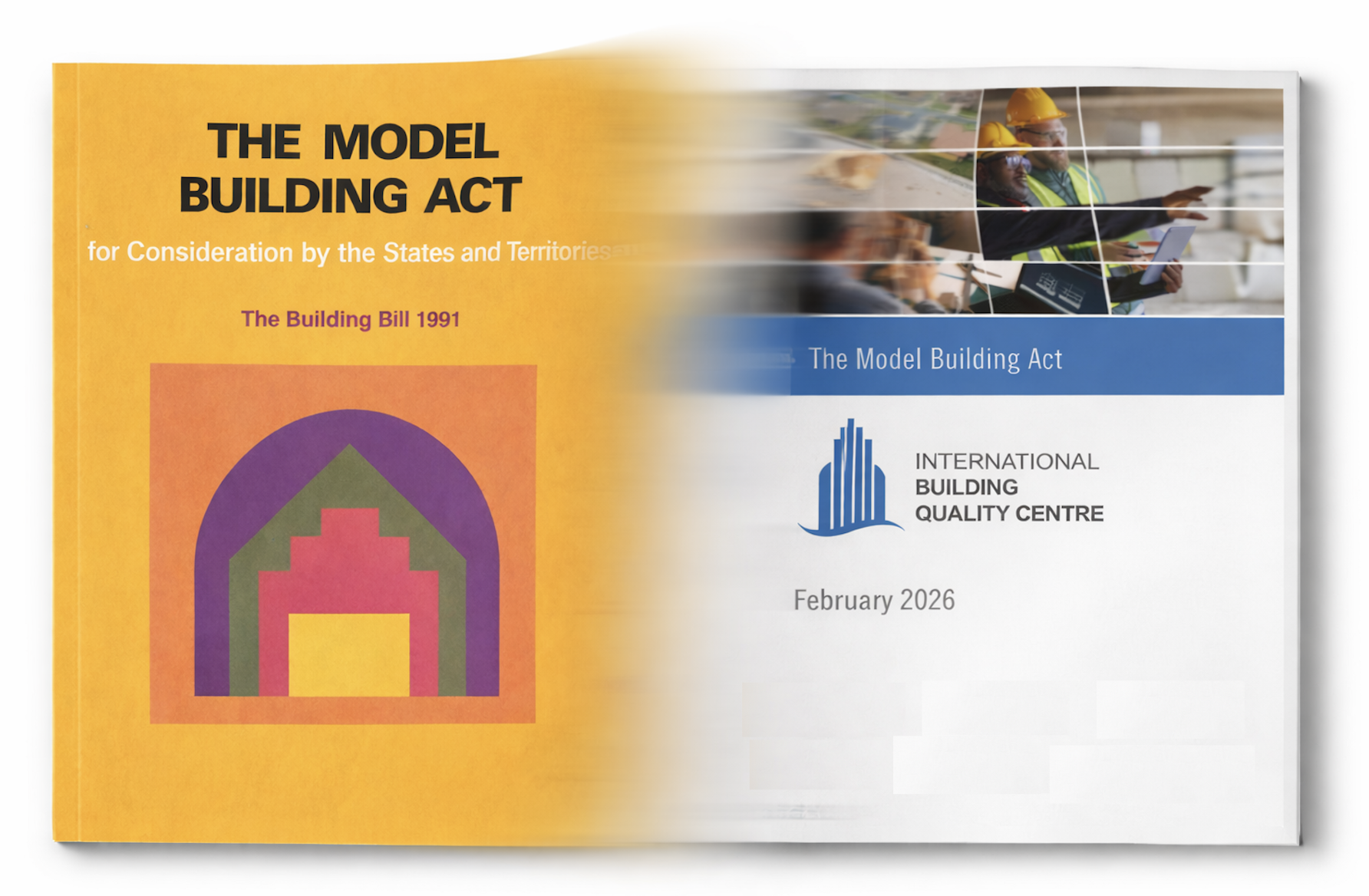
That experience informed the IBQC Model Building Act, released in February 2026: an international reference statute integrating design, approval, construction, product safety, occupation, maintenance, enforcement and dispute resolution.
Unlike the AUBRCC project, the IBQC occupies no legislative seat. Its authority is persuasive. It offers reforming jurisdictions a coherent instrument designed for local adaptation, not direct enactment without jurisdiction-specific advice.
The two projects also shared a drafting partnership. On the Victorian Building Act 1993, I served as instructing officer and Gemma Varley—later Chief Parliamentary Counsel of Victoria and a Law Reform Commissioner—served as draftsperson.
For the IBQC Model Building Act, I prepared the instructions and policy architecture, and Gemma translated them into legislative form. That continuity brought together decades of legislative-drafting and law-reform experience in Australia and internationally, a strong pedigree if you will.
The international Act draws substantially on the Australian model but does not repeat it. As evidence, technology and institutional experience evolve, best practice evolves too. The method remained constant; the answers changed.
What the International Instrument Adds
One expression of that evolution is the final joint-inspection protocol. The IBQC Act links mandatory inspections to building risk and, for medium- and high-risk buildings, requires an in-person final inspection involving the owner, builder, engineer, architect and relevant building official before an occupancy permit can issue, unless exempted by regulation.
The protocol drew on my later World Bank work advising Chinese governments—including in Beijing, Shanghai, Guangzhou and Chongqing—on building-regulatory reform. Serious reform does not ask which foreign system can be copied. It asks which mechanism works, why and how it must be adapted.
The lesson was clear: a lone certifier can become a single point of failure. Joint inspection makes those responsible for ownership, construction, engineering, design and statutory oversight confront the completed work together. Faults must be rectified and the building reinspected. Complex projects may receive independent peer review, while inspection intensity rises with risk classification.
Layered scrutiny and durable information do not eliminate error but make it harder to conceal, repeat or inherit unknowingly.
Here is the bridge to strata: the regulator’s file may close at occupation, but the building’s risk does not. Design assumptions, product information, safety systems and maintenance requirements must be transferred, through statutory handover, to those governing the occupied building.
Inside the Drafting Room: The Method Behind Both Blueprints
The point is not merely what the Acts contain, but how two blank canvases became integrated statutes. The method is repeatable.
First: separate mechanism from policy setting
Proportionate liability is a mechanism. The categories of claim to which it applies are policy settings. Mandatory registration is a mechanism. The classes of registration and prescribed qualifications are policy settings. Reserve funding is a mechanism. The contribution formula, threshold and transition period are policy settings.
A model act that confuses the two will export one jurisdiction’s political compromise as though it were a universal principle. A sound model identifies the durable machine and clearly labels the dials that a local legislature must set.
Second: draft for both adaptation and adoption
Every successful model act the presenter has encountered has been refined by experienced parliamentary counsel. That is its intended use. Clear objects, disciplined allocation between primary and subordinate legislation, identified local choices and provisions that survive changed terminology or institutions make adaptation safer.
Third: trace every borrowed provision to its source
A successful provision may depend on a hinterland of institutional infrastructure: a mature insurance market, a funded regulator, a specialist tribunal, a registration culture, reliable records or courts willing to enforce fiduciary standards.
Ask what problem a borrowed provision solved, what institutions made it work, what incentives it changed and whether those conditions exist in the receiving jurisdiction.
Fourth: let evidence move doctrine
The ten-year long-stop was informed by defect-emergence evidence, insurance considerations and a mature comparative precedent. The same discipline must govern strata law.
If voluntary reserve planning permits chronic underfunding, another aspirational clause is no answer. If risk data distinguishes a 200-lot high-rise from four townhouses, that proportionality must enter the operative provisions. If tribunal delay defeats emergency maintenance rights, review must reflect the urgency.
Fifth: design the ecosystem, not the clause
Experience adds a fifth proposition: every major duty needs an institutional home, an information trail, an enforcement pathway and a remedy.
A duty without a responsible actor is rhetoric. A duty without records is difficult to supervise. A duty without enforcement is optional. A duty without a proportionate remedy may be either toothless or oppressive.
The method is architectural: less like assembling a book of provisions than engineering a load path. Every part must transfer responsibility somewhere visible and capable of bearing it.
From Blank Canvas to Model Act: The Drafting Sequence
The principles describe the architecture. The sequence explains how it was built. Neither project began with clauses. Drafting too early hardens assumptions before the evidence has tested them. The first task was to define the problem, the objectives and the limits of the exercise; only then could words be committed to statutory form.
First: establish the commission
A model act needs a clear commission: what failure is being addressed, what the instrument should achieve and what must remain for local choice. AUBRCC supplied a national reform problem and asked for an adaptable template. The IBQC supplied an international objective without pretending to possess legislative authority. In each case, the commission created a discipline against wandering into every desirable reform.
Second: assemble the coalition
The people determine the range and quality of the possible answers. A drafting coalition needs parliamentary drafting, regulatory design, building science, insurance, economics, dispute resolution and enforcement expertise. Selection is not a representational census. Members are chosen for the knowledge and judgment they contribute, not to negotiate a settlement among constituencies.
That distinction protects the purity of the idea. Industry, professions, consumers and regulators all possess indispensable knowledge, but none should enjoy a veto or own the instrument. Participants must be able to argue hard, change their minds and ultimately row in the same direction; even one misaligned participant can curdle the cream.
Third: create the conditions for candour
The chair or project director is the steward of the process. The role is not to dictate each answer, but to maintain intellectual discipline, expose disagreement, prevent the best-resourced voice from becoming the loudest truth and keep the project moving. Leadership must also recognise when apparent consensus is merely fatigue; the chair cannot allow the process to drift.
This is where coalition chemistry becomes decisive. Technical brilliance is insufficient if members become proprietorial about their contributions. A good team can separate criticism of an idea from criticism of its author. That permits an attractive mechanism to be discarded when the evidence is against it and a difficult mechanism to survive when the evidence demands it.
Fourth: build the comparative evidence base
No jurisdiction does everything best. The task is not to rank countries, but to locate the strongest response to each defined failure. For every candidate mechanism, the team must ask: what problem did it solve; what evidence supports it; which institutions made it work; what incentives did it alter; how was it enforced; and could those conditions travel?
The French ten-year responsibility for serious defects was therefore not copied as doctrine. It was examined as comparative evidence for a knowable outer limit. The same discipline applied to registration, insurance, private certification and specialist review. The search was for the best available mechanism, not the most familiar jurisdiction.
I saw the rigour of this method again in Japan. In 1997 and 2013, I participated in think tanks concerning reform of the Building Standard Law. Comparative research was tested against how systems operated in practice and affected communities and the built environment. Assertions were interrogated, weaknesses exposed and claimed benefits tested against experience.
Fifth: settle the policy architecture
Comparative research does not decide policy automatically. It provides informed choices. The project director must integrate those choices into an architecture: identify the responsible actors, connect duties to information, align liability with insurance, match inspection intensity to risk and ensure that review and remedies support the substantive obligations.
This is the point at which the blank canvas begins to show a load path. A proposal that works alone may fail when connected to another. Proportionate liability without insurance can leave a successful claimant with an empty judgment. Private certification without independence, audit and discipline can convert an efficiency reform into a conflict-of-interest regime. The parts must bear weight together.
Sixth: prepare the drafting instructions
The instructions are the bridge between policy and legislation. Each objective must be translated into a mechanism; each mechanism traced to its evidence and comparative source; each unresolved policy choice exposed; and each relationship with another part of the Act explained. Good instructions tell parliamentary counsel not merely what words are wanted, but what work the provision must perform.
The relationship between policy design and legislative drafting must be iterative. Policy propositions need to be sufficiently clear to draft, while drafting questions expose gaps or contradictions in the policy. It is not a handover from one craft to another, but a continuing exchange between them.
Seventh: produce and interrogate the draft
The first draft is sculptor’s clay, not a finished monument. Definitions, powers, duties, defences, remedies and review rights must be tested clause by clause. Does the provision advance an objective? Can it be enforced or evaded? Does it collide with another institution? Does it create a perverse incentive? Will it survive a change of terminology or administrative structure?
The team must apply as much imagination to failure as it applied to creation. It must search for disappearing records, unallocated functions, unfunded duties, gaps between regulators and tribunals and seams that a determined actor could exploit. “Interrogate, interrogate and interrogate again” is not rhetorical excess; it is quality control.
Eighth: submit to parliamentary-counsel scrutiny
Experienced parliamentary counsel does not merely polish language. Counsel tests whether the policy has become law: whether powers are legally bounded, duties attach to the intended actor, definitions operate consistently, delegated legislation has proper limits and remedies correspond to the gravity of non-compliance. Drafting scrutiny may require reconstruction, not cosmetic correction.
Ninth: expose the instrument to independent review
Recognised peers who did not produce the Act must challenge its assumptions, blind spots and claims to best practice. Review is not ceremonial endorsement. Sound criticism must alter the instrument. A model act earns persuasive authority by demonstrating that no contributor, chair, drafter or sponsor is beyond challenge.
The sequence is disciplined but not linear. Evidence may revise an objective; drafting may reveal a policy gap; stress-testing may send the team back to comparative research. What matters is traceability. Every major provision should be explainable from problem to evidence, mechanism, drafting choice, institution and remedy. That is how a blank canvas becomes a blueprint capable of surviving translation into living law.
What the Blueprint Method Makes Possible
Only now do I return to the panel’s question: could there be a Model Strata Management Act? Yes—but as an application of this method, not as a second and separate thesis.
A building act regulates creation: design, approval, construction, inspection and occupation. A strata act regulates duration: stewardship, maintenance, collective decisions, insurance, records, disputes and life safety for perhaps a century. The owner selling next year votes on a roof that must last twenty years; the resident living with water ingress cannot wait. That collective-action problem cannot be solved by a collection of disconnected clauses.
The same blueprint method suggests three organising questions.
First: how do we secure stewardship?
Local hazards differ—fire, earthquake, cyclone, flood, corrosion or subsidence—but portable mechanisms recur: a named duty holder, a living risk record, mandatory review and a regulator capable of intervention. Stewardship begins with a digital, updatable handover package containing the documents and information needed to understand and maintain the building. It continues through condition assessment, long-term capital planning and recurring reserves. People move, committees turn over and developers disappear. The building remains.
Second: how do we make governance proportionate and accountable?
A ten-lot scheme should not carry the burdens of a 200-lot high-rise, yet a high-consequence building should not escape oversight because it has few lots. Classification must alter real duties—inspection, qualifications, reserve planning, reporting and emergency preparation—or it is decoration, not proportionality. Duties and conflict rules must identify who is responsible, whom the obligation protects and what cannot be contracted away, while good-faith volunteers receive training, advice, indemnity and safe harbours.
Third: which institutions make the duties real?
Core safeguards belong in the Act; regulations should carry technical detail without hollowing out rights. An independent regulator and a specialist review body need explicit functions and relationships. Enforcement should graduate from education and undertakings to rectification, civil penalties, administration, suspension and emergency intervention, reserving criminal sanctions for conduct of corresponding gravity.
Every major duty therefore needs the same four elements that disciplined the building acts: a responsible actor, an information trail, an enforcement pathway and a remedy. Otherwise, legislation produces the appearance of governance rather than its reality.
Australian governments show little appetite to commission a national strata model as AUBRCC did in 1990. That makes the IBQC route instructive. An independent coalition can compare systems, publish its evidence and create reform pressure through the quality of the work itself.

This is soft power: turning “something should be done” into “this is what a coherent system could look like.”
I have tested that proposition by preparing a Model Strata Management Act with AI. It remains sculptor’s clay—material for an independent, hand-picked coalition to challenge and reshape. AI can compress research, map sources and test consistency, but it is an instrument, not the arbiter. Human authors remain responsible for the architecture, and transparent funding must support the work without purchasing its conclusions.
Strata is therefore not a departure from the subject of this paper. It is the final test of the proposition established by the two building acts: that a model law can begin without governmental command, draw the best from different systems, resist capture and become influential because its architecture is too coherent, practical and useful to ignore.
Closing — The Work Worth Doing
Thirty-five years ago, the National Model Building Act gave Australian reformers a coherent vocabulary and an integrated set of mechanisms. It did not command identical legislation. Its power was that it provided a credible reform template: it made the architecture of reform visible, adaptable and usable.
That was the power of the National Model Building Act. It is now the power of the IBQC Model Building Act. Independent experts have recognised precisely that quality.
Dr Robert Guild, Team Leader of the PRIF Coordination Office, wrote:
“This new model building act is an excellent resource for developing countries looking to update their regulatory framework.”
Keiko Sakoda, Senior Disaster Risk Management Specialist at the World Bank, wrote:
“This model Building Act framework would be a great resource to look into for countries who are on the journey of building regulatory reforms!”
Jayashree Srinivasan, Regulatory Specialist at the World Bank, described it as:
“one of the more practical ‘whole-of-system’ blueprints I’ve seen”
And Alejandro Espinosa-Wang, Senior Economist at the World Bank, wrote that:
“it gives jurisdictions — particularly emerging economies — a credible blueprint for law reform.”
These are personal, professional observations, not institutional endorsements. But the convergence matters. Different experts, different disciplines and different reform settings have reached the same conclusion: a coherent model gives reform somewhere credible to begin.
That is the enduring achievement of the building-act projects. They began as blank canvases, were disciplined by evidence, shaped through disagreement and converted by legislative craft into blueprints. Their authority comes not from commanding adoption, but from becoming too rigorous, practical and useful to ignore. That is how a blueprint becomes living law.
Author Biography
Adjunct Professor Kim Lovegrove HonD.Litt (WSU), MSE, RML is the founder of Lovegrove & Cotton Lawyers and Chairman of the International Building Quality Centre.
Across a legal and law-reform career spanning more than four decades, Kim has advised governments, regulators and industry organisations on construction law, building regulation and the design of modern regulatory systems.
He was Project Director of Australia’s National Model Building Act, which became an influential blueprint for building-control reform across several Australian jurisdictions. He was also the policy architect of the 2026 IBQC International Model Building Act—the world’s first international model building legislative template—and prepared the policy architecture and drafting instructions underpinning the instrument.
Kim’s experience informs the work of Lovegrove & Cotton, a construction and planning law firm advising building professionals, property owners, developers, strata communities, industry bodies and government organisations.
The firm assists clients with construction and building disputes, defective building work, regulatory compliance, practitioner disciplinary proceedings, planning matters, construction contracts, owners corporation and strata matters, risk management and legislative reform.
Lovegrove & Cotton provides clear, commercially focused legal advice informed by an extensive understanding of building regulation and the construction industry.
For assistance with a construction, planning, building-regulatory or strata matter, contact Lovegrove & Cotton Lawyers
