
From Launch to Good Practice Guidelines and Model Building Act: The IBQC Trajectory
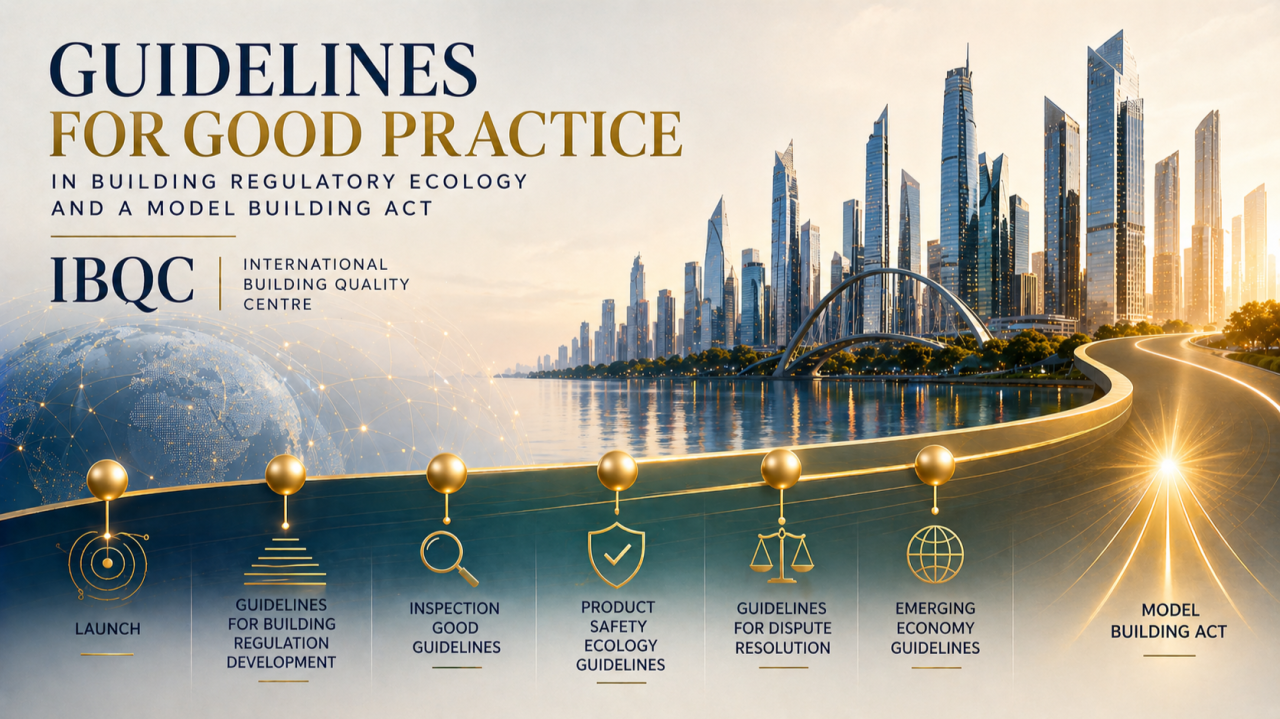
The International Building Quality Centre was launched on 4 February 2020 at the University of Canberra, with the event attended by the Honourable David Hurley AC DSC (Retd), then Governor-General of Australia. From the outset, the IBQC was conceived not as a conventional industry association, but as an international public-interest initiative dedicated to improving the quality, safety and integrity of building regulatory systems.
Leadership and institutional character
A defining feature of the IBQC has been its composition. Its leadership has brought together a multinational group of senior figures drawn from regulation, law, dispute resolution, engineering, fire safety, policy and institutional reform.
The current leadership page includes Prof (Adj/conjt) Kim Lovegrove Doctorate Litt (honouris causa) FRSN.; Professor Charles Lemckert; Adjunct Professor Prof (Adj) Robert Gordon Whittaker AM FRSN Judy Zakreski 赵笛; Professor Robert Hurtle Dame Judith Hackitt, Ms. Stephanie Barwise KC, Alejandro Espinosa-Wang, Adjunct professor Neil Savery Dominic Sims, Judge Maedot Yeshak Tesfaye, Professor José Torero FRSE, FRSN Zama Ngcobo Tsigereda Lovegrove – Building Lawyer – Adj Fellow SCU and our CEO Judy Zakreski 赵笛
Significant credit must also be given to past and inaugural board members Bronwyn Weir and Prof. Alfred Omenya, PhD and Michael de Lint, MA,PLE. each of whom played a key role in the early development of the IBQC’s guideline body of work.
That calibre of board current and past goes a long way to explaining why the International Building Quality Centre has generated work that is not merely discursive, nor loosely networked, but instead coherent, structured and capable of real-world regulatory application.
The IBQC’s institutional footing is reinforced by the breadth and calibre of its supporters, which include globally recognised standard-setting and professional bodies such as the International Code Council, The Chartered Institute of Building (CIOB) the CEBC Consortium of European Building Control the Building Officials Institute of NZ and law firm Lovegrove and Cotton; academic institutions UCL Western Sydney University, Southern Cross University, RMIT University, University of Canberra, Technical University of Munich and Massey University – Te Kunenga ki Pūrehuroa
This institutional, academic and legal mix underscores the IBQC’s character as a non-commercial, public-interest collaboration directed to systemic improvement in building regulation rather than private gain.
Just as important is the International Building Quality Centre’s orientation. While it brings together both public and private sector expertise, its board and industrious contributors are drawn from the upper ranks of the profession—senior jurists, leading academics and pre-eminent practitioners in building regulation, code writing bodies and law. The character of the enterprise is unmistakably public-interest and non-commercial: directed to better building regulation, more coherent construction dispute resolution, stronger product assurance and improved public safety outcomes, rather than private gain.
Foundation phase: principles and first architecture
The early phase of the IBQC’s work was foundational. It articulated system-level principles rather than jumping immediately to statutory drafting. That work is reflected in IBQC Good Practice Principles for Building Regulation and IBQC Good Practice Guidelines for Low Income Countries. Those publications established the IBQC’s method: identify first principles, frame them in a usable form, and make them capable of adaptation across jurisdictions.
Expansion phase: development of a specialised guideline corpus
The next phase was the development of a more specialised guideline corpus. In 2022, the IBQC published Good Practice Building Inspector Guidelines for Emerging Economies and IBQC – Good Practice Guidelines for the Development of Construction Dispute Resolution Tribunals and Decision-Making Institutions.
In the same period, it began a major workstream on building products with Building Product Performance Part 1 – Discussion Paper, followed by IBQC Good Practice Regulatory Framework for Building Product Performance Part 2. These were complemented by Risk-Based Building Classification and Inspection Guidelines, which advanced a model for classifying buildings by risk and aligning inspection intensity accordingly.
In 2025, the IBQC added IBQC Good Practice Guidelines for Existing Buildings, further extending the organisation’s reach from new building control into the stewardship and safety of the existing built environment.
A coherent body of work
What is striking about that body of work is its coherence. These are not disconnected papers. They address interlocking parts of the same regulatory ecology: principles, institutional design, inspector capability, dispute resolution architecture, product safety, risk classification, inspection regimes and the performance of existing buildings. Read together, they show a disciplined progression from broad normative principles to increasingly granular guidance on how a modern building control system should function.
Integration phase: from guidance to framework
On that view, the IBQC Model Building Act should not be treated as the beginning of the story. It is better understood as the latest expression of a much longer institutional journey. The Model Building Act draws together recurring IBQC themes already visible across the earlier publications: accountability, inspection, practitioner regulation, product safety, enforcement and dispute resolution within a unified statutory design. It is therefore the culmination of a developing corpus rather than a standalone intervention.
Conclusion
The IBQC trajectory is therefore best described as a progression from launch, to principles, to specialised guideline development, and then to integrated framework design. Its significance lies not in any single publication, but in the fact that, within a relatively short period, it has produced a coherent suite of work addressing multiple pillars of building regulatory reform. That is the real story: the deliberate construction of an international body of guidance aimed at lifting the quality of building regulation and dispute resolution in the public interest.
Disclaimer
This article is intended to be for general information purposes only and should not be relied on as legal advice. For expert construction law guidance for your own individual circumstances, don’t hesitate to contact experienced construction lawyers to assist you with dispute resolution, contractual and regulatory advice and related matters.
Image Acknowledgements:
The digital renders used in this article were developed collaboratively by Kim Lovegrove and ChatGPT.
