
Regularisation of Non-Compliant Building Work in Victoria: Notices, Orders, Emergency Powers and Practical Pathways to Compliance
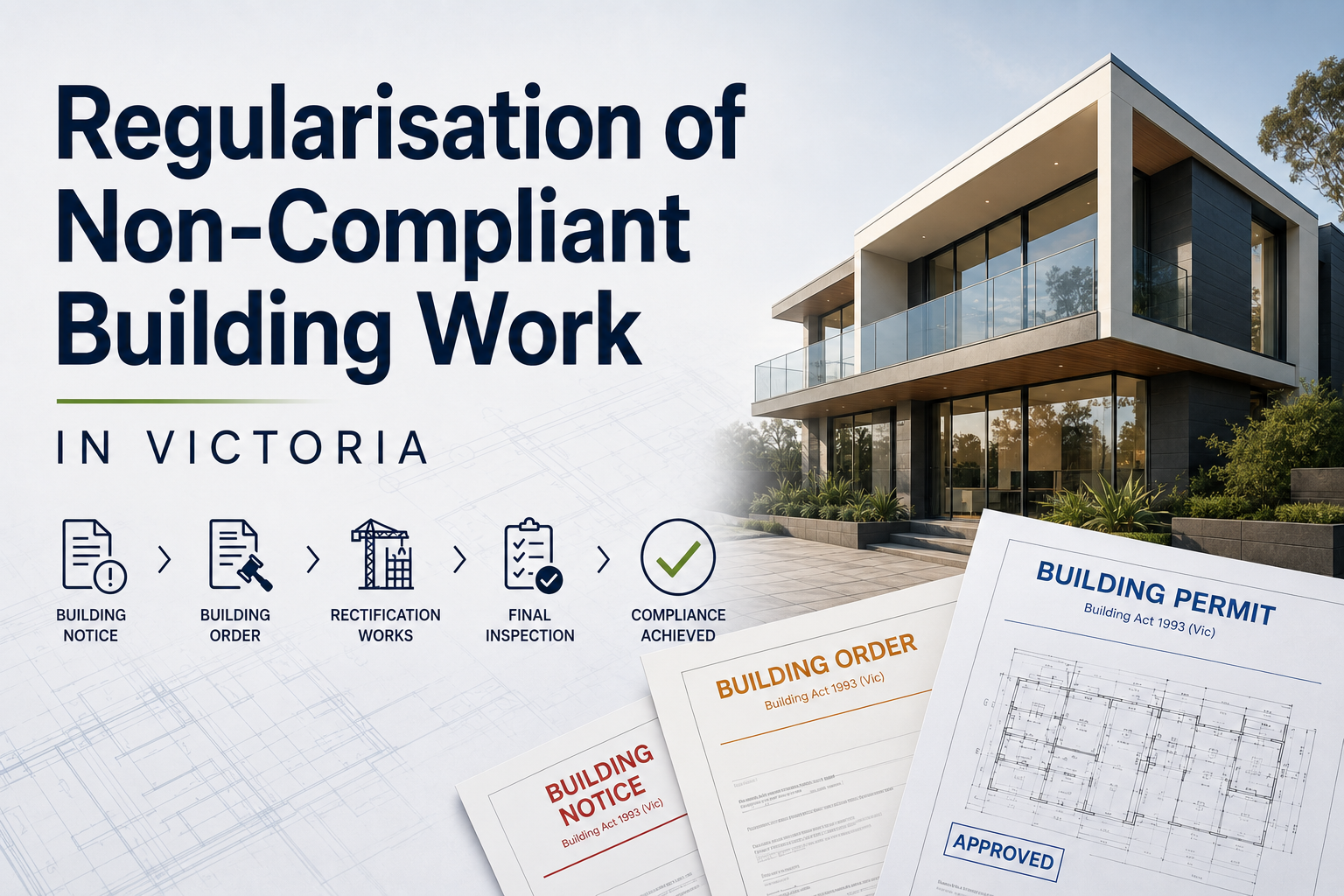
Municipal building surveyors and private building surveyors are frequently confronted with situations where building work has been carried out without a building permit or in contravention of an existing permit. In other instances, buildings are occupied or utilised for purposes that are inconsistent with their approved classification under the National Construction Code.
When such circumstances arise, the priority is not merely to identify the contravention. Rather, the challenge is to determine the most effective pathway to restore compliance, protect public safety and maintain the integrity of Victoria’s building control system.
Having advised both local government authorities and respondents seeking to regularise non-compliant building work for decades, the authors have observed that the most successful outcomes are typically achieved through a combination of decisive regulatory intervention, sound technical advice, and practical cooperation between all stakeholders.
Change of Use Contraventions
One of the more common forms of non-compliance involves the unauthorised change of use of a building.
A typical example is where a shed or barn constructed and approved as a Class 10a building is converted into accommodation or residential living quarters more consistent with a Class 1 or Class 2 building classification.
Where this occurs, the owner may contravene section 16 of the Building Act 1993, as building work has been undertaken beyond the scope of that authorised by the building permit.
Such situations often present significant life-safety concerns because buildings designed for storage purposes are rarely constructed to meet the fire safety, structural, health and amenity requirements applicable to residential buildings.
Statutory Powers Available to Building Surveyors
Municipal Building Surveyors
Where a municipal building surveyor (MBS) becomes aware of material non-compliance, the Building Act provides significant enforcement powers.
Depending upon the circumstances, the MBS may issue:
- Building Notices;
- Building Orders; and
- Emergency Orders.
The selection of the appropriate statutory instrument requires careful consideration of both the nature of the contravention and the level of risk posed to occupants and the public.
Where a Building Notice is not satisfactorily responded to, a Building Order will ordinarily follow.
Where circumstances present an immediate threat to life, property or public safety, an Emergency Order may be warranted.
Private Building Surveyors
Where a private building surveyor (PBS) becomes aware that building work is being carried out in contravention of the Building Act or building permit, the PBS likewise has statutory obligations to intervene through the issue of compliance notices and orders.
Should non-compliance continue, the matter must generally be referred to the Victorian Building Authority for further action.
The Importance of Properly Drafted Building Orders
The effectiveness of a Building Order often depends upon the quality of its drafting.
Poorly drafted orders frequently become vulnerable to challenge and may ultimately frustrate the enforcement process.
Good practice dictates that a Building Order should:
1. Clearly Identify the Contravention
The relevant provisions of the Building Act 1993 and associated regulations should be expressly identified.
2. Describe the Non-Compliant Conduct
The factual circumstances giving rise to the contravention should be accurately articulated.
3. State the Required Remedial Action
The order should clearly specify the works or measures required to achieve compliance.
4. Prescribe Realistic Timeframes
Compliance periods should reflect the practical realities of engaging consultants, obtaining engineering advice, preparing drawings and undertaking rectification works.
5. Be Proportionate
The enforcement response should be proportionate to the seriousness of the contravention and the risk posed.
The objective is not merely enforcement for its own sake, but rather the achievement of compliance and the protection of the public.
Practical Tip for Property Owners
If you receive a Building Notice, Building Order or Emergency Order, it is prudent to obtain advice immediately. Delays in responding can reduce available options, increase costs and, in some circumstances, expose owners to prosecution or further enforcement action.
Early engagement with experienced building surveyors, engineers and legal advisers will often facilitate a more efficient pathway to compliance.
Emergency Orders: A Case Study
Many years ago, while acting for a Victorian municipal council, one of the authors was involved in an enforcement matter on behalf of the council that demonstrated the importance of swift regulatory intervention.
The Facts
A property developer had excavated a substantial section of a hillside immediately adjacent to a public roadway overlooking the Maribyrnong River.
The excavation had been undertaken without a building permit.
No protection works notices had been served upon adjoining owners.
Residents reported movement in neighbouring properties and concerns quickly emerged regarding the stability of the site.
One resident reported that a large boulder had broken away from the excavation area, rolled across the roadway and ultimately fallen into the river below.
Fortunately, no member of the public was injured.
The Immediate Response
The MBS immediately attended the site.
It was apparent that there was a significant risk of further ground movement and potential damage to adjoining properties.
Appropriately qualified structural and geotechnical engineers were engaged without delay by the respondent.
An Emergency Order was issued requiring:
- Immediate cessation of excavation works;
- Immediate stabilisation measures;
- Ongoing engineering supervision; and
- Implementation of measures necessary to prevent further site deterioration.
The Emergency Order was amended and extended as circumstances evolved and engineering solutions were progressively implemented.
The Outcome
The owner cooperated fully.
Specialist consultants were engaged and substantial stabilisation works were undertaken, including the installation of protective steel mesh and sprayed concrete reinforcement.
The immediate danger was eliminated.
Once the site was stabilised and future building work could proceed safely, the Emergency Order was lifted and a building permit was subsequently issued for compliant future works.
A potentially catastrophic situation was avoided because the municipal building surveyor acted quickly, exercised appropriate statutory powers and relied upon expert technical advice.
The Discretion to Prosecute
Once compliance has been achieved, a separate question often arises: should the offending party be prosecuted?
The Building Act provides enforcement authorities with a discretion.
The exercise of that discretion will depend upon numerous considerations, including:
- The seriousness of the contravention;
- The degree of risk created;
- The conduct of the respondent;
- The extent of cooperation demonstrated; and
- Broader public policy considerations.
In the Maribyrnong case study, prosecution proceeded because the unlawful excavation was serious and created a significant risk to public safety.
However, not all contraventions warrant the same response.
Many years ago, one of the authors appeared in a prosecution involving the demolition of a small dilapidated outbuilding that had been removed without a permit.
The Magistrate queried whether the proceeding amounted to “using a sledgehammer to crack an acorn”.
The anecdote serves as a useful reminder that while contraventions should be taken seriously, enforcement responses should remain proportionate to the nature and consequences of the breach.
Practical Pathways to Regularisation
Over the years the firm has represented numerous recipients of Building Notices and Building Orders seeking to regularise non-compliant building work.
The most effective pathway commonly involves:
Step 1 – Engage an Experienced Consulting Building Surveyor
A consulting building surveyor should be retained at the earliest opportunity and, depending on the case, an engineer.
Step 2 – Engage with Council
Constructive dialogue with the municipal building surveyor frequently assists in identifying a practical pathway to compliance.
Step 3 – Obtain Technical Advice
Depending upon the circumstances, architects, engineers, draftspersons and other specialists may need to be engaged.
Step 4 – Prepare Rectification Documentation
Appropriate plans and technical documentation should be prepared to demonstrate how compliance will be achieved.
Step 5 – Undertake Rectification Works
The required works should be undertaken by registered building practitioners.
Step 6 – Certification and Inspection
Upon completion, the consulting building surveyor may issue the appropriate certification and, in many instances, rectification work will be undertaken in accordance with a building permit issued for the discrete task of regularisation and remediation.
In due course, a Certificate of Final Inspection may be issued. This will be a case-by-case scenario, and expert legal advice should be obtained on point.
The municipal building surveyor should undertake a final inspection to satisfy themselves that compliance has been achieved before any Building Order is lifted.
In the authors’ experience, councils are generally receptive to requests for reasonable extensions of time where respondents demonstrate genuine efforts to achieve compliance and engage suitably qualified experts.
Appeals
Recipients of Building Orders and Emergency Orders may appeal to the Building Appeals Board.
Common grounds of appeal include:
- Defective drafting;
- Ambiguous directives;
- Unrealistic compliance requirements;
- Excessively short compliance timeframes; and
- Jurisdictional concerns.
These considerations reinforce the importance of careful drafting and the exercise of sound regulatory judgement when preparing statutory instruments.
Cooperation as a Compliance Strategy
Whilst enforcement powers are essential, experience demonstrates that cooperation often produces the best outcomes.
Where respondents engage competent consultants, communicate openly with regulators and demonstrate a genuine commitment to achieving compliance, matters can frequently be resolved more efficiently and at substantially lower cost.
Conversely, where respondents adopt an obstructive approach, councils may have little choice but to escalate enforcement action, potentially resulting in significant expense for all concerned, not the least of which may be prosecution and potentially significant fines.
The most effective outcomes generally occur when regulators and respondents work constructively towards a shared objective: the restoration of compliance and the protection of the public.
Concluding Remarks
The Building Act 1993 does not permit retrospective approval of unlawful building work.
Where building work has been undertaken without a permit, or in contravention of a permit, the focus must be upon regularisation through appropriate statutory processes, technical verification and future compliance.
The role of the building surveyor—whether municipal or private—is fundamental to this process.
Equally important is the willingness of respondents to engage qualified professionals and cooperate with regulators in implementing practical solutions.
When these elements align, even complex cases of non-compliance can often be worked through efficiently, safely and in a manner that upholds both the integrity of Victoria’s building control system and the broader public interest.
Disclaimer
This article is provided for general informational and educational purposes only and does not constitute legal advice. The contents are necessarily general in nature and may not apply to particular circumstances. Readers should obtain independent legal or professional advice before acting upon any information contained in this article.
Lovegrove & Cotton Lawyers accepts no responsibility for any loss or liability arising from reliance upon this publication. Should you require advice regarding building notices, building orders, emergency orders, regulatory compliance, Building Appeals Board proceedings or related matters, professional advice should be obtained based upon the specific facts and circumstances of your case.
Image Acknowledgements:
The digital renders used in this article were developed collaboratively by Lovegrove & Cotton and ChatGPT.
Footnote
¹ This article updates and expands upon an earlier Lovegrove & Cotton publication, Building Notices and Orders: The Regularisation of Non-Compliant Building Work in Victoria, available at: https://lclawyers.com.au/building-notices-and-orders-the-regularization-of-non-compliant-building-work-in-victoria/
Authors’ Biography
For more than 30 years, Lovegrove & Cotton Construction and Planning Lawyers has acted for municipal councils, building practitioners, property owners, developers and respondents in matters involving building regulatory compliance, enforcement proceedings, building notices, building orders, emergency orders and the regularisation of non-compliant building work.
The firm’s founder, Adjunct Professor Kim Lovegrove, was engaged as the principal legal adviser and instructing officer in connection with the development of the Building Act 1993 (Vic), legislation that continues to underpin Victoria’s building regulatory framework. He has also advised governments, regulators and industry bodies on building regulatory reform both nationally and internationally.
Drawing upon decades of experience acting for both regulators and respondents, the firm has assisted numerous stakeholders in navigating complex compliance challenges and identifying practical pathways towards the regularisation of non-compliant building work.
For direct enquiries regarding building notices, building orders, emergency orders, regulatory compliance or building regularisation matters, please contact Tsigereda Lovegrove or Justin Cotton at Lovegrove & Cotton Construction and Planning Lawyers.
