
The 2025-27 Victorian Owners Corporation reforms begin
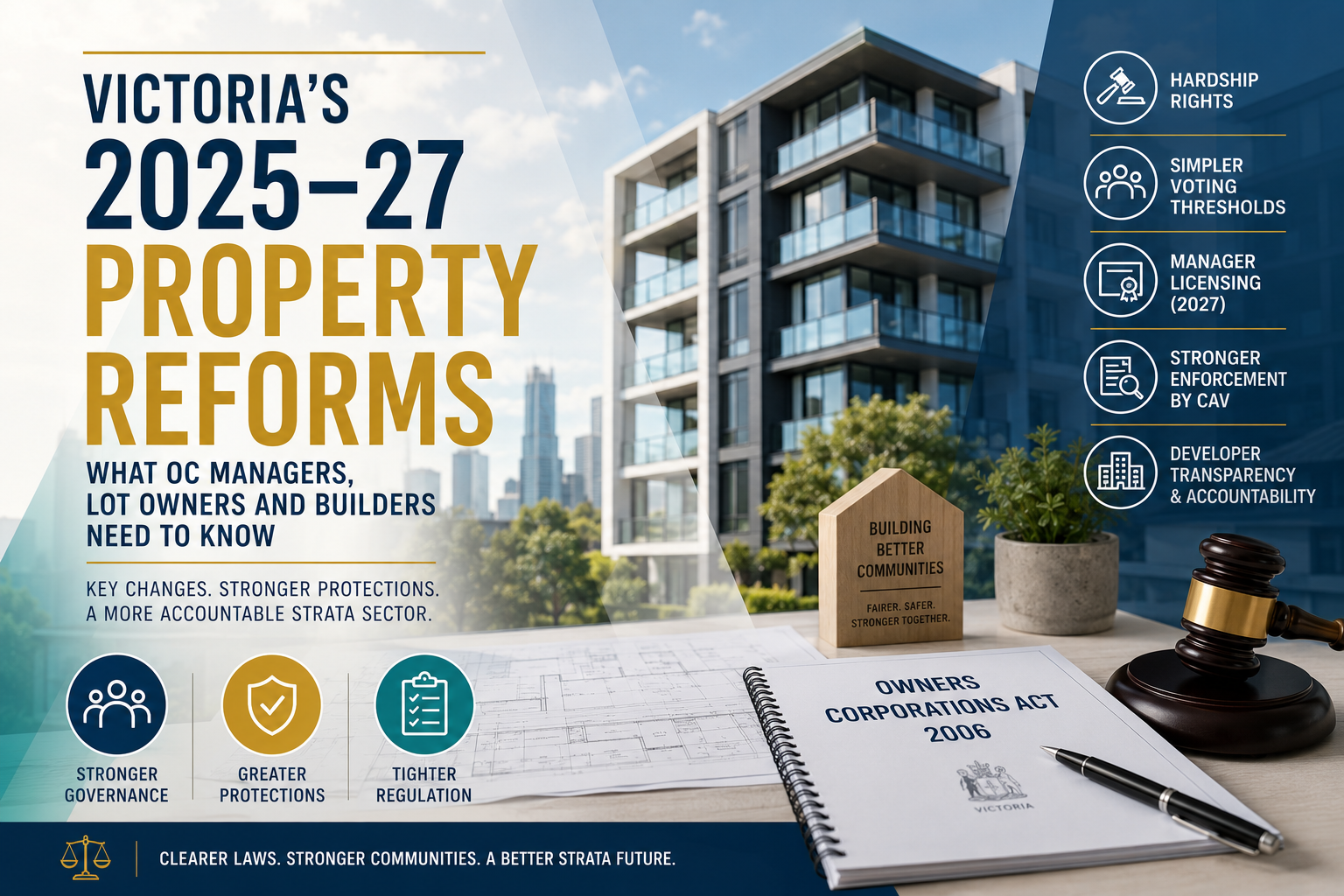
The 2025-27 reform program of Victoria’s Owners Corporation (“OC”) laws will arguably be the most significant overhaul of the Owners Corporations Act 2006 since its 2021 amendments.
It responds to the growth of apartment and townhouse living, rising governance and financial concerns, dispute resolution delays, and other matters.
Strata living accounts for over 1 million lots, housing over 20% of Victorians. On 3 June 2026, the Victorian Government introduced property reform legislation as part of its target to build 800,000 homes by 2034.
The statutory review process commenced in June 2025. Following public consultation, an expert panel delivered 51 recommendations, and the Government supported 46 of these in full, in part, or in principle.
The reforms aim to improve consumer protections, accountability, governance and regulatory oversight across the OC sector for apartment and townhouse owners by:
- Expanding Consumer Affairs Victoria’s (“CAV”) regulatory functions and proactive enforcement powers.
- Introducing a mandatory licensing scheme for professional OC managers.
- Streamlining internal OC governance structures and voting thresholds.
- Improving education and mandatory information sharing across the sector.
Takeaway for OC managers: OC management is shifting to a highly regulated environment. Managers should prepare for mandatory licensing, ongoing professional development, active compliance audits by CAV, and stricter statutory governance obligations.
Takeaway for Lot Owners: The reforms aim to strengthen consumer protections. Eventually, owners will gain stronger regulatory oversight mechanisms, including greater ability for CAV to intervene in cases of serious misconduct without relying solely on VCAT proceedings.
Takeaway for Builders and Developers: The governance framework for strata developments will tighten. Developers will face increased transparency and compliance obligations during project delivery and after handover, including requirements relating to financial records, service agreements, asset registers, and ongoing operational governance.
‘Immediate’ changes: Tranche I (2026)
- Financial hardship
Once passed by the Upper House after it is tabled in late July, lot owners will have a statutory right to request a hardship payment plan for unpaid OC fees, fast-tracked in response to cost-of-living pressures. OCs must pause enforcement action where an owner applies for, or is complying with, such a plan.
- Access to VCAT and legal proceedings
OCs may soon commence non-monetary proceedings by simple majority vote, reducing barriers to dispute resolution. Amendments to the Subdivision Act 1988 will also remove the ability of a single owner to block subdivision changes supported by the majority. Again, once it is passed by the Upper House.
Takeaway for OC managers: Internal debt collection workflows and software must be updated. Debt recovery processes will need updating to pause enforcement action where an owner applies for or complies with a hardship payment plan.
Takeaway for Lot Owners: If you encounter genuine economic distress, your OC can no longer immediately default you or launch debt-collection litigation. You have a statutory right to request a formal hardship variation plan.
Takeaway for Builders and Developers: Developers retaining large numbers of unsold lots may face cash flow impacts from mandatory hardship payment processes, increasing the importance of realistic initial budget projections.
Future changes: Tranche II (coming 2027)
The June 2026 amendments are the first tranche of reforms following the review. The government has indicated that additional legislation is being developed, anticipated to include:
- Expanded enforcement powers for Consumer Affairs Victoria
- A mandatory licensing scheme for OC managers
- Stronger conduct obligations for managers, including measures to address conflicts of interest and undisclosed financial arrangements
- Greater transparency over how OC funds are managed and decisions are made
However, the precise scope and timing of these measures remain subject to further policy work, consultation, and resourcing decisions by the government.
Developer obligations & embedded networks
Developers will face new obligations, including duties to act in owners’ interests, independent certification of maintenance and levy estimates for larger OCs, and stricter regulation of embedded energy network contracts.
Collective sales recommendation (100% rule)
The suggested reforms address difficulties caused by Victoria’s current requirement for unanimous consent for collective sales. The reforms propose a new pathway that would allow collective sale or redevelopment schemes to proceed with 75% owner approval for economically unviable buildings, subject to independent expert reports, judicial oversight, and protections for vulnerable owners. The government has given support in principle to this recommendation.
Takeaway for OC managers: If the reforms become law, managers of older buildings should prepare protocols for structural and economic assessments, as the OC could now play a key role in facilitating the proposed 75% collective sale processes.
Takeaway for Lot Owners: In economically unviable buildings, 75% owner approval may enable a collective sale to a redeveloper with court oversight, ensuring fair market value, rather than requiring all owners to fund major repair works.
Takeaway for Builders and Developers: This would open up urban renewal opportunities in inner Melbourne, with a streamlined owner approval pathway replacing unanimous consent for collective sales of ageing strata sites.
Remaining gaps
While the 2026 reforms provide greater clarity, some uncertainties remain, including the content of recommendations still under review, the timing of the 2027 licensing and audit reforms, and the rollout of CAV’s proposed centralised OC database and reporting system.
Conclusion
The June 2026 property reform package marks a major shift in Victoria’s strata sector, moving some recommendations into legislation. The immediate reforms will fast-track hardship rights and remove unanimity barriers for certain disputes and subdivision decisions, while the 2027 changes are expected to introduce manager licensing and tighter regulation.
For OC managers, the reforms signal a shift toward more professionalisation through stronger transparency and compliance. For lot owners, they provide clearer protections through hardship rights and simpler voting thresholds for resolving key building issues. For developers, long-term success will depend on aligning projects with stricter consumer protection and disclosure requirements across design, delivery and governance.
General
Victoria’s landmark 2025-2027 property reforms are fundamentally changing the strata and building industries.
Whether you are an OC manager looking for a fresh perspective and alternative legal advice, a builder navigating complex defect and delay claims, or a lot owner, we offer the practical, direct advice you need.
Contact us today to secure clear, commercial solutions tailored to your situation.
Author Biography
Levent Karaca is an Associate at Lovegrove & Cotton Construction & Planning Lawyers. He practises in construction law with particular expertise in Owners Corporation (strata) matters, advising OCs, property owners, builders and building practitioners on building defects, regulatory compliance, dispute resolution and litigation. He regularly assists clients in VCAT proceedings and complex building disputes.
Image Acknowledgements:
The digital renders used in this article were developed collaboratively by Lovegrove & Cotton and ChatGPT
Disclaimer
Legal Disclaimer
This article is for general information only and does not constitute legal advice. It is based on Victorian legislation and reform proposals current at the date of publication, some of which have not yet been enacted and may change. Readers must obtain independent legal advice rather than relying on this information.
