
IBQC Model Act – Victorian Building Act – Similar Doctrinal Architecture.
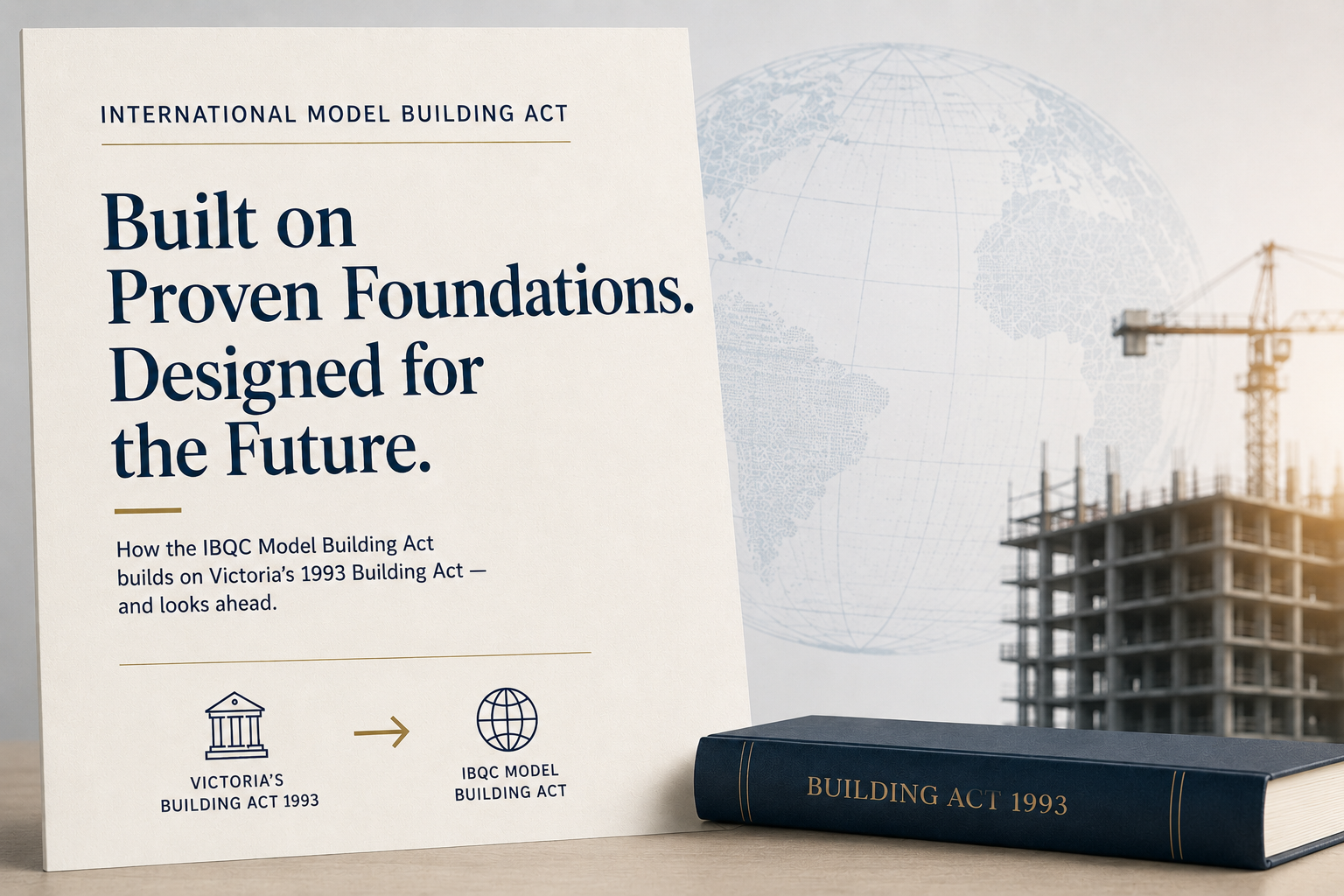
Since the IBQC released the International Model Building Act in February, one question keeps coming up: of every building statute in the world, which one does it most resemble?
On a structural comparison, it is Victoria’s Building Act 1993. The two instruments share a common institutional origin, and much of the same regulatory architecture reappears across both.
Shared Architecture
Victoria’s Building Act 1993 was itself built on the conceptual and doctrinal foundations of the National Model Building Act, an Australian Uniform Building Regulatory Co-ordinating Council initiative from 1990. The drafting instructions for that statute were prepared by an instructing officer — who happens to be the IBQC’s current Chair — working with Victorian Parliamentary Counsel.
The IBQC Model Building Act was produced through the same instruction and-drafter model: policy architecture and drafting instructions on one side, and legislative drafting — undertaken for the IBQC Model Act by Gemma Varley, former Victorian Chief Parliamentary Counsel and Law Reform Commissioner — on the other.
That shared process goes some way to explaining why the resulting frameworks look alike. Both are the product of an instructing brief translated into statute by parliamentary drafting expertise.
Where the Two Frameworks Converge
Independent Regulator
Both frameworks place an independent statutory body above day-to-day building control administration. The Model Act’s Building Authority is a direct analogue of Victoria’s then Building Control Commission, now the Building and Plumbing Commission.
Mandatory Registration of Key Practitioners
Both require builders, architects, engineers and building surveyors to be registered as a precondition of practising, backed by a disciplinary board. The Model Act’s Building Practitioners Board mirrors the body Victoria established in 1993
Proportionate Liability
Victoria’s Act was the first in Australia to replace joint and several liability with proportionate liability (originally s.131, now carried in the Wrongs Act 1958 s.24AI). The Model Act adopts the identical principle.
Mandatory Inspection Regime
Victoria’s Building Act 1993 introduced a staged mandatory inspection regime: building work must be inspected in person by the relevant building surveyor at prescribed mandatory notification stages — footings and frame among them — before construction can proceed to the next stage. The Model Act incorporates the same underlying discipline, requiring mandatory inspections calibrated to a building’s risk classification. The joint final inspection, discussed below, is layered on top of that staged regime as a further, China-informed refinement, not a replacement for it.
Ten-Year Long-Stop Limitation
Both cap a claimant’s window to ten years, and both start the clock from the same event — the issue of the occupancy permit or final inspection certificate. This mechanism, adapted from the ten-year décennale liability rule in the French Napoleonic Code, first entered Australian law through the Victorian Act and reappears in the Model Act almost unchanged.
Compulsory Insurance
Both tie registration to mandatory professional or contractual insurance for the same broad class of practitioners.
A Dispute Tribunal and an Enforcement Ladder
The Model Act’s Building Appeals Tribunal is functionally identical to Victoria’s Building Appeals Board, and both use an escalating sequence of notices, orders and rectification powers rather than moving straight to prosecution.
The Joint Final Inspection: An Input from China
One provision in the Model Act did not come from Victoria. The requirement for a mandatory joint final inspection on medium- and high-risk buildings — bringing the owner, builder, engineer, architect and building official together on site before an occupancy permit can issue — was informed by first-hand observation of China’s building control system.
Adjunct Professor Kim Lovegrove, IBQC Chair, was retained by the World Bank as a senior law reform consultant advising Chinese jurisdictions on international best practice approaches to building control design, including a 2019 conference in Beijing, jointly hosted by the World Bank and the Ministry of Finance of the People’s Republic of China, on best practice building regulation. Through that engagement he observed China’s final joint inspection protocol directly: the practice of bringing the owner, builder, quality assurance engineer, architect and building official together on site at the point of occupancy.
The assessment reached was that this represented sound international practice because it embeds peer review by every key actor responsible for a building’s safety at the single most consequential checkpoint in the construction process. That observation is the direct source of the IBQC Model Act’s joint final inspection provision.
Where the Two Frameworks Diverge
Binding Law Versus Adaptable Template
The most fundamental difference is one of legal status, not content. The Building Act 1993 is a binding statute of the Victorian Parliament. The IBQC Model Act is a non-binding reference instrument, drafted so any jurisdiction can adopt it wholesale, adapt parts of it, or benchmark against it — in a more principles-based register than a fully worked state statute, leaving operational detail to model regulations and codes.
Risk-Based Classification as an Organising Spine
The Model Act is built around a risk-tiered, codified system of building classification, with permit pathways, inspection intensity and approval scrutiny scaling to the consequences of failure. The 1993 Act was not organised around risk classification in this way; that has entered Victorian practice only through later, separate reforms.
Product Safety Chain of Responsibility
The Model Act imposes a non-delegable duty across designers, manufacturers, importers, installers and specifiers of building products, and gives the regulator power to ban unsafe products by public notice, including without prior notice in urgent cases. No equivalent existed in the original Victorian Act. Comparable product-safety regimes only emerged in Australia after 1993, following the combustible cladding crisis.
Digital Building Records and Independent Peer Review
The Model Act requires local authorities to maintain a digital building record for every building and provides for independent expert peer review on complex projects, with costs recoverable from the owner or builder. Neither had a counterpart in 1993. Digital recordkeeping was not a realistic legislative concept three decades ago, and mandatory independent peer review reflects a regulatory sensibility that has developed more recently.
Observations
The comparison is not intended to suggest that one framework is superior to the other, or that the Model Act simply reproduces the Victorian one.
Rather, the comparison shows that a common regulatory architecture — independent oversight, mandatory practitioner registration, staged mandatory inspection, proportionate liability, a ten-year long-stop, compulsory insurance and a dedicated appeals tribunal — first assembled in Victoria in 1993, has been carried into an international instrument largely intact.
What has been added reflects developments and observations from the intervening thirty years, including practice observed directly in China, product safety failures, high-rise fire risk, and a stronger contemporary emphasis on digital recordkeeping and independent scrutiny of complex projects.
The full text of the IBQC Model Building Act is available here: https://www.ibqc.org.au/library/ibqc-model-building-act/
Disclaimer
Image Acknowledgements:
The digital renders used in this article were developed collaboratively by Lovegrove & Cotton and ChatGPT
This article published by Lovegrove and Cotton
This article is intended solely for general informational and educational purposes and does not constitute legal advice. Readers should obtain independent professional advice before acting upon any matter discussed in this article. The views expressed are not necessarily those of any institution, organisation, university, chamber, regulator, government agency or professional body with which the author is associated.
For enquires contact Tsigereda Lovegrove who is a construction and planning lawyer with Lovegrove & Cotton Construction and Planning Lawyers. She advises builders, developers, building surveyors and property owners on construction law, regulatory compliance, planning, contractual risk allocation and dispute resolution. Tsigereda regularly advises industry participants on navigating building regulation, managing regulatory risk and responding to complex building disputes.
Lovegrove & Cotton has practised exclusively in construction, planning and building law for more than three decades. The firm advises builders, developers, building surveyors, engineers, architects, owners corporations and government authorities on regulatory reform, contract drafting, project risk management and complex construction disputes.
