
Housing Affordability and the Regulatory Ecology: An Overlooked Dimension of the Housing Debate
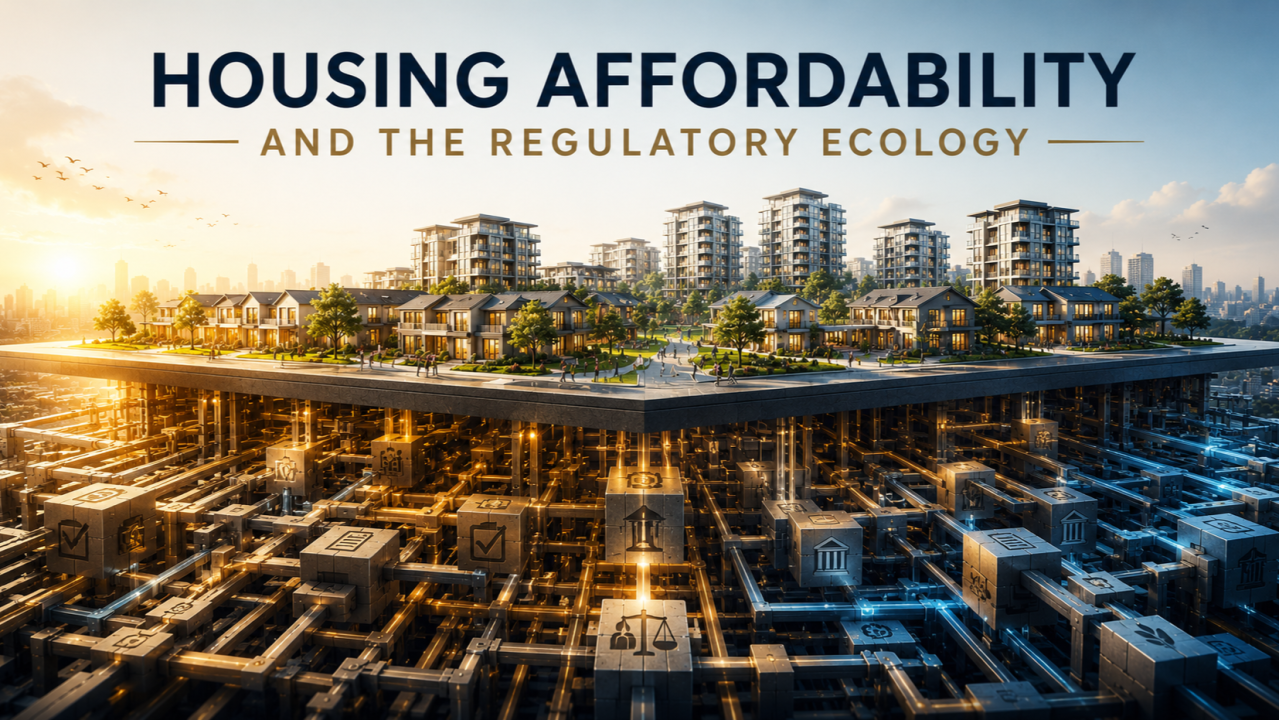
Housing affordability is one of the defining public policy challenges of our time. The debate is typically framed around land supply, planning controls, infrastructure provision, construction costs, labour availability, taxation settings and access to finance. These are all important determinants of housing outcomes.
Yet there is another dimension that receives comparatively little attention.
The quality and performance of a jurisdiction’s building regulatory ecology can materially influence the efficiency, certainty, cost and sustainability of housing delivery.
The term regulatory ecology refers to the interconnected system of legislation, building codes, approval pathways, inspection regimes, practitioner competency requirements, insurance frameworks, liability settings, enforcement powers and dispute resolution mechanisms that collectively govern the built environment.
Although building regulation is not the primary determinant of housing affordability, it is an important institutional variable that can either facilitate or impede housing outcomes.
When regulatory systems are fragmented, poorly calibrated or inadequately resourced, they can create unnecessary friction, increase transaction costs, generate uncertainty and undermine market confidence. Those costs are ultimately borne by developers, building owners, purchasers, tenants, insurers and governments.
Conversely, where regulatory systems are coherent, risk-based and fit for purpose, they can support efficient housing delivery while preserving public safety, building durability and consumer protection.
The proposition advanced in this article is a modest but important one: while building regulation alone cannot solve housing affordability challenges, the quality of the regulatory ecology can materially influence housing outcomes.
Beyond the Regulation Versus Affordability Debate
Housing affordability discussions often fall into a simplistic binary narrative whereby regulation is characterised as an impediment to housing supply.
Such a characterisation fails to distinguish between regulatory burden and regulatory quality.
The critical question is not whether regulation should be increased or reduced. Rather, it is whether the regulatory system is coherent, proportionate and capable of achieving its objectives efficiently.
Poorly designed regulation can delay development and increase costs. Equally, inadequate regulation can result in defective construction, remediation programs, insurance market instability, extensive litigation and loss of consumer confidence. Both scenarios impose significant costs on the housing system.
Good regulation is therefore not synonymous with more regulation. Good regulation is regulation that is fit for purpose.
The objective should be regulatory optimisation rather than deregulation.
Risk-Based Regulation and Efficient Housing Delivery
One of the most important developments in contemporary building regulatory theory is the adoption of risk-based approaches to regulation.
The International Building Quality Centre (IBQC) has been at the forefront of advancing this concept through its Risk-Based Building Classification and Inspection Guidelines.
The significance of these guidelines lies in their provision of a structured methodology for classifying buildings according to the likelihood and consequence of failure and calibrating regulatory responses accordingly.
The framework has implications not merely for inspection intensity, but also for building classification, approval pathways, practitioner competency requirements, regulatory oversight and the allocation of regulatory resources.
Under such a framework, routine low-risk housing may be subject to streamlined approval and inspection pathways, while higher-risk and more complex developments attract greater regulatory scrutiny.
This approach enables regulatory resources to be allocated where they are most needed.
Importantly, risk-based regulation demonstrates that efficiency and safety need not be competing objectives. A well-designed risk-based system can facilitate timely housing delivery while ensuring that buildings posing greater risks receive an appropriate level of oversight.
In this respect, risk-based building control should not be viewed as an impediment to housing supply. Properly implemented, it can become an enabler of efficient and sustainable housing delivery.
Risk-Weighted Regulatory Calibration
A central premise of the IBQC Risk-Based Building Classification and Inspection Guidelines is that regulatory intervention should be calibrated according to risk.
The guidelines recognise that buildings can be categorised according to low, medium or high-risk profiles by reference to the likelihood and consequence of failure. As the risk profile increases, so too should the intensity of regulatory oversight.
Accordingly, lower-risk buildings may be subject to more streamlined approval and inspection pathways, whereas higher-risk buildings may warrant more rigorous scrutiny, increased inspection frequency, enhanced competency requirements and, in some instances, peer review mechanisms.
The significance of this approach lies in its proportionality. It enables regulators to concentrate resources where the consequences of failure are greatest while avoiding unnecessary regulatory burdens for lower-risk building work.
In policy terms, risk-weighted calibration offers an important alternative to the often polarised debate between deregulation and increased regulation. The question is not whether there should be more regulation or less regulation. Rather, the question is whether regulatory intervention is proportionate to risk.
In the context of housing delivery, the guidelines demonstrate that regulatory efficiency need not be achieved through reduced oversight. Rather, it can be achieved through more intelligent, risk-weighted and proportionate oversight.
Regulatory Fragmentation as a Hidden Cost Driver
One of the least discussed contributors to inefficiency in housing delivery is regulatory fragmentation.
In many jurisdictions, responsibilities for building control are dispersed across multiple statutes, regulators, approval authorities and administrative bodies. While each component may serve a legitimate purpose, the absence of integration can generate duplication, delay and uncertainty.
Regulatory fragmentation can itself operate as a hidden cost within housing systems.
Where market participants must navigate overlapping requirements, inconsistent regulatory expectations, multiple approval pathways and fragmented accountability structures, transaction costs increase and project delivery becomes more difficult.
Those costs are rarely visible in public debates concerning housing affordability. Yet they can materially influence project feasibility, development timelines and ultimately housing costs.
For this reason, the quality of the regulatory architecture matters as much as the existence of regulation itself.
Building Regulatory Systems as Institutional Infrastructure
Building regulatory systems are often viewed as administrative mechanisms.
A more accurate characterisation is that they constitute a form of institutional infrastructure.
Just as transport networks, energy systems and telecommunications infrastructure support economic activity, building regulatory systems support the orderly delivery of the built environment.
They establish the rules of engagement for designers, builders, certifiers, regulators, insurers, financiers and property owners.
Where that institutional infrastructure performs effectively, it provides certainty, predictability and accountability. Where it performs poorly, uncertainty increases, transaction costs rise and housing delivery becomes more difficult.
The performance of housing markets is therefore influenced not only by physical infrastructure but also by the quality of the institutional frameworks that govern building activity.
The Importance of Legislative Architecture
Recognising the challenges associated with fragmented regulatory systems, the International Building Quality Centre developed the IBQC International Model Building Act.
The Model Building Act is significant because it approaches building control as an integrated legislative architecture rather than a collection of disconnected regulatory instruments.
The Act is intended to function as a comprehensive legislative framework for building control. It seeks to integrate the principal components of the building regulatory ecology — including building classification, approvals, practitioner registration, inspections, enforcement, product regulation, occupation, maintenance, liability settings, insurance architecture and dispute resolution mechanisms — within a coherent statutory structure.
Its objective is not legislative uniformity. Nor is it intended to be transplanted wholesale into every jurisdiction.
Rather, it provides governments, regulators and law reform bodies with an international reference framework that can be adapted to local legal, constitutional and institutional circumstances.
The significance of the Model Building Act lies in its recognition that building control systems function most effectively when their constituent elements operate as part of an integrated and coherent legislative architecture.
Durability and Lifecycle Affordability
Housing affordability should not be assessed solely by reference to acquisition costs.
A dwelling that is inexpensive to construct but later experiences systemic defects, structural failure, water ingress, building product deficiencies or significant uninsured losses may impose substantial costs upon its owners and occupants.
The true cost of housing includes maintenance, remediation, compliance, insurance and dispute resolution costs over the life of the asset.
For this reason, durability, resilience and insurability should be regarded as important dimensions of affordability.
Buildings that perform effectively throughout their intended design life are more likely to deliver genuine affordability than buildings that require substantial rectification shortly after completion.
Long-term affordability and long-term building performance are therefore closely connected.
The Cost of Regulatory Failure
The economic consequences of regulatory failure can be profound.
History provides numerous examples where deficiencies in building control systems have resulted in widespread building defects, major rectification programs, insurance market disruption and substantial financial losses for building owners and governments.
The New Zealand leaky building crisis, combustible cladding failures that affected a number of jurisdictions, and other systemic building failures demonstrate that the costs of regulatory failure are rarely confined to the construction phase. Rather, they can persist for decades and impose substantial burdens upon consumers, insurers, industry participants and governments.
These experiences underscore an important point. Housing affordability cannot be assessed solely by reference to the upfront cost of delivering housing. Consideration must also be given to the long-term costs associated with regulatory failure, defective construction and inadequate risk management.
In this sense, effective building regulation should be viewed not merely as a compliance mechanism, but also as a form of economic risk mitigation.
Insurability and Housing Affordability
Insurance is an often-overlooked component of housing affordability.
A housing market that cannot attract affordable and sustainable insurance is unlikely to remain affordable over the long term. Where insurers perceive elevated systemic risk, premiums may increase, coverage may become restricted and, in some circumstances, insurers may withdraw from segments of the market altogether.
Accordingly, regulatory systems that promote building quality, accountability and effective risk management can contribute not only to consumer protection outcomes but also to the long-term stability and affordability of insurance markets.
The International Building Quality Centre (IBQC) Contribution
Over recent years, the International Building Quality Centre has developed a suite of international good-practice instruments addressing critical components of the building regulatory ecology.
Among the most significant of these initiatives are the IBQC Good Practice Principles for Building Regulation, the Risk-Based Building Classification and Inspection Guidelines and the IBQC International Model Building Act.
Together with the Good Practice Building Inspector Guidelines for Emerging Economies, the Good Practice Guidelines for Existing Buildings and the Good Practice Regulatory Framework for Building Product Performance, these instruments provide governments, regulators and law reform bodies with one of the most comprehensive international frameworks currently available for building regulatory reform.
Collectively, these instruments seek to promote regulatory systems that are proportionate, risk-calibrated, coherent and capable of delivering safe, durable and insurable buildings without imposing unnecessary regulatory burdens upon the development process.
The collective value of these instruments lies not merely in their individual content, but in the manner in which they complement one another. Together they address foundational regulatory principles, legislative architecture, risk calibration, practitioner competency, building stewardship and product integrity.
They reflect a holistic view of building control that recognises the interconnected nature of modern regulatory systems.
Table 1: Selected IBQC Instruments Relevant to and Regulatory Performance
IBQC Good Practice Principles for Building Regulation¹ Establishes foundational principles for effective building regulation, including proportionality, accountability, competency, transparency and regulatory coherence.
Risk-Based Building Classification and Inspection Guidelines² Provides a methodology for calibrating regulatory intervention according to risk and consequence, enabling more proportionate allocation of regulatory resources.
IBQC International Model Building Act³ Provides an integrated legislative architecture for modern building control systems.
Good Practice Building Inspector Guidelines for Emerging Economies⁴ Promotes inspection competency and regulatory capability.
Good Practice Guidelines for Existing Buildings⁵ Addresses stewardship of ageing building stock and lifecycle building performance.
Good Practice Regulatory Framework for Building Product Performance⁶ Promotes robust product control systems and helps mitigate systemic product failure risks.
References
¹ IBQC Good Practice Principles for Building Regulation
² IBQC Risk-Based Building Classification and Inspection Guidelines
³ IBQC International Model Building Act
⁴ IBQC Good Practice Building Inspector Guidelines for Emerging Economies
⁵ IBQC Good Practice Guidelines for Existing Buildings
⁶ IBQC Good Practice Regulatory Framework for Building Product Performance
Further information regarding these instruments can be accessed through the IBQC Knowledge Library and Guidelines Repository available through the IBQC website.
Conclusion
Housing affordability is not solely an economic challenge, nor is it solely a planning challenge.
It is also, in part, a systems challenge that is influenced by the quality of the institutions and regulatory frameworks that govern the built environment.
The quality of a jurisdiction’s building regulatory ecology can influence the efficiency, certainty, durability and sustainability of housing delivery.
The work of the International Building Quality Centre demonstrates that effective building regulation is not achieved through isolated interventions. It is achieved through coherent legislative architecture, risk-based regulation, competent practitioners, effective inspection systems, robust product controls and fit-for-purpose accountability frameworks.
The IBQC’s body of work is notable because it approaches these issues as components of an integrated regulatory ecosystem rather than discrete policy problems.
The ultimate proposition is a simple one. Housing affordability is often treated primarily as a supply-side challenge. It is more accurately characterised as a systems challenge.
The jurisdictions that achieve the greatest success in delivering safe, durable, insurable and affordable housing are likely to be those that recognise that the performance of the housing system depends not only upon how many homes are built, but also upon the quality of the regulatory systems that govern how those homes are designed, approved, constructed, inspected, maintained and, where necessary, remediated.
Legal Disclaimer
This article is published for general informational purposes only. It does not constitute legal advice, regulatory advice, policy advice or professional advice and should not be relied upon as a substitute for obtaining advice specific to particular circumstances. The views expressed are general in nature and concern issues of building regulation, housing policy, regulatory design and institutional reform.
Image Acknowledgements:
The digital renders used in this article were developed collaboratively by Lovegrove & Cotton and ChatGPT.
Author Bio
Adjunct Professor Kim Lovegrove DLitt (honoris causa), MSE, RML is Chair of the International Building Quality Centre (IBQC) and founder of Lovegrove & Cotton Construction and Planning Lawyers.
He has spent more than four decades at the intersection of construction law, building regulation, regulatory design, and law reform, including serving as the principal legal adviser on the development of the Building Act 1993 (Vic) and as Project Director of the Australian National Model Building Act.
He was also a key architect of the IBQC International Model Building Act, a contemporary model statute developed to assist jurisdictions in designing coherent, risk-based, and integrated building regulatory systems.
The IBQC is an international thought-leadership coalition dedicated to advancing global best-practice building regulation, building control, dispute resolution, building safety, and practitioner accountability frameworks.
More recently, Kim has advised on building law reform settings in New Zealand, including work connected with MBIE’s proportionate liability reform programme. Through Lovegrove & Cotton, he continues to advise on complex construction law, building regulation, liability, building control, and regulatory compliance matters across Australia and New Zealand.
