
Reflections on the New Zealand Building Act and the Emergence of the IBQC International Model Building Act
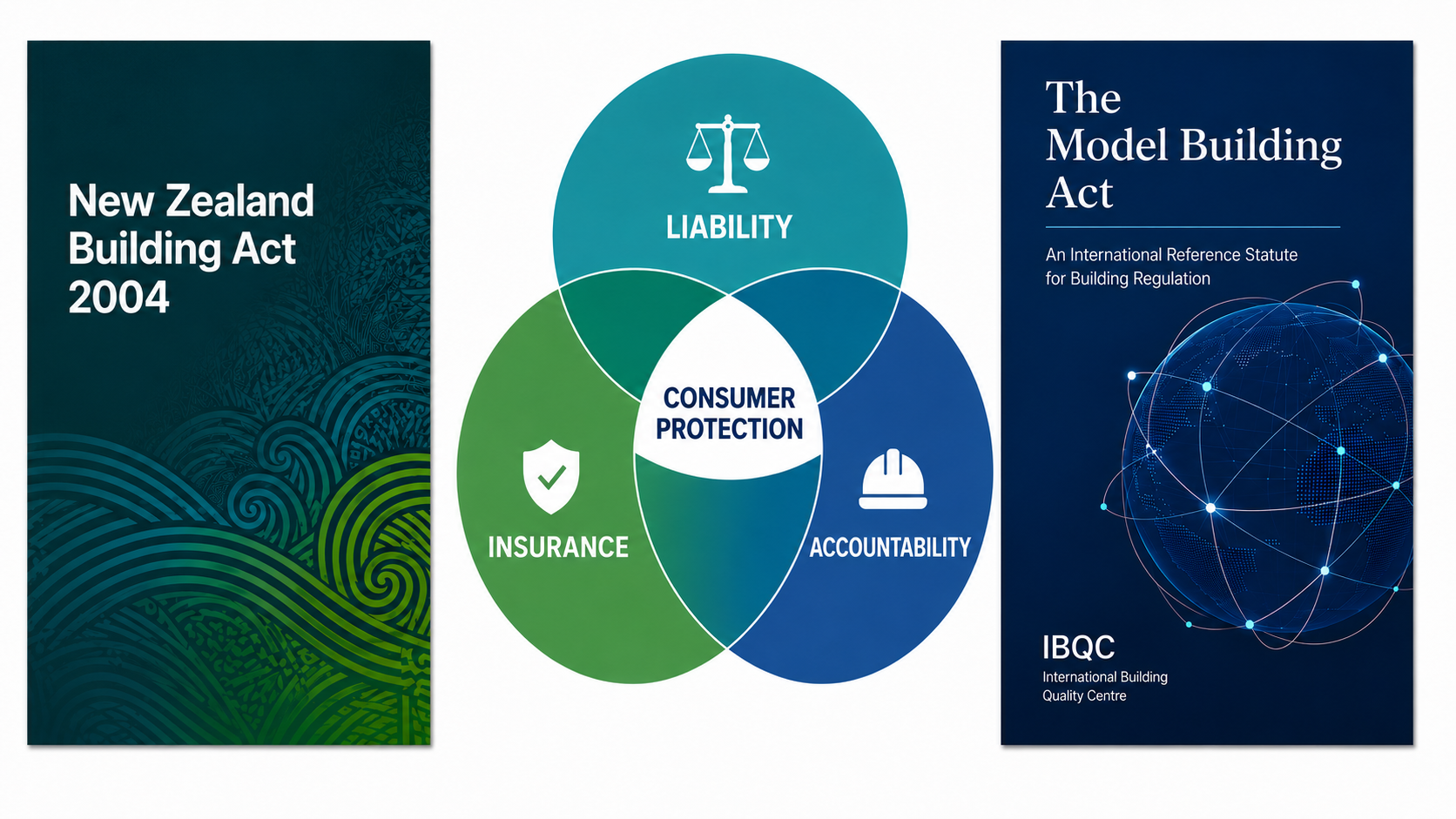
The enactment of the New Zealand Building Act 2004 marked a significant chapter in the evolution of building regulation in New Zealand. Introduced in response to changing regulatory challenges and heightened expectations regarding building quality and accountability, the Act established a legislative framework that continues to underpin New Zealand’s building control system.
Over the ensuing two decades, the Act has provided the principal legislative framework for building control in New Zealand. Like most major regulatory statutes, it has evolved over time through amendment, judicial consideration and policy review as governments, regulators, industry participants and consumer advocates have grappled with issues of accountability, consumer protection, practitioner competency, building quality, liability allocation and regulatory effectiveness.
More recently, the International Building Quality Centre (IBQC) developed the International Model Building Act, a legislative framework designed for adaptation across a range of jurisdictions and regulatory environments. Developed with contributions from regulators, lawyers, academics, building practitioners and policy experts from several countries, the Model Building Act seeks to distil many of the regulatory concepts that have emerged internationally as hallmarks of good practice building control.
The emergence of the IBQC International Model Building Act provides an opportunity to reflect upon different approaches to building regulatory design. Such a comparison is not intended to suggest that one framework is superior to another. Rather, it provides an opportunity to consider how different legislative architectures seek to achieve common objectives: safe buildings, accountable practitioners, effective regulatory oversight and consumer protection.
The Enduring Strengths of the New Zealand Building Act
The New Zealand Building Act is notable for the breadth of matters addressed within a single legislative framework.
The Act established:
- Building control and consent processes;
- Practitioner licensing;
- Enforcement mechanisms;
- Building compliance requirements;
- Consumer protection measures; and
- Regulatory oversight.
The Act nevertheless relative to some jurisdictions operates within a mature institutional framework supported by the Licensed Building Practitioner regime and central government stewardship.[1][2] The practitioner registration framework draws, in part, upon concepts that were earlier embodied in the building practitioner registration regime established under the Victorian Building Act 1993.
The Evolution of New Zealand’s Liability and Consumer Protection Framework
The evolution of New Zealand’s building control framework in the 21st century may be viewed through several important milestones.
The first was the enactment said Building Act, which established the modern legislative architecture for building control, practitioner accountability and consumer protection.
The second milestone occurred in August 2025 when the Government announced its intention to replace joint and several liability with proportionate liability in the building and construction sector. In announcing the reform, Building and Construction Minister Hon Chris Penk MP simultaneously signalled the Government’s intention to introduce accompanying consumer protection measures, including mandatory professional indemnity insurance and mandatory home warranty protections.[3]
The third milestone occurred later when the Government announced supporting reforms designed to accompany the transition to proportionate liability. These included mandatory professional indemnity insurance for key building practitioners, mandatory home warranty protections and strengthened disciplinary sanctions for Licensed Building Practitioners.[4]
Viewed collectively, these reforms demonstrate a policy recognition that liability allocation systems, insurance protections and practitioner accountability mechanisms are interconnected elements of an effective building control framework. These reforms are aligned with the IBQC framework.
The IBQC International Model Building Act
The IBQC International Model Building Act was developed in a different context.
Unlike national legislation designed for a single jurisdiction, The IBQC International Model Building Act was conceived as a framework capable of adaptation across diverse economies, governance structures and regulatory systems.
The objective was to establish a legislative framework capable of assisting jurisdictions seeking either to modernise existing building control systems or establish new systems informed by contemporary international good practice.
Further information is available in the IBQC International Model Building Act.[5]
The Model Building Act incorporates a range of holistic regulatory concepts that have emerged internationally over recent decades, including:
- Risk-based regulation;
- Mandatory registration of key practitioners;
- Proportionate liability;
- Compulsory insurance frameworks;
- Modern enforcement powers;
- Consumer protection measures;
- Competency assurance systems;
- Clear accountability pathways;
- Modern dispute resolution mechanisms;
- Clear ten-year liability capping;
- Strong building permit delivery systems;
- robust mandatory inspection systems.
Legislative Architecture
One of the more interesting distinctions between the two frameworks lies in legislative architecture.
The New Zealand Building Act reflects the requirements of a mature national regulatory system and therefore contains detailed provisions dealing with a broad range of operational and administrative matters.
The IBQC International Model Building Act adopts a more principles-based structure. It establishes core legislative foundations while allowing detailed operational requirements to be supplemented by regulations, codes and guidelines.
The distinction is less one of regulatory objective than legislative philosophy. The New Zealand Building Act embodies relative to some other jurisdictions a comprehensive statutory approach to building control, whereas the IBQC International Model Building Act seeks to articulate the core elements of a building regulatory framework in a comparatively concise and adaptable form. The comparison provides an interesting insight into alternative approaches to regulatory architecture.
The appropriate balance will often depend upon the historical, political and institutional circumstances of the jurisdiction concerned.
Risk-Based Regulation and Building Classification
One of the defining features of the IBQC International Model Building Act is its emphasis upon risk-based regulation.
The Model Act proceeds on the basis that regulatory intervention should be proportionate to the consequences of failure. Buildings that present higher risks to life safety, public safety or economic loss attract greater regulatory scrutiny, more intensive inspections and more rigorous approval processes. Lower-risk buildings may be subject to more streamlined regulatory pathways.
This philosophy is reinforced by the IBQC Risk-Based Building Classification and Inspection Guidelines .[6]
The concept has attracted increasing international interest as governments seek to balance public safety objectives with housing affordability, regulatory efficiency and productivity outcomes.
Risk-based regulation should not be interpreted as deregulation. Rather, it is an approach that seeks to direct regulatory resources to where they are most needed.
Liability Allocation, Mandatory Insurance and Regulatory Accountability
One of the more interesting areas of convergence between the 2025 New Zealand reforms, the Victorian building regulatory framework and the IBQC International Model Building Act concerns the relationship between liability allocation, practitioner accountability and insurance.
Tsigereda Lovegrove – Building Lawyer – Adj Fellow SCU has opined that ‘the New Zealand reforms are noteworthy because proportionate liability was not introduced as a stand-alone initiative. Rather, the reforms were accompanied by mandatory professional indemnity insurance and mandatory home warranty protections’.
This reflects an appreciation that responsibility-based liability systems are most effective when coupled with robust insurance mechanisms and consumer protection safeguards.
- The IBQC International Model Building Act adopts a similar philosophy.
The Model Act incorporates a responsibility-based proportionate liability regime that recognises the importance of aligning liability allocation with comparative responsibility. It also advocates compulsory insurance arrangements for key building actors.
The rationale is straightforward. Proportionate liability allocates responsibility according to fault. Compulsory insurance assists in ensuring that those responsible possess the financial capacity to respond to legitimate claims.
In this regard, there are noteworthy similarities between policy settings that have evolved in New Zealand, the Australian state of Victoria and the architecture of the IBQC International Model Building Act.
Each framework recognises the importance of insurance as a consumer protection mechanism and as a means of underpinning confidence in the building sector.
The convergence between the 2025 New Zealand reforms and the architecture of the IBQC International Model Building Act is particularly noteworthy. Both frameworks recognise that responsibility-based liability systems are most likely to succeed when accompanied by robust insurance mechanisms, practitioner accountability and consumer protection safeguards.
Liability Tenure and Regulatory Certainty
Liability tenure represents another area of interest.
New Zealand’s building legislation incorporates a ten-year long-stop limitation period, which has become an established feature of the country’s building control framework.
The IBQC International Model Building Act likewise adopts a ten-year liability tenure.
A notable point of distinction, however, lies in the commencement mechanism.
Under the IBQC International Model Building Act, the ten-year period runs from a single, objectively ascertainable event, namely the issuance of the occupancy permit by the building offical. The rationale is to provide a clear and readily identifiable commencement date for owners, practitioners, regulators, insurers and the courts.
By contrast, the New Zealand long-stop provision is linked to the act or omission upon which the relevant civil proceeding is based. In practice, this may require consideration of when the particular act or omission giving rise to the claim occurred, a matter that can assume greater complexity where multiple participants have contributed to a project over an extended period.
The distinction is not one of liability duration, as both frameworks adopt a ten-year tenure. Rather, it concerns the identification of the event from which the limitation period runs. The IBQC International Model Building Act adopts a commencement mechanism intended to maximise certainty by linking the commencement of the liability period to a single readily ascertainable milestone in the building process.
Registration and Licensing of Key Practitioners
Another notable area of alignment concerns practitioner registration.
New Zealand has long recognised the importance of practitioner competency through its Licensed Building Practitioner regime.
Victoria similarly maintains mandatory registration requirements for a broad range of building practitioners.
The IBQC International Model Building Act adopts the same underlying philosophy. It proceeds on the basis that those who undertake critical building functions should be registered, licensed, accredited or otherwise formally recognised by the relevant regulatory authority. Although it is much closer aligned to the Victorian registration system in term of competency criteria than NZ.
Although the specific registration pathways differ between jurisdictions, the policy objective remains substantially the same: ensuring that those entrusted with responsibilities affecting public safety, structural integrity and building performance are subject to competency requirements and appropriate regulatory oversight.
Housing Affordability, Regulatory Efficiency and Building Control
Housing affordability has become a major policy challenge across many developed economies.
While affordability debates frequently focus upon land supply, planning controls and construction costs, increasing attention is also being directed towards the design of regulatory systems.
The challenge for policymakers is to ensure that regulatory intervention remains proportionate to risk. Excessive regulatory burdens imposed upon lower-risk projects may increase costs and delay housing delivery without necessarily generating corresponding safety benefits. Conversely, inadequate scrutiny of higher-risk projects may expose consumers and communities to unacceptable risks.
The IBQC International Model Building Act seeks to address this challenge through a risk-based regulatory philosophy that aligns regulatory intensity with the consequences of failure.
This approach reflects a broader international trend towards ensuring that building control systems simultaneously support public safety, regulatory efficiency and housing affordability.
Concluding Reflections
The New Zealand Building Act 2004 has provided the legislative framework for building control in New Zealand for more than two decades. During that period, questions concerning building quality, liability allocation, consumer protection, insurance arrangements and regulatory effectiveness have remained recurring themes in legislative reform, policy development and industry debate.
The 2025 reforms represent a significant development in that continuing evolution. In particular, the proposed transition from joint and several liability to proportionate liability, together with mandatory professional indemnity insurance and home warranty protections, reflects an increasing recognition of the interconnected nature of liability allocation, insurance and consumer protection within contemporary building regulatory systems.
The IBQC International Model Building Act engages with many of the same regulatory questions but does so through a legislative framework designed for adaptation across diverse jurisdictions and regulatory environments.
A comparison of the two frameworks reveals a number of common themes, including practitioner accountabilit, liability allocation, insurance, dispute resolution and regulatory oversight. It also reveals differing approaches to legislative architecture and the organisation of regulatory responsibilities.
Perhaps the most distinctive feature of the IBQC International Model Building Act is its breadth. Rather than confining itself to building approvals, compliance and enforcement, the Model Act seeks to address within a single legislative framework many of the issues that have featured prominently in building regulatory reform debates over recent decades. These include:
- risk-based building classification;
- risk-based building permit delivery pathways;
- risk-based inspection regimes;
- proportionate regulatory intervention;
- mandatory registration of key practitioners;
- clear allocation of responsibilities;
- proportionate liability provisions;
- compulsory insurance frameworks;
- consumer protection measures;
- modern enforcement powers;
- dispute resolution mechanisms;
- competency assurance systems; and
- clear liability tenure provisions.
Whether these matters are addressed through primary legislation, subordinate legislation or separate statutory instruments varies from jurisdiction to jurisdiction. What distinguishes the Model Act is the extent to which it seeks to bring them together within a single legislative architecture.
Particularly noteworthy is the integration of risk-based building classification with permit delivery and inspection intensity. Under that approach, regulatory oversight is calibrated according to the nature and consequences of building risk, with higher-risk buildings attracting greater regulatory scrutiny and more intensive inspection pathways than lower-risk buildings. This reflects a growing international interest in risk-informed approaches to building control and the deployment of regulatory resources in a manner proportionate to potential consequences.
One point of particular interest is the extent to which recent New Zealand reforms and the architecture of the IBQC International Model Building Act both engage with the relationship between liability allocation, insurance and consumer protection. Although developed in different contexts, each treats those issues as components of a broader regulatory framework rather than as isolated policy questions.
The comparison highlights how different jurisdictions may adopt different legislative pathways when addressing common regulatory challenges. In that respect, the New Zealand reforms and the IBQC International Model Building Act form part of a broader international discussion concerning building quality, liability allocation, consumer protection, insurance, practitioner accountability and the continuing evolution of building control systems.
References
[1] Building Act 2004 (NZ).
[2] Ministry of Business, Innovation and Employment (MBIE), Licensed Building Practitioner Scheme.
[3] Hon Chris Penk, Minister for Building and Construction, announcement of proposed proportionate liability reforms, August 2025.
[4] New Zealand Government and MBIE materials concerning mandatory professional indemnity insurance, mandatory home warranty protections and related consumer protection reforms announced in 2025.
[5] International Building Quality Centre (IBQC), International Model Building Act.
[6] International Building Quality Centre (IBQC), Risk-Based Building Classification and Inspection Guidelines.
Authors Biography
Adjunct Professor Prof (Adj/conjt) Kim Lovegrove Doctorate Litt (honouris causa) FRSN.
Adjunct Professor Kim Lovegrove is the Founder of Lovegrove & Cotton Construction and Planning Lawyers Australia, is Barrister at 48 Shortland Chambers Auckland, Chair of the International Building Quality Centre (IBQC), Adjunct Professor at the University of Canberra and Western Sydney University, and Visiting Professor at RMIT University.
He was Project Director of Australia’s National Model Building Act reform initiative and an instructing officer for the Victorian Building Act 1993. He has published extensively on building regulation, proportionate liability, dispute resolution, insurance reform and regulatory architecture in Australia, New Zealand and internationally.
Tsigereda Lovegrove
Tsigereda Lovegrove – Building Lawyer – Adj Fellow SCU is a Construction and Planning Lawyer with Lovegrove & Cotton Construction and Planning Lawyers Australia, where she practises in building, construction and planning law. She is also the Practice Manager of Lovegrove & Cotton New Zealand and a Board Member of the International Building Quality Centre (IBQC).
In Australia she advises on building disputes, regulatory compliance, construction litigation and planning matters, and contributes to international building regulatory reform initiatives through her work with the IBQC. She is also responsible for the strategic and operational management of the Lovegrove & Cotton practices in Australia and New Zealand.
Kim Lovegrove and members of the Lovegrove & Cotton law reform team namely Tsigereda Lovegrove – Building Lawyer – Adj Fellow SCU and Justin Cotton were engaged by New Zealand’s Ministry of Business, Innovation and Employment (MBIE) to advise on liability reform options and associated insurance settings in connection with New Zealand’s transition from joint and several liability to proportionate liability. The team has also published and presented extensively on liability allocation, consumer protection, mandatory insurance and building regulatory reform throughout Australasia.
Disclaimer
This article represents the personal views of the author. It is intended solely for general informational and educational purposes and does not constitute legal advice. Readers should obtain independent professional advice before acting upon any matter discussed in this article. The views expressed are not necessarily those of any institution, organisation, university, chamber, regulator, government agency or professional body with which the author is associated.
Image Acknowledgements:
The digital renders used in this article were developed collaboratively by Lovegrove & Cotton and ChatGPT
