
The review of the National Construction Code (NCC) is both timely and important.
The writer recently participated in discussions with members of the review team and was afforded the opportunity to reflect upon both the origins of Australia’s performance-based building code and contemporary international developments in building regulatory design.
The review arrives more than three decades after the genesis of Australia’s performance-based building code. During that period, the NCC has evolved through successive amendments, state and territory variations and increasing layers of technical complexity. While those developments have often been driven by legitimate policy objectives, they have also resulted in a considerably larger and more intricate regulatory instrument than that originally envisaged.
The review therefore presents an opportunity not merely to refine existing provisions but also to consider broader international developments in building regulatory philosophy.
Recollections from the Genesis of the Performance-Based Code
The writer’s interest in the current review is informed by direct involvement in the early evolution of Australia’s modern building regulatory framework.
The writer’s interest in the NCC review is informed by his time at the Australian Building Codes Board (ABCB) during the development of Australia’s first performance-based building code. While serving as Deputy Executive Director of the ABCB and leading its legal and policy division, the writer witnessed first-hand the policy deliberations and reform initiatives that culminated in the introduction of the nation’s inaugural performance-based building code in 1996.
One meeting remains particularly vivid.
At an ABCB committee meeting chaired by the late Jim Service AO, it was resolved that Australia would embark upon the development of a performance-based building code. A two-year timetable was established for the project.
At the time, New Zealand’s Building Code provided an important conceptual reference point.
The central objective was to create an alternative solution pathway that would allow designers, engineers and building practitioners to demonstrate compliance through performance-based solutions rather than being confined to prescriptive requirements.
Prior to those reforms, practitioners wishing to pursue non-prescriptive approaches frequently had to seek dispensation through modification processes and applications to bodies such as the then Victorian Building Appeals Board. If approval was granted, departures from strict prescriptive requirements could be sanctioned.
The performance-based framework in the Building Code of Australia fundamentally altered that paradigm.
Provided that a proposed alternative solution could demonstrate compliance with the underlying performance objectives of the code, alternative solutions could be considered on their merits by the relevant building surveyor.
The objective was to encourage innovation while preserving safety outcomes.
The initiative ultimately culminated in Australia’s first performance-based building code in 1996, a reform that was widely regarded as one of the most significant advances in building regulation of its era.
Thirty Years Later: A More Complex Regulatory Instrument
Three decades later, the regulatory landscape is markedly different.
The NCC has expanded significantly through successive revisions, technical additions and jurisdictional variations.
This evolution is unsurprising. Building technologies have advanced, societal expectations have changed, and governments have responded to new safety challenges.
Yet complexity inevitably accumulates.
As regulatory systems mature, questions naturally arise as to whether their architecture remains optimally calibrated to contemporary risks and contemporary regulatory objectives.
It is against this backdrop that the current review assumes considerable significance.
International Thinking Continues to Evolve
Yet while the NCC has continued to evolve through successive amendments, international thinking has also evolved.
Increasingly, attention is being directed towards regulatory systems that not only accommodate performance-based design but also calibrate regulatory intervention according to building risk and consequence.
In that sense, the contemporary discussion is no longer confined to how buildings may comply with code requirements. Increasingly, it concerns how regulatory systems themselves should be structured.
Questions are being asked internationally about how finite inspection resources should be allocated, when independent expert involvement should be mandated, and whether all building typologies warrant identical levels of regulatory intervention.
It is within this context that the work of the International Building Quality Centre assumes particular relevance.
The Emergence of Risk-Based Building Classification
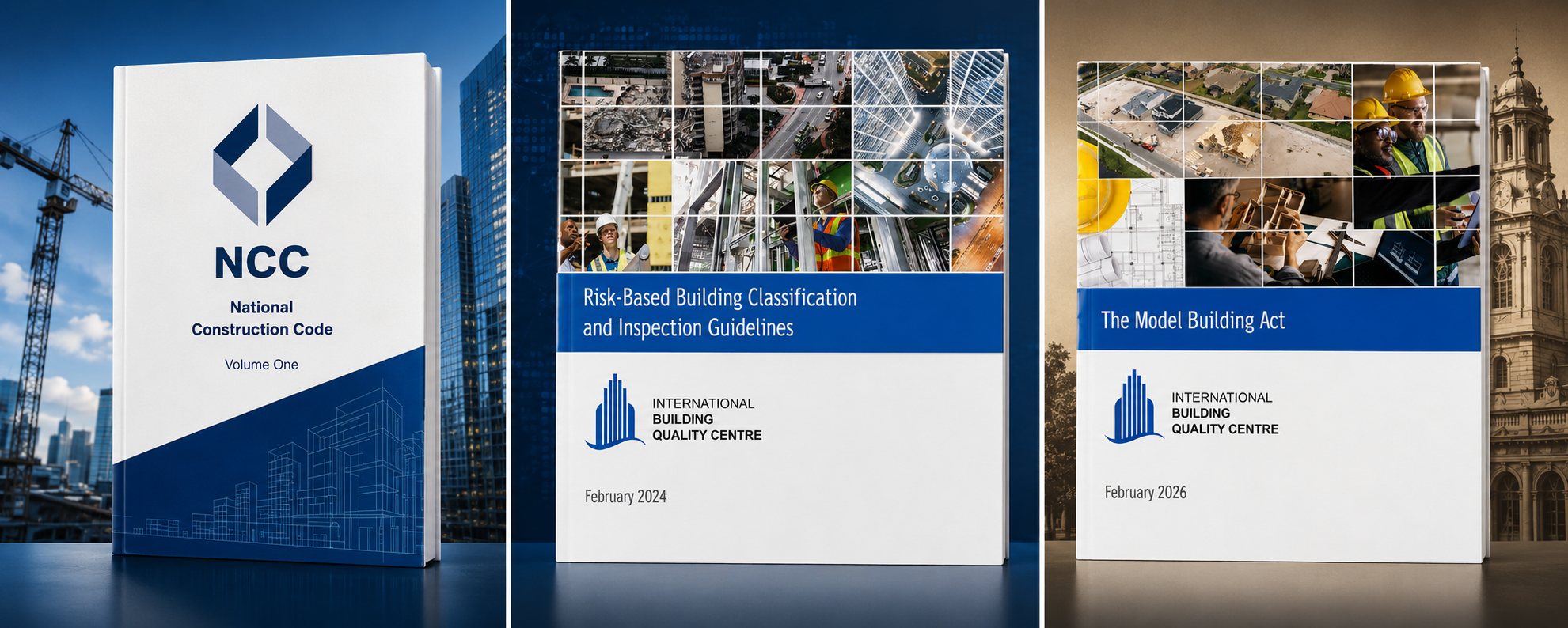
One of the most significant developments in recent years has been the publication of the IBQC Risk-Based Building Classification and Inspection Guidelines.
The guidelines advocate a regulatory philosophy whereby buildings are classified according to risk and consequence rather than merely by use or occupancy.
The fundamental premise is straightforward.
Not all buildings present equivalent risks to life safety, economic wellbeing, societal continuity, environmental resilience or public confidence.
Accordingly, inspection regimes, regulatory intervention and compliance oversight should be calibrated according to risk.
Under such an approach:
Low-risk buildings attract relatively modest regulatory intervention.
- Medium-risk buildings attract greater levels of oversight.
- High-risk buildings attract more intensive inspection and verification requirements.
- Buildings with the highest consequence profiles attract the greatest degree of mandatory intervention, independent review and specialist practitioner involvement.
The philosophy recognises that a detached outbuilding, a suburban dwelling, a multi-storey residential tower, a hospital and critical infrastructure facility do not present equivalent consequence profiles.
It follows that identical levels of inspection intervention may not always represent the most effective deployment of finite regulatory resources.
The approach seeks to ensure that regulatory effort is concentrated where failure consequences are greatest.
In simple terms, the higher the risk and consequence profile, the greater the degree of regulatory oversight.
This philosophy lies at the heart of both the Guidelines and the emerging International Model Building Act.
European Foundations and International Best Practice
The concepts embodied within the guidelines did not emerge in isolation.
The guidelines drew heavily upon long-established European building classification principles that have evolved over many decades.
European regulatory systems have long recognised that building control intervention should be proportionate to risk and consequence.
The allocation of regulatory resources according to building consequence categories has become a recurring feature of mature building control systems internationally.
The guidelines seek to distil and adapt those principles into a framework capable of application across a broad range of jurisdictions.
Importantly, the approach is not concerned merely with classification for classification’s sake.
Rather, classification becomes the foundation upon which inspection intervention, practitioner involvement, approval processes and regulatory oversight are calibrated.
The International Model Building Act
The risk-classification philosophy is further developed within the International Model Building Act.
The Model Building Act is designed as a holistic building regulatory framework rather than merely a building code.
Importantly, it seeks to integrate:
- Building classification
- Building approval systems
- Inspection regimes
- Practitioner competency requirements
- Regulatory oversight mechanisms
- Enforcement powers
The philosophy underpinning the model is that building regulation functions most effectively when its constituent parts operate as an integrated regulatory ecology.
Building classification, inspection intervention, practitioner competency requirements and approval pathways are designed to interact cohesively rather than operate as isolated regulatory components.
The Model Building Act therefore provides a legislative architecture through which risk-based classification can be translated into practical regulatory outcomes.
Calibrating Inspection Intensity to Building Risk
One of the most notable features of the model is the deliberate calibration of inspection intervention to risk classification.
Simply stated:
- Lower-risk buildings require fewer mandatory inspections and less regulatory intervention.
- Medium-risk buildings require greater oversight.
- High-risk buildings require enhanced regulatory scrutiny.
- Buildings of the highest consequence profile require mandatory engagement with appropriately qualified independent experts together with more intensive inspection intervention.
Such an approach recognises that identical inspection requirements for vastly different building typologies may not always represent the most effective deployment of regulatory resources.
The objective is not deregulation.
Rather, it is the optimisation of regulatory effort by directing resources towards those buildings where failure carries the greatest potential consequences.
The model therefore seeks to align regulatory effort with risk in much the same way that modern safety systems allocate resources according to consequence and exposure.
Why the IBQC Material May Be Informative to the NCC Review
The NCC review presents an opportunity to consider contemporary international developments in building regulatory design.
The Risk-Based Building Classification and Inspection Guidelines and the International Model Building Act may be informative in this regard for several reasons.
First, both initiatives were developed through extensive international collaboration involving leading building regulatory experts, academics and practitioners from multiple jurisdictions.
Contributors have included former Australian Building Codes Board Chief Executive Officer and IBQC Board Member Neil Savery; Professor Robert Hertle of the Technical University of Munich and IBQC Board Member; together with fire engineers, structural engineers, lawyers, building control practitioners, academics and former senior public servants from a range of jurisdictions.
Secondly, the initiatives were developed independently of any single national regulatory system. The objective was not to advance the interests of a particular jurisdiction or preserve existing regulatory arrangements. Rather, the work sought to identify regulatory principles capable of application across a broad range of legal, economic and institutional settings.
Thirdly, the Guidelines and the International Model Building Act were conceived as complementary instruments.
- The Guidelines establish a methodology for classifying buildings according to risk and consequence.
- The Model Building Act provides a legislative framework through which risk-calibrated building approval processes, inspection regimes, practitioner competency requirements and enforcement mechanisms can be operationalised.
Together they form part of a broader regulatory ecology in which building classification, practitioner competency requirements, inspection intervention and regulatory oversight are deliberately aligned with building risk.
Under such an approach, lower-risk buildings attract fewer mandatory interventions, while higher-risk and higher-consequence buildings attract increasing levels of regulatory scrutiny, inspection oversight and independent expert involvement.
This objective is becoming increasingly important as governments attempt to balance public safety, housing affordability, construction productivity, regulatory efficiency and the effective deployment of finite regulatory resources.
Conclusion
The NCC review is a welcome and timely initiative.
The performance-based code movement represented a profound regulatory innovation when it was conceived more than three decades ago. The writer was fortunate to witness that development at its inception.
The regulatory challenges confronting policymakers today, however, are different from those that existed in the early 1990s.
Internationally, increasing attention is being directed towards risk-based building classification systems and regulatory frameworks that calibrate inspection intervention according to building consequence and complexity.
The IBQC Risk-Based Building Classification and Inspection Guidelines and the International Model Building Act represent examples of that emerging thinking.
The performance-based code movement transformed the manner in which compliance could be demonstrated. The emerging risk-based paradigm seeks to address a different question: how regulatory oversight itself should be structured and deployed.
Whether elements of those approaches ultimately find expression within future iterations of Australian building regulation remains a matter for policymakers.
The observations in this article should not be interpreted as criticism of the NCC or the performance-based reforms that have served Australia for decades. Rather, they are offered as a contribution to the broader discussion concerning how building regulatory systems may continue to evolve in response to changing societal expectations, technological advancement and contemporary risk management thinking.
As building regulatory systems continue to evolve, risk-based classification, risk-calibrated inspection regimes and integrated regulatory ecologies may well represent the next stage in the evolution of modern building control.
About the Author
Adjunct Professor Prof (Adj/conjt) Kim Lovegrove Doctorate Litt (honouris causa) FRSN. is the founder of Lovegrove & Cotton Construction and Planning Lawyers and Chair of the International Building Quality Centre (IBQC).
He served as Project Director of the National Model Building Act initiative in the early 1990s and later as Deputy Executive Director of the Australian Building Codes Board (ABCB), where he led legal and policy initiatives during the formative years of Australia’s performance-based building code reforms.
He has advised governments and international agencies on building regulatory reform for more than four decades, including appointments as a World Bank law reform consultant. He has participated in building regulatory reform initiatives in Australia, New Zealand, China and Malaysia and continues to advise on building control, practitioner regulation, liability systems and dispute resolution frameworks.
He is Chair of the International Building Quality Centre (IBQC), an international coalition of leading building regulators, academics, engineers, lawyers and policymakers dedicated to advancing good practice building regulation worldwide.
Legal Disclaimer
This article is published for general informational purposes only. It does not constitute legal advice, regulatory advice, policy advice, or professional advice and should not be relied upon as a substitute for obtaining advice specific to particular circumstances. The views expressed are general in nature and are directed to issues of building regulatory design, building control, and housing policy at a systemic level.
