
How building laws, institutional and accountability systems reduce human loss before disaster occurs
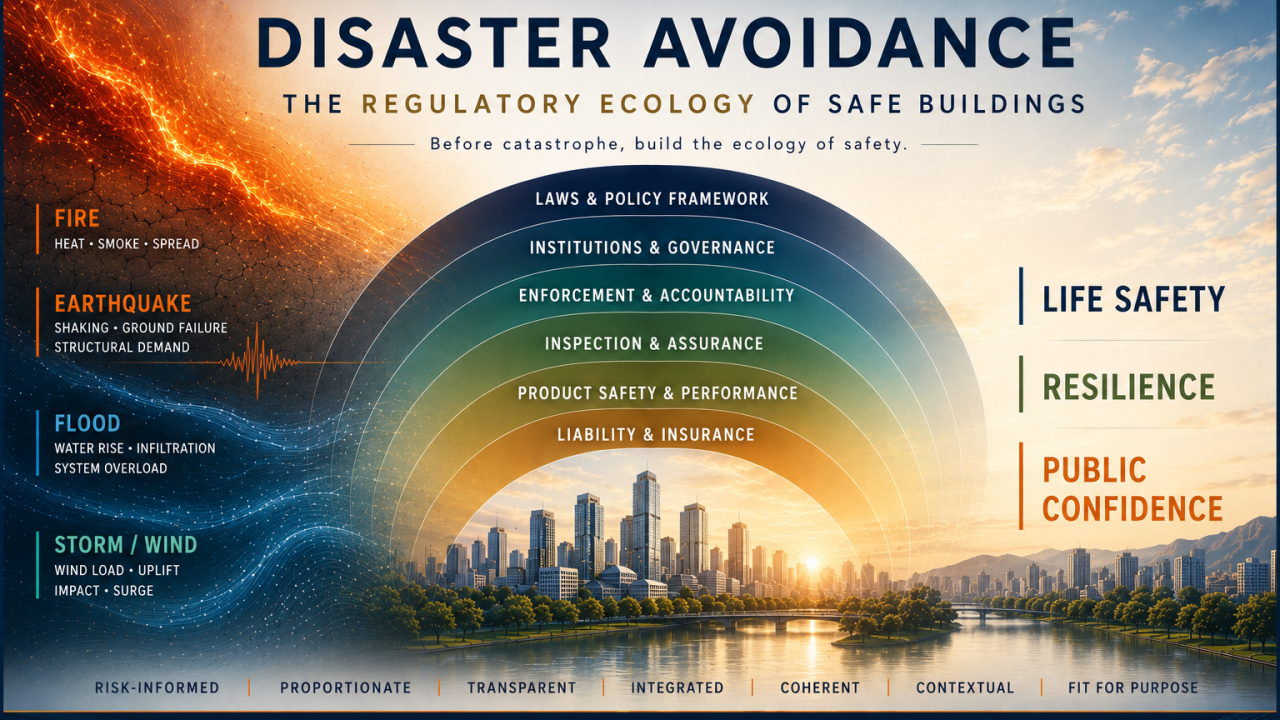
Disaster avoidance begins before disaster
Disasters do not always begin when the flames rise, the ground shakes, the floodwaters enter, or the structure fails. They often begin much earlier — in the quality of the laws, institutions, inspection systems, product controls and accountability settings that govern the built environment.
Fires, earthquakes, floods, cyclones and tempests cannot be legislated out of existence. But the scale of human loss, the spread of fire, the collapse of buildings, the failure of systems and the cost of recovery are profoundly influenced by the regulatory settings that existed before the event.
The central question is not whether regulation can eliminate every hazard. It cannot.
The better question is whether a jurisdiction has created the legal, institutional and professional conditions that reduce avoidable loss, contain collateral damage and prevent foreseeable hazards from becoming catastrophes.
That is the true purpose of building regulation.
Building regulation as life-safety infrastructure
Building regulation is often misunderstood as a technical compliance system. In truth, it is life-safety infrastructure.
It determines who may design, approve, build, inspect, certify, insure and occupy buildings. It determines whether products are fit for purpose. It determines whether practitioners are competent. It determines whether regulators have the powers, resources and independence required to intervene before risk becomes tragedy.
This is why the work of the International Building Quality Centre is directed not merely to building codes, but to the broader architecture of building regulation: governance, accountability, risk classification, inspection, enforcement, insurance, liability and dispute resolution.[1]
Natural hazards and man-made disasters
There is an important distinction between natural hazards and man-made disasters.
An earthquake is a natural hazard. A building collapse caused by poor design, weak inspection, defective construction or compromised enforcement is not purely natural.
A fire may begin accidentally. But rapid fire spread through unsafe materials, poor compartmentation, inadequate evacuation systems or regulatory failure may transform an incident into a disaster.
The Grenfell Tower fire, catastrophic nightclub fires and other catastrophic building failures remind us that some disasters are not simply events. They are system failures.
They occur when warning signs are missed, responsibilities are blurred, product controls are weak, enforcement is ineffective, and the building control architecture fails to protect those who rely upon it.
Risk-based regulation: scrutiny where failure costs lives
A mature building regulatory system does not treat every building, product, practitioner or risk in the same way.
It calibrates regulatory scrutiny according to consequence. Low-risk work should not be trapped in unnecessary bureaucracy. But high-risk buildings, complex designs, vulnerable occupancies, combustible materials, structural systems and life-safety elements require heightened oversight.[2]
Risk-based building control is not about slowing construction. It is about directing regulatory effort to where failure would have the greatest human, social and economic cost.
More speed where it is safe. More Scrutiny where it is necessary.
Product safety, cladding and systemic failure
Building product safety is central to disaster avoidance.[3]
A regulatory system that cannot control or prevent access to market of unsafe products, trace their use, identify systemic risk and compel rectification is not a complete regulatory system.
Combustible cladding failures internationally demonstrate that building safety is not secured merely by having codes. Codes must be supported by competent approval systems, product assurance, inspection discipline, enforcement powers, practitioner accountability and clear lines of responsibility.
A code without an ecology is a document. A regulatory system is what gives the code force, meaning and effect.
Existing buildings and latent risk
Disaster avoidance is not confined to new construction.
Existing buildings carry accumulated risk: ageing materials, altered uses, legacy approvals, deferred maintenance, non-compliant alterations, obsolete fire-safety systems and products that may no longer meet contemporary expectations.
A mature regulatory system must therefore address the safety of existing buildings, not merely the approval of new ones.[4]
If existing building risk is ignored, jurisdictions may inherit a silent stock of vulnerability that only becomes visible when fire, earthquake, storm or flood exposes it.
Accountability, inspection and the chain of responsibility
Disaster avoidance depends upon accountability before the disaster, not blame after it.
The chain of responsibility must be clear. Designers, builders, certifiers, regulators, product suppliers, owners and insurers all operate within an institutional framework. If the system blurs responsibility, weakens inspection or allows accountability to dissipate, risk accumulates.
Effective building regulation therefore requires:
- clear statutory duties;
- competent practitioners;
- independent inspection and certification;
- enforceable product controls;
- adequate insurance settings;
- proportionate liability architecture;
- effective dispute resolution;
- and regulators with real powers to act.
These are not administrative details. They are the architecture of public safety.
Insurance, liability and market discipline
Insurance and liability settings are not peripheral to building regulation. They are part of the risk-control system.
Where liability is unclear, insurance is unavailable, accountability is fragmented or defective work cannot be practically pursued, the market receives the wrong signals.
A sound regulatory framework aligns responsibility, risk and consequence.
It ensures that those who create risk are not insulated from it, that consumers are not left carrying catastrophic loss, and that insurers can price and support a system they can understand.
From isolated incidents to system design
After disasters, inquiries often identify familiar themes: fragmented responsibility, poor enforcement, weak product control, inadequate inspection, unclear accountability and institutional drift.
The lesson is that building failures rarely arise from one defect alone. They arise from interactions between law, institutions, culture, competence, products, markets and enforcement.
That is why the IBQC’s work has consistently focused on coherent building regulatory systems, not isolated reform measures. The IBQC Good Practice Principles for Building Regulation provide the foundation for this systems-based approach.[5]
The challenge is systemic. The solution must be systemic.
Why imported codes fail without contextualisation
Many jurisdictions adopt or adapt building codes from elsewhere. That may be useful, but it is not enough.
A building code cannot administer itself. It cannot inspect a building. It cannot discipline a practitioner. It cannot remove a dangerous product from the market. It cannot resolve disputes. It cannot insure risk. It cannot rebuild public confidence.
Nor can an imported code succeed if it is not fit for purpose in the jurisdiction in which it is deployed.
Building regulation must be contextualised to local conditions: economic capacity, institutional maturity, available professional expertise, construction typologies, enforcement resources, customary practices, informal settlement realities and the practical capacity of regulators to administer the system.[6]
This is particularly important in emerging economies, where regulatory transplantation without institutional adaptation can create paper compliance rather than real safety. The IBQC’s work on low-income countries, emerging-economy building inspection and African dispute resolution systems is directly relevant to this challenge.[7][8][9]
The question is not only: What does the code say?
The deeper question is: What local regulatory ecology makes the code work?
The Building Act as Mission Control
A well-designed Building Act is the operating system of the built environment.
It should integrate:
- building classification;
- practitioner registration;
- approval pathways;
- inspection systems;
- product safety;
- enforcement powers;
- liability settings;
- insurance requirements;
- dispute resolution;
- and regulatory oversight.
This is the purpose of the IBQC International Model Building Act, which provides a coherent legislative framework for building regulatory design.[10]
Where these elements are scattered, inconsistent or underpowered, disaster risk increases.
Where they are coherent, risk can be identified, managed and reduced before tragedy occurs.
Dispute resolution as part of disaster avoidance
Dispute resolution is often treated as an afterthought. It should not be.
Where building disputes are slow, fragmented or inaccessible, defects remain unresolved, unsafe conditions persist, and confidence deteriorates.
The IBQC’s work on construction dispute resolution in emerging economies recognises that dispute systems are part of regulatory design, not separate from it.[9]
A jurisdiction that cannot resolve building disputes efficiently cannot properly manage building risk.
Conclusion: regulation as disaster avoidance
The central task of building regulation is not merely to approve buildings.
It is to create the conditions in which buildings are designed, constructed, inspected, insured, maintained and occupied with an acceptable level of risk.
A mature regulatory ecology cannot eliminate every hazard. But it can reduce avoidable loss, prevent foreseeable failures, contain collateral damage and ensure that natural events do not become regulatory catastrophes.
For governments, development agencies, regulators and law reformers, the lesson is clear: building safety cannot be secured by codes alone. It requires institutions, accountability, inspection, enforcement, insurance, liability settings and dispute resolution operating as one coherent system.
For jurisdictions exposed to fire, flood, earthquake, cyclone or rapid urbanisation, the imperative is clear: do not wait for catastrophe to reveal regulatory weakness. Build the ecology of safety before the next event occurs.
This is the real measure of building law reform.
Not paperwork.
Not red tape.
Life safety, resilience and public confidence.
The jurisdictions that understand this will not merely regulate buildings.
They will protect communities.
Legal disclaimer
This article is published for general informational and thought-leadership purposes only. It does not constitute legal advice, regulatory advice, policy advice or professional advice, and should not be relied upon as a substitute for obtaining advice specific to particular circumstances. The views expressed are general in nature and are directed to issues of building regulatory design, public safety and institutional reform at a systemic level.
Author bio
Prof (Adj/conjt) Kim Lovegrove Doctorate Litt (honouris causa) FRSN. is Chair of the International Building Quality Centre, founder of Lovegrove & Cotton.
He has spent more than four decades at the intersection of construction law, regulatory design and law reform, including as principal legal adviser on the development of the Building Act 1993 (Vic) and project director of the National Model Building Act. He was also a key architect behind the IBQC International Model Building Act, a contemporary model statute developed to assist jurisdictions in designing coherent, risk-based and integrated building regulatory systems.
More recently, Kim has advised on building law reform settings in New Zealand, including work connected with MBIE’s proportionate liability reform program. Through Lovegrove & Cotton, he continues to advise on complex construction law, building regulation, liability and regulatory compliance matters across Australia and New Zealand.
Footnote table
[1]International Building Quality Centre[2]IBQC Risk-Based Building Classification and Inspection Guidelines[3]IBQC Good Practice Regulatory Framework for Building Product Performance — Part 2[4]IBQC Good Practice Guidelines for Existing Buildings[5]IBQC Good Practice Principles for Building Regulation[6]IBQC Guidelines page[7]IBQC Good Practice Guidelines for Low-Income Countries[8]IBQC Good Practice Building Inspector Guidelines for Emerging Economies[9]IBQC Guidelines for Developing Construction Dispute Resolution Systems in Emerging Economies in Africa[10]IBQC International Model Building Act[11]Lovegrove & Cotton[12]Building Act 1993 (Vic)
Infographic Prepared by KNL with drafting and design assistance from ChatGPT.
