
Unexpected Site Conditions: Who Pays When Ground Conditions Differ?
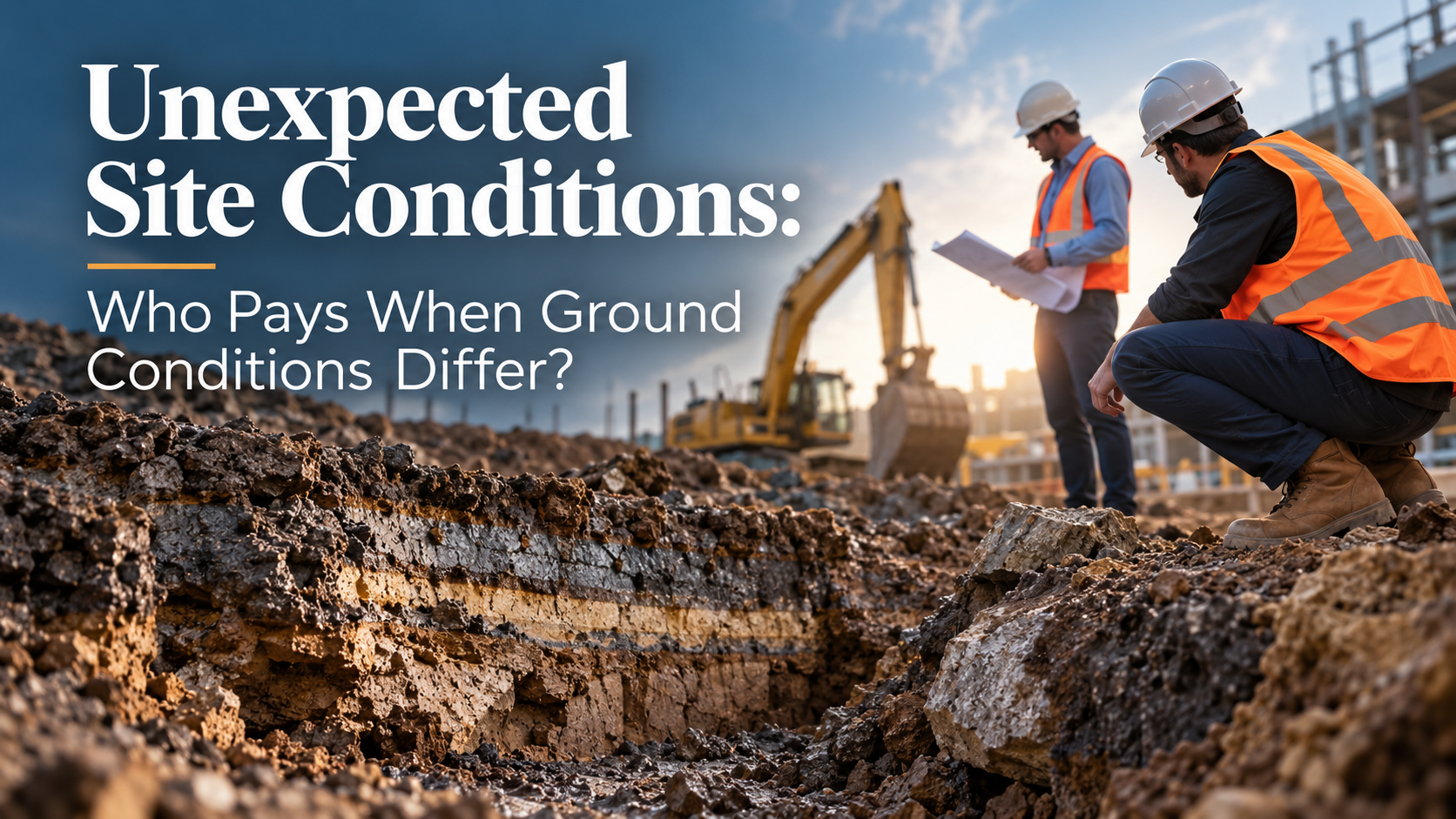
Unexpected ground conditions can create significant difficulties for building contractors. This is particularly so on larger commercial projects, where conditions beneath the surface may differ substantially from those anticipated when the contract was priced and signed.
Whether a contractor can recover the resulting additional costs depends on the allocation of risk under the contract, the information provided before the agreement was made, and any applicable statutory obligations.
The traditional approach to site conditions
Historically, the courts have offered contractors limited relief when the ground beneath a building site proves different from what they expected.
In Dillingham Constructions Pty Ltd v Downs [1972] NSWLR 49, Justice Hardie expressed the view that a party contracting to perform building work on or beneath land must satisfy themselves about the nature and characteristics of that land, both above and below the surface.
Contractors have therefore traditionally faced difficulties claiming damages against a principal where the contract requires them to undertake their own inquiries into site conditions, levels and dimensions. Those inquiries may extend to subsoil conditions identified through geotechnical reports or foundations data, whether obtained by the contractor or supplied to them.
This approach has a long history. In Pakenham v Board of Land and Works (1874) 5 AJR 37 at 38, the Court stated:
“We think that the statement [in the contract] that ‘the contactor is to satisfy himself as to the correctness of the levels and dimensions’ sufficiently indicate (sic) the intention of the parties that each was to take his own risk of the accuracy or inaccuracy of the plans.”
The wording of the contract is consequently central to determining who bears the financial consequences of unexpected site conditions.
Representations made before the contract
The development of the law of negligent misstatement has provided a possible avenue of recovery for contractors who encounter conditions different from those represented before entering into a contract.
In some circumstances, damages may be available where a party was induced to enter an agreement by relying on representations made beforehand, including information contained in plans or other site documents.
However, negligent misstatement should not be regarded as a dependable general remedy for unexpected ground conditions. The availability of a claim depends on the particular representations, the circumstances of reliance and the relevant contractual terms.
The importance of latent conditions clauses
Many standard form contracts used for commercial building work in Australia contain a latent conditions clause. Such clauses can provide a contractual mechanism for claiming an adjustment to the contract price where the relevant requirements are met.
A contractor’s entitlement will depend on the wording of the clause and compliance with the prescribed procedure. Identifying an unexpected condition does not, by itself, establish a right to additional payment.
Contractors should therefore examine and follow the contractual process carefully. Where a latent conditions mechanism is available, using it is generally a more reliable starting point than relying solely on a common law claim.
Foundations data in Victorian domestic building work
In Victoria, section 30 of the Domestic Building Contracts Act 1995 imposes a specific obligation concerning foundations data.
The section applies where proposed work under a major domestic building contract requires the construction or alteration of a building’s footings, or may adversely affect those footings. In those circumstances, the builder must obtain foundations data for the site before entering into the contract. A penalty applies for failing to comply.
Foundations data includes the information a builder exercising reasonable care and skill would need to prepare a proper footings design and an adequate estimate of the cost of constructing those footings. It also encompasses reports, surveys, test results, plans, specifications, computations and other information required by the regulations.
The obligation does not necessarily require a builder to commission new investigations in every case. Section 30 allows reliance on existing foundations data to the extent that the data already exists and it is reasonable for the builder to rely on it.
For example, an owner may have obtained a geotechnical or soil report and provided it to the builder. The relevant question remains whether it is reasonable for the builder to rely on that information for the proposed work.
Understanding the risk before a dispute arises
Unexpected site conditions can raise difficult questions about who bears the risk and whether a contractor is entitled to additional payment. Contractors should understand their obligations to investigate the site, assess the information available before entering into the contract, and follow any applicable contractual procedures when unexpected conditions are encountered.
If you need advice about your rights and responsibilities in this area, or are involved in a building dispute, seek prompt legal advice.
Lovegrove & Cotton — Construction and Planning Lawyers
Established in 1993, Lovegrove & Cotton advises and represents builders, building surveyors and other building practitioners in construction disputes and regulatory matters, including matters in Victoria, New South Wales, Queensland and the Australian Capital Territory.
This article was settled by Tsigereda Lovegrove
For assistance with a building dispute or advice about your contractual obligations, feel free to contact us via our website Lovegrove & Cotton’s website or email enquiries@lclawyers.com.au.
Disclaimer: This article provides general information only and does not constitute legal advice. Seek advice specific to your circumstances.
Image Acknowledgements:
The digital renders used in this article were developed collaboratively by Lovegrove & Cotton and ChatGPT
Latent Conditions, Building Work and Legal Liability
