
Why Water Ingress Has Become One of Australia’s Most Significant Building Defect Problems
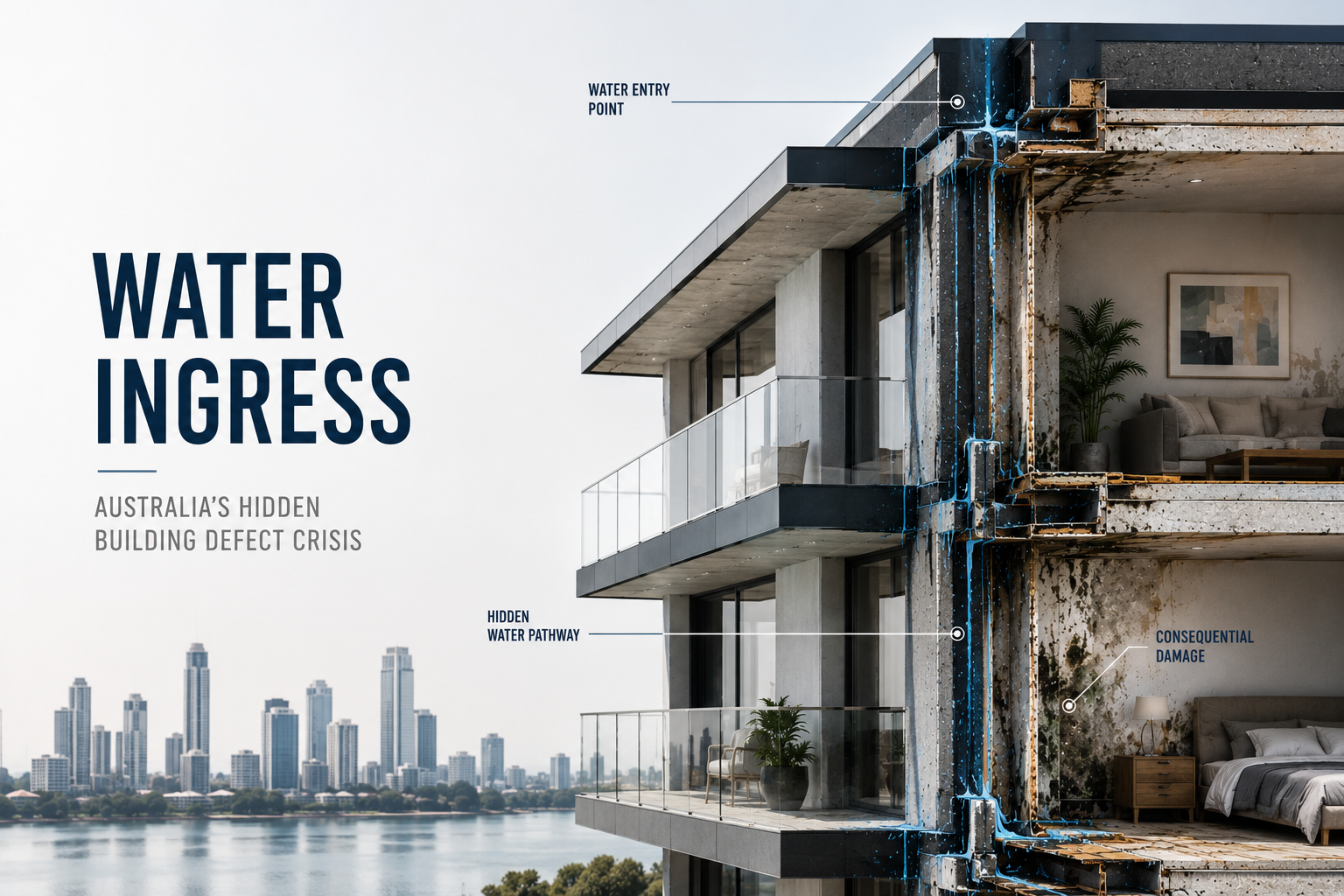
Water ingress has become one of the most common causes of apartment and strata disputes in Australia.
Whether the issue arises from defective waterproofing, failed balconies, façade defects, roofing failures, defective flashing systems or common property defects, water ingress can give rise to complex legal issues involving construction law, owners corporation law, insurance law, nuisance, negligence and building defect litigation.
At Lovegrove & Cotton Construction and Planning Lawyers, we have acted in numerous matters involving water penetration, building envelope failures, waterproofing defects, apartment water damage claims and consequential mould contamination. These matters frequently involve substantial rectification costs, multiple potentially liable parties and complex legal and technical issues.
Water ingress legal representation in Australia frequently involves apartment water damage claims, building defect litigation, owners corporation disputes, insurance recovery proceedings and nuisance claims. Because these disputes often involve significant rectification costs and multiple potentially liable parties, obtaining timely legal and technical advice is critical.
For apartment owners, owners corporations, developers and building practitioners alike, understanding the legal framework governing water ingress is essential.
What Is Water Ingress?
Water ingress occurs when water enters a building through defects in the building envelope or associated building systems.
Common causes include:
- Defective waterproofing membranes;
- Balcony failures;
- Roof defects;
- Window and door penetrations;
- Inadequate flashing;
- Defective cladding systems;
- Building movement;
- Cracked façades;
- Defective drainage systems;
- Service penetrations.
Water ingress may initially appear minor. However, over time it can cause significant damage to both the building structure and internal finishes.
Common consequences include:
- Structural deterioration;
- Corrosion of steel components;
- Timber decay;
- Damage to plasterboard and finishes;
- Mould growth;
- Reduced property values;
- Health and amenity concerns.
In many instances, the visible leak is merely a symptom of a broader underlying defect.
What Laws Apply to Water Ingress Claims in Australia?
A common question asked by apartment owners and owners corporations is:
“What law applies to water ingress disputes?”
The answer is often that several legal regimes may apply simultaneously.
Australia’s building regulatory framework operates very much like eight different countries, with each State and Territory maintaining its own legislative and regulatory regime. Accordingly, careful regard must always be had to the legislation applicable in the relevant jurisdiction.
Depending upon the circumstances, a water ingress dispute may involve:
- Building legislation;
- Domestic building legislation;
- Owners corporation legislation;
- Contract law;
- Negligence law;
- Insurance law;
- Consumer protection legislation;
- Statutory warranty regimes;
- The law of nuisance;
- Water legislation and statutory rights relating to drainage, stormwater and water management;
- Limitation legislation.
In Victoria, disputes may also involve rights and obligations arising under the Building Act, the Owners Corporations Act, the Water Act and domestic building legislation.
Depending on the facts, these may include:
- Breach of statutory warranties;
- Breach of contract;
- Negligence;
- Private nuisance;
- Misrepresentation;
- Consumer law claims;
- Owners corporation proceedings;
- Building Act causes of action;
- Insurance claims and recovery actions.
Accordingly, water ingress litigation often requires expertise across multiple areas of law.
Why Water Ingress Cases Are Often Complex
Water ingress disputes are rarely straightforward.
The location where water becomes visible is frequently not the location where the defect originates.
The cause may involve one or more of the following:
- Design deficiencies;
- Construction defects;
- Product failures;
- Inadequate inspections;
- Building envelope failures;
- Poor workmanship;
- Maintenance issues;
- Subsequent alterations.
Potentially responsible parties may include:
- Builders;
- Developers;
- Architects;
- Engineers;
- Building surveyors;
- Waterproofing contractors;
- Façade consultants;
- Product suppliers.
Determining causation and liability commonly requires detailed expert investigation.
What Legal Claims Can Arise from Water Ingress?
Water ingress disputes may give rise to a variety of legal causes of action.
Depending on the facts, these may include:
- Breach of statutory warranties;
- Breach of contract;
- Negligence;
- Private nuisance;
- Misrepresentation;
- Consumer law claims;
- Owners corporation proceedings;
- Building Act causes of action;
- Insurance claims and recovery actions.
Frequently, multiple causes of action arise from the same defect.
Each matter requires careful legal and technical assessment.
Can Water Ingress Give Rise to a Nuisance Claim?
Yes.
Water ingress disputes are not always confined to building defect law.
In some circumstances, persistent water penetration may constitute a nuisance where it substantially interferes with another person’s use and enjoyment of property.
Examples may include:
- Recurring water penetration into neighbouring lots;
- Overflow from defective balconies or terraces;
- Defective drainage systems;
- Water migration from common property into private lots;
- Long-term moisture intrusion resulting in mould or habitability issues.
Whether a nuisance claim is available will depend upon the particular facts and applicable legal principles.
Water Damage Claims: More Than Just a Building Defect
Many owners assume that water ingress claims are purely construction disputes.
In reality, water ingress frequently generates a range of interconnected legal issues.
These may include:
- Property damage claims;
- Loss of rent claims;
- Consequential loss claims;
- Owners corporation disputes;
- Insurance claims;
- Professional negligence claims;
- Mould-related personal injury, compensation and damages claims;
- Regulatory compliance issues.
A single leak may ultimately involve multiple parties, experts, insurers and legal proceedings.
The Role of Insurance in Water Ingress Claims
Insurance is often a critical aspect of water ingress disputes.
Relevant insurance policies may include:
- Owners corporation insurance;
- Building insurance;
- Domestic building warranty insurance;
- Professional indemnity insurance;
- Public liability insurance;
- Contractor insurance policies.
One of the first issues that should be investigated is whether there is insurance available that may respond to some or all of the loss.
In some matters, insurers may fund remediation works.
In others, insurers may pursue recovery actions against parties responsible for defective construction or design.
The interaction between construction law and insurance law can be highly complex and often requires specialist legal advice.
The New Zealand Leaky Building Crisis: Lessons for Australia
Although Australia has not experienced a crisis on the scale of New Zealand’s leaky building disaster, the New Zealand experience remains highly instructive.
The crisis demonstrated the potentially catastrophic consequences that can arise where water ingress becomes widespread across residential building stock.
The lessons arising from New Zealand continue to underscore the importance of:
- Effective building regulation;
- Competent design and construction;
- Adequate inspection regimes;
- Proper waterproofing systems;
- Timely remediation of defects.
Common Property or Private Property?
One of the first issues requiring investigation is whether the defect affects common property, private lots or both.
This issue may significantly affect:
- Who is responsible for repairs;
- Who may commence legal proceedings;
- Who may recover damages;
- How rectification costs are allocated.
In many apartment developments, water ingress affects both common property and multiple lots simultaneously.
Owners corporations frequently play a central role in these disputes.
The Importance of Early Expert Investigation
One of the most common mistakes made by owners is delaying investigation.
Water ingress rarely resolves itself.
Delay often results in:
- Escalating damage;
- Increased rectification costs;
- Loss of evidence;
- Insurance complications;
- Limitation period risks.
Early engagement of appropriately qualified building consultants, engineers and legal advisers can significantly improve prospects of a successful outcome.
Mould: The Hidden Consequence of Water Ingress
Water ingress frequently creates ideal conditions for mould growth.
Mould may affect:
- Internal finishes;
- Building materials;
- Indoor air quality;
- Occupant wellbeing.
In severe cases, mould remediation costs may rival the cost of rectifying the original water ingress defect.
Accordingly, any investigation should consider both the source of water entry and any consequential damage.
Can Owners Recover Their Losses?
Potential remedies depend upon the circumstances of each case.
Claims may arise under:
- Building contracts;
- Statutory warranties;
- Negligence principles;
- Consumer protection legislation;
- Owners corporation legislation;
- Building legislation;
- Insurance policies.
The availability of recovery will depend upon factors including:
- The nature of the defect;
- The age of the building;
- Applicable limitation periods;
- Available evidence;
- The parties involved;
- Insurance responses.
- Statutory causes of action under laws governing the flow of water.
Every matter requires careful assessment on its own facts.
Choosing Lawyers Experienced in Water Ingress Litigation
Water ingress litigation sits at the intersection of construction law, building regulation, owners corporation law, insurance law and dispute resolution.
Successful outcomes often require a legal team that understands:
- Building science;
- Waterproofing systems;
- Building regulation;
- Expert evidence;
- Insurance law;
- Owners corporation law;
- Construction litigation;
- Alternative dispute resolution.
For more than three decades, Lovegrove & Cotton Construction and Planning Lawyers has acted in building defect, water ingress and regulatory matters involving apartment owners, owners corporations, developers, consultants and building practitioners.
The firm’s experience extends to complex apartment disputes, building defect litigation, water ingress claims, regulatory compliance matters and major construction disputes.
Conclusion
Water ingress is rarely a simple maintenance issue.
More often, it is the manifestation of deeper design, construction, product, regulatory or maintenance failures.
The earlier the problem is identified and investigated, the greater the prospects of preserving legal rights and mitigating loss.
For apartment owners, owners corporations, developers and property investors, understanding the legal and technical dimensions of water ingress is essential.
As Australia’s apartment stock continues to age and evolve, water ingress disputes are likely to remain one of the most significant areas of construction and property litigation.
Author Bio
Justin Cotton is a Director of Lovegrove & Cotton Construction and Planning Lawyers and has more than two decades of experience in construction law, building regulation and dispute resolution. He advises owners corporations, developers, building practitioners, consultants and property owners on building defect disputes, regulatory compliance matters and complex construction litigation. Justin has acted in numerous water ingress, waterproofing and building defect matters involving apartment developments and multi-unit residential projects in Australia. He is admitted to practise in both Australia and New Zealand and regularly advises on complex construction, regulatory and building defect matters in Australia.
Disclaimer
The information provided in this article is for general informational purposes only and does not constitute legal advice. Readers should not act or refrain from acting on the basis of this article without obtaining legal advice tailored to their specific circumstances. The views expressed are those of the author and do not necessarily reflect the views of any organisation with which the author is affiliated.
Image Acknowledgements:
The digital renders used in this article were developed collaboratively by Lovegrove & Cotton and ChatGPT.
