
Housing Affordability and the Missing Regulatory Equation
Why Housing Affordability Is Not Just a Planning Problem
Housing affordability is traditionally framed as a debate over land supply, zoning, interest rates, taxation, and construction costs. Each of these levers matters. However, they do not tell the whole story.
A less visible, but highly consequential, factor is the health of the building regulatory system itself. The quality of a nation’s building control system, building code, Building Act, practitioner accountability framework, building approval pathways, and dispute resolution architecture can materially influence housing affordability outcomes.
Where regulation is not holistic, properly resourced, or calibrated to the real balance of risk, it becomes an invisible bottleneck. If the building code, approval pathways, inspection regimes, liability settings, and enforcement architecture are not properly aligned, the system delays supply, increases risk, and undermines market confidence. Ultimately, those systemic friction costs are passed on to purchasers, renters, insurers, and developers.
“The point is not that regulation is the enemy of affordability. Quite the opposite. Good regulation is an affordability enabler; poor regulation is an affordability ‘tax’.”
The “Red Tape” Fallacy: Symmetrical Control vs. Bureaucracy
Critics and free marketeers frequently argue that in a supply crisis, the fastest way to lower prices is to slash red tape, compress approval timelines, and reduce government oversight. This is a false economy that confuses the volume of regulation with its quality.
The objective should never be less regulation; it must be better regulation. This means a system that is clear, proportionate, professionally administered, and capable of delivering safe, durable, and insurable buildings.
A weak regulatory system may appear cheaper and faster at the front end, but those savings can be illusory. The cost is simply transferred downstream to the consumer through structural defects, water ingress, costly rectification works, construction disputes, insurance stress, and a loss of public confidence.
“Cutting compliance rules to speed up housing targets is a dangerous shortcut. It doesn’t create affordability; it creates a deferred liability for the next generation of homebuyers.”
The Power of Risk-Based Control: Speeding Up Low-Risk Builds
A common pushback from some builders is that robust regulatory frameworks slow down construction pipelines. This occurs only when a system is clumsy and uncalibrated.
A mature, modern building regulatory system does not treat every building or risk the same way. As championed by the International Building Quality Centre (IBQC), a sophisticated model classifies buildings according to risk.
It establishes fast-tracked, lighter-touch approval and inspection pathways for genuinely low-risk, routine housing, while dynamically shifting more intensive scrutiny to complex, high-risk buildings.
Far from slowing down the market, a risk-based framework actively accelerates safe housing supply by eliminating the administrative bottlenecks that choke standard developments.
“We do not have to choose between construction speed and building safety. A risk-based regulatory system fast-tracks simple housing while increasing oversight for higher-risk buildings — delivering speed where it is safe, and mandated high-level scrutiny where it is needed.”
Consolidating the Operating System: The Building Act
Opponents of regulatory reform often worry that establishing a complete regulatory architecture will simply spawn more confusing bureaucratic agencies.
In reality, the goal of a well-designed Building Act is the exact opposite: radical simplification.
A comprehensive Building Act operates as a streamlined operating system for the built environment. It consolidates fragmented responsibilities, clearly defines practitioner accountability, integrates building approval pathways, mandates appropriate insurance settings, and establishes efficient dispute resolution mechanisms.
When these elements are integrated rather than piecemeal, they strip away overlapping agency confusion that costs developers, consumers, and governments both time and money.
This holistic approach underpins the IBQC International Model Building Act.
“Friction in the housing market doesn’t come from having rules; it comes from having fragmented and non-fit-for-purpose rules. A unified Building Act, regulations, and code pyramid replace regulatory convolution with clarity.”
Durability Is the True Measure of Affordability
A home is not affordable simply because it was cheap to approve or fast to construct.
A property that later suffers from severe structural defects, water ingress, combustible cladding problems, building product failures, or uninsured losses can become a significant financial burden.
True housing affordability cannot be calculated solely at the point of sale. It must be measured across the entire life cycle of the asset.
Durability, safety, insurability, and regulatory compliance are non-negotiable components of an affordable home. Securing those outcomes requires a resilient and fit-for-purpose building regulatory framework.
“A home riddled with systemic defects is not affordable housing. Shifting construction risks downstream onto everyday buyers does not solve a housing crisis — it simply rebrands it as a consumer crisis.”
Conclusion: A Foundations-First Approach
Governments seeking to solve the housing crisis must resist the temptation to frame regulation as the obstacle.
The critical question policymakers should ask is this:
What type of regulatory system enables safe, timely, affordable, durable, and insurable housing supply?
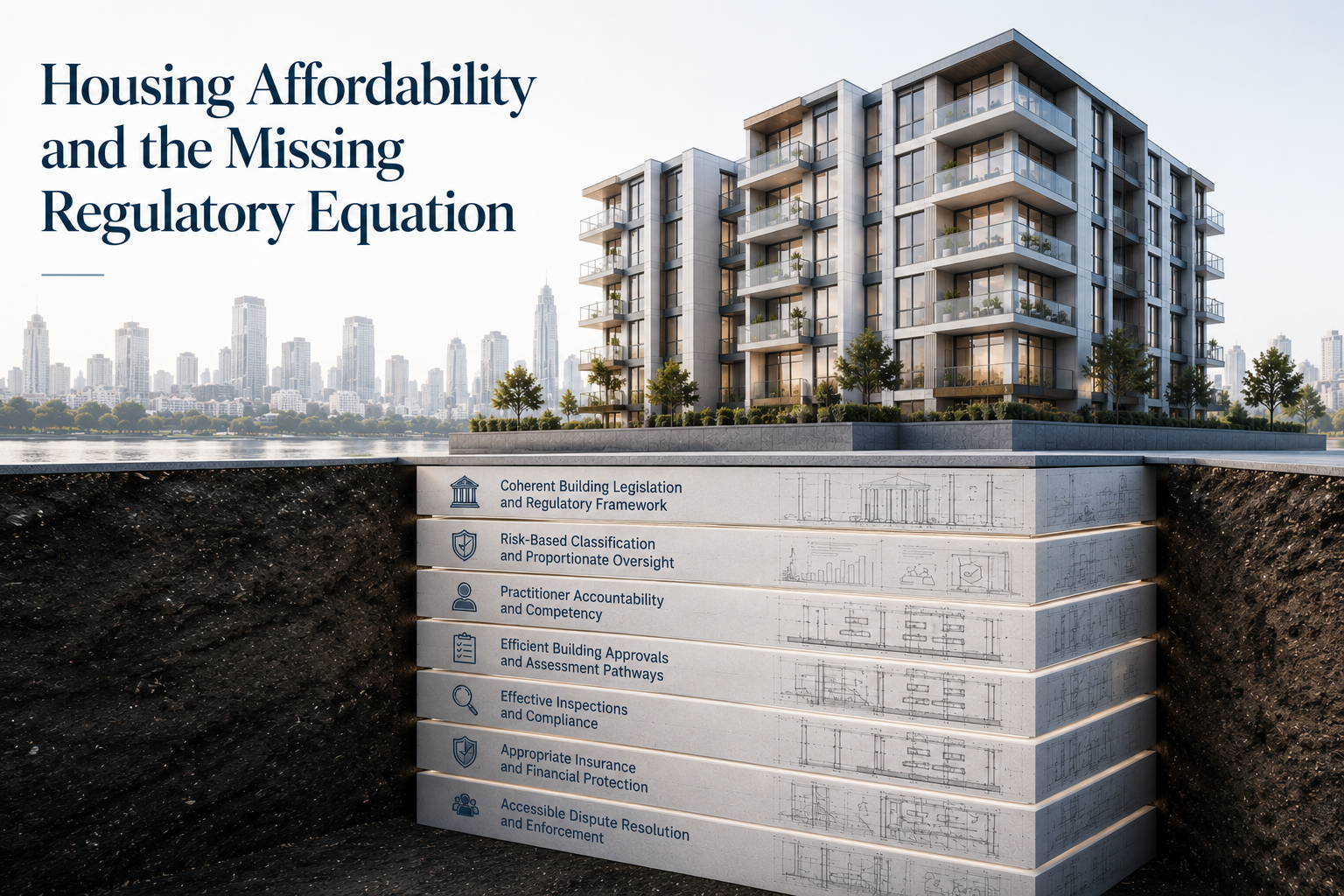
The answer lies in coherent legislation, risk-based building classification, accountable practitioners, effective building approval systems, robust building compliance mechanisms, reliable inspection regimes, appropriate insurance settings, and efficient construction dispute resolution frameworks.
These are principles championed by the International Building Quality Centre (IBQC) through its international good-practice guidelines and model legislative frameworks.
Drawing upon decades of experience in construction law, building regulation, regulatory compliance, dispute resolution, liability reform, and building control, Lovegrove & Cotton Construction and Planning Lawyers has observed firsthand the economic consequences that flow from fragmented regulatory systems, poorly calibrated approval frameworks, and inadequate accountability settings.
Housing affordability will not be solved by building regulation alone.
But it will never be solved without it.
Building regulation is not peripheral to the housing crisis; it is one of its foundations.
That is not red tape.
That is good governance.
Author Bio
Adjunct Professor Kim Lovegrove DLitt (honoris causa), MSE, RML is Chair of the International Building Quality Centre (IBQC) and founder of Lovegrove & Cotton Construction and Planning Lawyers.
He has spent more than four decades at the intersection of construction law, building regulation, regulatory design, and law reform, including serving as the principal legal adviser on the development of the Building Act 1993 (Vic) and as Project Director of the Australian National Model Building Act.
He was also a key architect of the IBQC International Model Building Act, a contemporary model statute developed to assist jurisdictions in designing coherent, risk-based, and integrated building regulatory systems.
The IBQC is an international thought-leadership coalition dedicated to advancing global best-practice building regulation, building control, dispute resolution, building safety, and practitioner accountability frameworks.
More recently, Kim has advised on building law reform settings in New Zealand, including work connected with MBIE’s proportionate liability reform programme. Through Lovegrove & Cotton, he continues to advise on complex construction law, building regulation, liability, building control, and regulatory compliance matters across Australia and New Zealand.
Legal Disclaimer
This article is published for general informational purposes only. It does not constitute legal advice, regulatory advice, policy advice, or professional advice and should not be relied upon as a substitute for obtaining advice specific to particular circumstances. The views expressed are general in nature and are directed to issues of building regulatory design, building control, and housing policy at a systemic level.
Image Acknowledgements:
The digital renders used in this article were developed collaboratively by Lovegrove & Cotton and ChatGPT.
