The Building Appeals Board (‘BAB’) of Victoria is an independent specialist merits review tribunal established under Part 10 of the Building Act 1993 (Vic) (‘the Act’).
The BAB is responsible for determining certain disputes, appeals and applications arising under the building control framework in Victoria. It plays an important regulatory role by providing a specialist avenue of review for decisions made under the Act and the Building Regulations.
The Board therefore functions as a specialist forum for resolving building control disputes, reviewing decisions made by statutory authorities, determining applications for regulatory modification, and resolving certain disputes between parties involved in building works.
Within Victoria’s building regulatory framework, decisions concerning building permits, compliance and regulatory determinations frequently involve the interpretation and application of the National Construction Code, making the availability of a technically specialised merits review body particularly important.
Unlike the courts, which are confined primarily to questions of law, the BAB conducts merits review and may reconsider the substance of the decision under challenge.
The Board is a specialist expert tribunal. Panels are made up of professionals amongst the building industry, who are selected upon the nature of the matter and the expertise required.[1] Typically, up to three members preside over a hearing.
Because of its specialist composition and procedures, the BAB is generally regarded as a more streamlined and less formal forum than the courts for resolving technical building control issues.
Legal representation is not mandatory, although parties frequently engage construction lawyers given the statutory and technical issues that may arise. In the view of the present authors, legal representation is often advisable. The Building Act 1993 has become a substantial and technically complex statute. In recent years, legal representation has become increasingly common in contested BAB matters.
Justin Cotton has nearly two decades of experience appearing before the BAB and advises that practitioners should not underestimate the rigour required for effective advocacy in this jurisdiction.
This article outlines the types of matters that fall within the jurisdiction of the Building Appeals Board.
Historical Context and Institutional Continuity
The Building Appeals Board is not a recent creation. Specialist building appeal mechanisms have existed in Victoria for several decades. The Board operated under the Building Control Act 1981 (Victoria) and was continued under the Building Act 1993 (Victoria) when that statute modernised Victoria’s building regulatory framework.
As a result, the BAB benefits from a long institutional lineage within Victoria’s building control system.
The longevity of the BAB has contributed to the development of a well-established specialist jurisdiction dealing with technical building control issues. Its continued operation reflects a longstanding policy decision in Victoria that regulatory building control disputes are best determined by a specialist tribunal with technical expertise in the building industry.
In international law reform work concerning building regulation and dispute resolution systems, Professor Kim Lovegrove has frequently cited the Victorian Building Appeals Board as an example of a specialist merits review mechanism that can contribute to effective regulatory oversight in building control systems. Specialist tribunals staffed by technically qualified members are widely regarded as good practice in the design of modern building regulatory frameworks.
Review of Decisions by Statutory Authorities
Part 10 Division 1 of the Building Act 1993 establishes the right to apply to the BAB for review of certain decisions made by statutory authorities under the Act.
These review rights ensure that parties affected by decisions made under the building regulatory regime have access to an independent merits review process.
Review of Decisions Concerning Building and Occupancy Permits
Section 138 provides that appeals may be brought to the BAB by either owners or purchasers of land[2] or reporting authorities[3] in relation to certain decisions concerning building permits and occupancy permits.
These review mechanisms are typically engaged during the pre-occupation stage of development.
Under s 138(1), an appeal may be brought against a decision to:
- refuse a building permit
- impose conditions on a permit
- amend or cancel a permit
- refuse an application to amend or cancel a permit
- fail to make a decision to amend or cancel a permit within a reasonable time.[4]
The BAB therefore has jurisdiction to review many decisions made by private building surveyors or municipal building surveyors in relation to building permits.
Subsection (2) also addresses situations where a reporting authority or building surveyor requires further information or amendments to permit documentation.
Reviews of Directions to Fix Building Work
Under Division 2 of Part 4 of the Act, a relevant building surveyor may issue a direction to fix building work where work does not comply with the Act, the Regulations or the National Construction Code.
A direction to fix may be reviewed by the BAB pursuant to s 138A of the Act.
Reviews Concerning Termination of Building Surveyor Functions
Section 140 of the Act provides a review pathway where the regulator refuses or fails to approve the termination of the appointment of a private building surveyor.
Following reforms to Victoria’s building regulatory framework, regulatory oversight is now exercised by the Building and Plumbing Commission, which replaced the Victorian Building Authority as the principal building regulator in Victoria.
Protection Works Appeals
A significant portion of BAB matters concerns protection works disputes under Part 7 of the Act.
These disputes may arise where building works have the potential to affect adjoining properties.
Under s 141, appeals may be brought by either:
- the owner undertaking the works; or
- the adjoining owner.
Protection works disputes are among the most common matters heard by the BAB.
Building Notices, Building Orders and Emergency Orders
Another common form of BAB proceeding concerns the review of building notices and building orders issued by a relevant building surveyor or municipal building surveyor.[5]
Emergency orders issued by municipal building surveyors may also be subject to review.
Building Regulation Appeals
Section 144 of the Act provides that where the Building Regulations confer discretion on a person or body to make a determination, an owner may appeal that determination to the BAB.
Examples include:
- projections beyond street alignment[6]
- construction within flood-prone areas[7]
- construction over easements requiring consent from a service authority.[8]
BAB versus VCAT – Choosing the Correct Forum
Practitioners and industry participants sometimes confuse the jurisdiction of the Building Appeals Board with that of the Victorian Civil and Administrative Tribunal (VCAT).
The BAB is a specialist statutory merits review tribunal established under Part 10 of the Building Act 1993. Its primary role is to review regulatory decisions made under the building control framework.
VCAT, by contrast, is a broad civil tribunal that resolves disputes between parties.
BAB matters commonly include:
- appeals concerning building permits
- directions to fix
- building notices and building orders
- protection works disputes
- regulatory modification applications
- building design compliance determinations.
VCAT matters commonly include:
- domestic building disputes
- contractual disputes between owners and builders
- claims for damages arising from defective work
- owners corporation (OC) disputes
- consumer disputes arising from building work.
Correctly identifying the appropriate forum at the outset is important, as commencing proceedings in the wrong jurisdiction can lead to delay and unnecessary cost.
Appeals Generally
BAB appeals are conducted “in the nature of a re-hearing.”
This means the Board may effectively step into the shoes of the original decision-maker.
Importantly, under s 146 of the Act, a decision that is subject to appeal does not take effect until the appeal period expires or the appeal is determined.[9]
The Act also provides a fast-track procedure under s 147.
Dispute Resolution at the BAB
In addition to appeals, the BAB also has jurisdiction to resolve certain statutory disputes between parties.
These disputes are outlined in Part 10 Division 3 and include:
- disputes between owners and building surveyors concerning inspection powers[10]
- disputes between owners and adjoining owners concerning emergency protection works[11]
- disputes concerning protection works insurance cover[12]
- disputes concerning dilapidation reports[13]
- disputes concerning the cost of supervision of protection works[14]
- disputes concerning building permit levy calculations[15]
- disputes concerning the application of building regulations[16]
- disputes concerning party walls.[17]
Determinations that May be Made by the BAB
The BAB may also determine matters including:
- compensation for adjoining owners[18]
- modification of building regulations[19]
- modification of disability access requirements[20]
- building design compliance determinations.[21]
Orders the BAB May Make
Section 161 of the Act provides that the BAB may make any order it considers appropriate in the circumstances.
Appeals from the BAB
A determination of the BAB is final on the merits.
However, decisions may be subject to judicial review by the Supreme Court of Victoria on a question of law.
Conclusion
The Building Appeals Board plays an important role within Victoria’s building regulatory system.
It provides a specialist and technically informed forum for resolving building control disputes and reviewing decisions made under the Building Act 1993 and the Building Regulations.
Although the jurisdiction is sometimes described as less formal than the courts, significant interests are often at stake and the preparation required for BAB proceedings should not be underestimated.
Levent Karaca reinforces Justin Cotton’s observation that strong technical evidence and expert analysis are often central to BAB proceedings, particularly in matters involving engineering, fire safety and compliance with the National Construction Code.
Author Biographies
Justin Cotton
Justin Cotton is a principal of Lovegrove & Cotton Construction & Planning Lawyers, a Melbourne law firm who have been experts in construction and planning law since 1993. He is also Chair of HIA Industrial Relations & Legal Services Committee.
Justin has more than two decades of experience in construction law and building regulatory matters. He regularly advises builders, developers, building surveyors and property owners on building disputes, regulatory compliance and risk management. He has extensive experience appearing before the Building Appeals Board, VCAT and the courts.
Levent Karaca
Levent Karaca is a construction lawyer at Lovegrove & Cotton Construction & Planning Lawyers. His practice focuses on building disputes, regulatory compliance matters and litigation arising under Victorian building legislation.
Levent has experience assisting in proceedings before the Building Appeals Board, VCAT and the courts, including preparation of pleadings, legal submissions and expert evidence in building defect disputes.
Author’s Note
This article is a revised and expanded edition of an earlier article titled “A User’s Guide to the Building Appeals Board”, originally published by Lovegrove & Cotton Construction & Planning Lawyers on 29 October 2024.
Footnotes
[1] Building Appeals Board, About Us.
[2] Building Act 1993 (Vic), s 138(4).
[3] Ibid, s 138(5).
[4] Building Act 1993 (Vic), s 138(1).
[5] Building Act 1993 (Vic), s 142.
[6] Building Regulations 2018 (Vic), reg 109.
[7] Ibid, reg 153.
[8] Ibid, reg 130.
[9] Building Act 1993 (Vic), s 146.
[10] Ibid, s 150.
[11] Ibid, s 151.
[12] Ibid, s 152.
[13] Ibid, s 153.
[14] Ibid, s 154.
[15] Ibid, s 156.
[16] Ibid, s 157.
[17] Ibid, s 158.
[18] Ibid, s 159.
[19] Ibid, s 160.
[20] Ibid, s 160B.
[21] Ibid, s 160A.
Disclaimer
This article is intended to be for general information purposes only and should not be relied on as legal advice. For expert construction law guidance for your own individual circumstances, don’t hesitate to contact experienced construction lawyers to assist you with dispute resolution, contractual and regulatory advice and related matters.
Image Acknowledgements:
The digital renders used in this article were developed collaboratively by Lovegrove & Cotton and ChatGPT.
Introduction
Victoria’s rectification order regime represents one of the most significant changes to the building regulatory landscape in recent decades. The Building Legislation Amendment (Buyer Protections) Act 2025 (Vic) inserted a new Part 5A – Orders for the rectification of incomplete, non-compliant or defective building work into the Building Act 1993 (Vic), creating a statutory framework empowering the regulator to direct the rectification of incomplete, defective or non-compliant building work.[1]
Historically, defect disputes in the domestic building sector were most commonly initiated by private parties (owners, owners corporations or developers) through proceedings in the Victorian Civil and Administrative Tribunal (VCAT) or the courts. The rectification order regime introduces a different sequence. The regulator may now intervene at the outset by issuing a rectification order requiring work to be completed or corrected.
In practical terms, the regulator may therefore become the initiating enforcement actor in a defect dispute. While the State does not become a plaintiff in the strict legal sense, the statutory architecture means that regulatory enforcement may precede and shape any later litigation.
The Statutory Trigger
The statutory trigger is contained in s 75B of the Building Act 1993 (Vic).
Under that provision, the Authority (which will be the Building & Plumbing Commission) may issue a rectification order to a person who carried out the building work and, in the case of residential apartment building work, to a developer of the work, where the Authority is satisfied that the building work is:
- incomplete;
- non-compliant with the Building Act or Regulations; or
- defective.[2]
The section also establishes a general temporal boundary: subject to extension under the Act, the Authority must not issue a rectification order if more than 10 years have elapsed since the relevant completion trigger specified in the section.[2]
Importantly, the statute does not require a complaint by a homeowner or purchaser as a prerequisite. The power is framed broadly and is capable of being exercised whenever the Authority forms the requisite state of satisfaction following investigation.
Extension of Time
Although the regime is generally bounded by the 10-year period in s 75B, the Act allows the regulator to apply to VCAT for an extension of time.
Under s 75C, VCAT may extend the period within which a rectification order may be issued if satisfied that the reasons justify doing so.[3]
For builders and developers, this means that the rectification order jurisdiction is not necessarily confined to a rigid limitation period cut-off.
Matters the Authority May Consider
Before issuing a rectification order, the Authority may have regard to a range of matters listed in s 75D, including:
- the terms of the contract for the building work;
- decisions of other qualified inspectors;
- any direction to fix;
- any emergency order or building order;
- any undertaking under the Act; and
- any other matter the Authority considers relevant.[4]
The breadth of this evaluative discretion indicates that the regime is designed to give the regulator flexibility when determining whether rectification action is required.
What a Rectification Order Can Require
The operative scope of a rectification order is set out in s 75E.
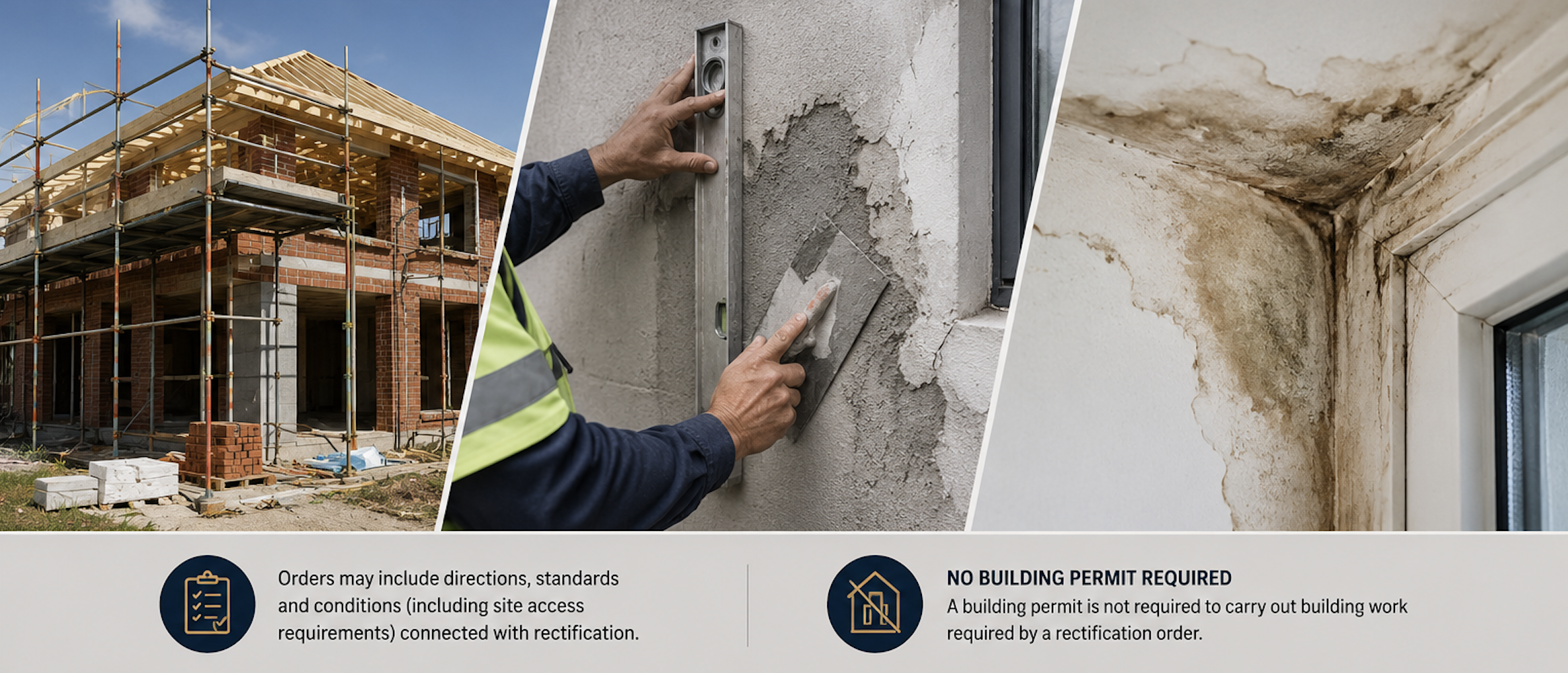
A rectification order may require the person to whom it is issued to:
- complete the building work;
- rectify non-compliant or defective building work;
- rectify damage caused by the building work or by defective work.[5]
The section also permits the Authority to require the recipient to follow directions or meet standards connected with the rectification, and to do other things connected with that action.[6]
In addition, the order may specify conditions to be satisfied by another person before the recipient is required to comply, including conditions relating to site access.[7]
The Act further clarifies that “damage caused in the carrying out of the building work or by the non-compliant or defective building work” includes matters such as impaired drainage, undermining of structures, water penetration or termite infestation.[8]
No Building Permit Required
One practical feature of the regime is especially important.
Section 75E(6) provides that a building permit is not required to carry out building work required by a rectification order, despite anything to the contrary in the Building Act or Regulations.[9]
For builders, this provision removes the need to obtain a fresh building permit before carrying out rectification work mandated by the order.
Evidentiary Findings
Under s 75F, a rectification order may include a finding by the Authority that building work is incomplete, non-compliant or defective.
Such a finding is evidence and, in the absence of evidence to the contrary, proof of that finding.[10]
This feature gives the order evidentiary weight and may influence the dynamics of later disputes.
Joint and Several Responsibility
Where a rectification order is issued to more than one person, s 75B(4) provides that the recipients are jointly and severally liable to comply with the order.[11]
This means that each person named in the order may be exposed to the full obligation as imposed by the Authority.
Review Rights
Persons affected by rectification order decisions have statutory review rights.
Under s 75S, an affected person may apply to VCAT for review of a decision to issue a rectification order, a decision not to issue a rectification order, or to issue a rectification costs order.[12]
In most cases the application must be made within 28 days after the person receives notice of the decision.[13]
Consequences of Non-Compliance
Failure to comply with a rectification order without reasonable excuse constitutes an offence under s 75M. [14]
Maximum penalties are:
- 500 penalty units for an individual; and
- 2,500 penalty units for a corporation.
In addition, amendments introduced by the 2025 Act mean that failure to comply with a rectification order may constitute a ground for disciplinary action or immediate suspension of registration.[15]
Rectification Costs Orders
The regime also empowers the Authority to recover its costs.
Under s 75O, the Authority may issue a rectification costs order requiring payment of amounts incurred in investigating the work, issuing the rectification order, monitoring compliance and taking action connected with the rectification process.[16]
Where such an order is issued to both the person who carried out the work and the developer, they are jointly and severally liable to comply with that order.[17]
How the Regime May Change the Face of Litigation
The rectification order regime is likely to re-sequence defect litigation rather than eliminate it.
Previously, defect disputes were often initiated through plaintiff-driven claims. Under the new regime, the first formal step may instead be a regulatory order requiring rectification.
The immediate issue becomes compliance with the order, rather than the determination of ultimate liability.
Litigation may therefore occur later, in the form of contribution to costs or recovery proceedings between builders, developers and other project participants.
Impact on Builders
For builders, the regime introduces a new layer of regulatory risk.
A builder served with a rectification order must decide quickly whether to comply or seek a review. The statutory deadlines are short, and the consequences of non-compliance are significant.
At the same time, the regime does not necessarily resolve all downstream disputes between project participants. A builder may still pursue recovery proceedings against others where rectification work is attributable to defective design, consultant advice or other causes.
The practical reality is that builders may now be required to address the rectification issue first, with the allocation of ultimate liability becoming a later dispute.
Conclusion
The rectification order regime represents a structural shift in Victoria’s building regulatory system.
It strengthens the regulator’s ability to compel rectification of defective building work and alters the sequence in which many disputes will unfold. Instead of beginning with plaintiff litigation, disputes may now begin with a regulatory rectification order.
For builders and developers, this means that early legal and technical advice will be essential whenever a rectification order is issued. The capacity to respond quickly and to protect downstream recovery rights may become a decisive factor in managing building risk in the years ahead.
Disclaimer
This article is for general informational purposes only and does not constitute legal advice. For advice specific to Owners Corporations, building defects, or dispute resolution, please contact Lovegrove & Cotton at enquiries@lclawyers.com.auor call (03) 9600 4077.
Author
Justin Cotton is a principal of Lovegrove & Cotton Construction & Planning Lawyers, a Melbourne law firm who have been experts in construction and planning law since 1993. He is also Chair of the HIA Industrial Relations & Legal Services Committee.
Justin has more than two decades of experience in construction law and building regulatory matters. He regularly advises builders, developers, building surveyors and property owners on building disputes, regulatory compliance and risk management. He has extensive experience appearing before the Building Appeals Board, VCAT and the courts.
Footnotes
- Building Legislation Amendment (Buyer Protections) Act 2025 (Vic) inserting “Part 5A – Orders for the rectification of incomplete, non-compliant or defective building work” into the Building Act 1993 (Vic).
- Building Act 1993 (Vic) s 75B.
- Building Act 1993 (Vic) s 75C.
- Building Act 1993 (Vic) s 75D.
- Building Act 1993 (Vic) s 75E(1)(a).
- Building Act 1993 (Vic) s 75E(1)(b).
- Building Act 1993 (Vic) s 75E(2).
- Building Act 1993 (Vic) s 75E(4).
- Building Act 1993 (Vic) s 75E(6).
- Building Act 1993 (Vic) s 75F.
- Building Act 1993 (Vic) s 75B(4).
- Building Act 1993 (Vic) s 75S.
- Building Act 1993 (Vic) s 75S(2).
- Building Act 1993 (Vic) s 75M.
- Building Act 1993 (Vic) s 85-86.
- Building Act 1993 (Vic) s 75O.
- Building Act 1993 (Vic) s 75O(5).
Image Acknowledgements:
The digital renders used in this article were developed collaboratively by Lovegrove & Cotton and ChatGPT.

The vexed question of who has standing over common property building defects in an apartment building is more pertinent than ever, in these days of more inhabitants of high-rise buildings administered by Owners Corporations.
It is also more relevant in these days of higher rainfall levels across Australia and including in Victoria where once, only little more than a decade ago, there was concern about an ongoing drought.
Waterproofing and leaky building defects, afflicting balconies, ceilings, and common area basements are now frequent hallmarks of domestic building claims in Victoria. Regularly encountered common area problems can be façade issues with render or combustible cladding, water ingress issues with pipes in wall cavities and water leaks from balconies, and cracking and water ingress in basements with slabs, columns and beams.

It is important to note that, save for cladding claims that may have a longer 15-year limitation period, the Owners Corporation will be subject to the usual 10 year limitation period (counted from the date of the Occupancy Permit) to issue legal proceedings against the original builder and other construction practitioners (eg designers) in building defect claims.
It is not a rare situation for building defect claims in Victoria to involve the Owners Corporation as the Applicant for the common property defects, and for various named lot owners as co-Applicants in relation to defects located on or affecting their private lots / apartments.
There is no special resolution needed (obviously) for private lot owners to bring legal proceedings for defects located in, or damage sourced in, their private apartments. However, for building defects located in or on the common property, only the Owners Corporation has legal standing to initiate such legal proceedings for redress.
Given that an Owners Corporation has a duty to repair and maintain the common property under the Owners Corporation Act 2006 (section 46) they may indeed have a duty to initiate legal proceedings against the parties responsible for such defects, or instead have the lot owners pay for such defect repairs directly (if there is not going to be legal proceedings against the builder or other parties).
Special Resolutions
In order to authorise an Owners Corporation to issue legal proceedings it is necessary to obtain a “Special Resolution” from the lot owner members of the Owners Corporation, either by vote at a meeting (AGM or SGM) or by ballot. A Special Resolution requires 75% of votes in favour, out of all lots entitled to a vote on the issue. Section 18 of the Act refers to the need for a Special Resolution in these circumstances.
If it is not possible to get a Special Resolution of votes in favour at the first attempt, at a meeting or by ballot, there can be some leeway on this, for instance by having an interim special resolution. However, to do this the Owners Corporation must satisfy the requirements in section 97 of the Owners Corporation Act 2006 (“the OC Act”) which is not always easy to do if there is not a quorum for the vote or if the vote in favour is not at least 50% of the total votes of all lots affected by the Owners Corporation.
Based on the precedent case in the Victorian Supreme Court of Body Corporate No 1 / PS40911511E St James Apartments v Renaissance Assets Pty Ltd [2004] VSC 438, the Supreme Court held that the Owners Corporation as a legal entity is the registered proprietor of the common property and was the “building owner” for the purposes of the OC Act in relation to the common property.
This meant that only the Owners Corporation, which owns the common property on behalf of the various lot owner members of the Owners Corporation, has legal standing to take legal proceedings in relation to common property.
So far it is relatively uncontroversial. It can be a complex question though on where exactly lies the demarcation between private property versus common property, when deciding who has standing to take legal action over apartment building defects. This is particularly so in relation to the balconies of private apartments, at least in the Victorian setting.
One can have regard to expert reports and the Plan of Subdivision to try to work out the separating line between private and common property in an Owners Corporation building. These tend to be more technical questions and legal interpretations are really confined to previous case law.
Often a Plan of Subdivision will show the boundary as the median line halfway between the two faces of the external and internal wall, or halfway between the ceiling of the topmost apartment and the roof. Needless to say, the roof of an apartment building will be seen as common property, as will the basement.

In relation to apartment balconies, the tiled floor of the balcony has traditionally been seen as private property appurtenant to the lot, while the inside face of the balustrade is similarly seen as private, but the outside balustrade face presenting to the street is seen as common property.
Between Australian jurisdictions, there have been differing case decisions on where the separating line is between common versus private property on apartment balconies. This is a critical question because it obviously affects the question of who has legal standing to bring legal proceedings.
It is generally accepted that the slab beneath and supporting a balcony is part of the infrastructure and with a purely functional purpose, and will be common property, while the tiles on the balcony floor are decorative and not functional and are private property.
In the New South Wales decision of The Owners SP 35042 v Seiwa Australia Pty Ltd [2007] NSWCA 272, it was held (lines 37-39) that the waterproofing membrane laid under the tiles on a balcony formed part of the common property for the building.
Also, in the ACT Supreme Court decision of The Owners Units Plan No 1917 v Koundouris [2016] ACTSC 96 (13 May 2016) the Judge declared at paragraph 580 that the waterproofing should most appropriately be treated as a part of the slab “because it is a functional rather than decorative treatment to the slab and is practically integrated with it. It is distinct from a finish such as tiling or painting.”
In contrast, in Victoria at the VCAT level a differing conclusion has been reached on where the separating line is between common versus private property and whether or not the waterproofing membrane should be regarded as private or common property.
There is little doubt across the jurisdictions that the floor tiles on a balcony, which can present as delaminating or lifting in many defect situations, are regarded as the private property of the lot owner. That said, the actual problem leading to the manifestation of distress is sourced in the waterproofing, or the lack thereof.
In the VCAT decision of Owners Corporation PS 508732B v Fisher [2014] VCAT 1358, the Tribunal found (in relation to a conventionally drawing Plan of Subdivision) that the balcony waterproofing membrane lay within the individual lot property boundary, making it part of the private property of the apartment.
This article is intended to be used for general information only and should not be relied on as formal legal advice. For more specialised advice on building defect claims and your legal rights and responsibilities, do not hesitate to take expert guidance from lawyers well versed in construction law.
Article written by Justin Cotton, Director of Lovegrove & Cotton Pty Ltd
Disclaimer
This article is not legal advice rather a discussion of the topic in only general terms. Should you be in need of legal advice, please contact a construction law firm. The experienced team at Lovegrove & Cotton can help strata communities and owners corporations resolve any type of building dispute.

Wrongful termination of contract
As a construction lawyer, the writer has witnessed many instances where builders and owners find themselves involved in unavoidable litigation due to wrongful termination of contract.
Usually, a well-crafted contract will have a procedure by which the contract can be brought to an end in the event the relationship between the parties breaks down irretrievably due to one party’s breach against the other, however terminating a contract is not always a “get out of jail free card”, as it were. One must be very careful and seek legal advice when considering terminating a contract.
Most contracts provide default provisions to allow parties to resolve their dispute without the need to take the matter to court. This may be issuing a ‘notice of dispute’ to enable parties to engage in dispute resolution discussions and resolve their dispute.
If the matter is not resolved within the dispute resolution period stipulated in the contract (if applicable), then the next step may be issuing a ‘notice of default’. An example of a party’s contractual
default may be carrying out defective building work or poor-quality workmanship by a builder, or failure to pay a progress payment by an owner. The reference to “default” means there must be a default or a substantial breach of the contract that one party is seeking to be remedied by the other party.
It should however be noted that one party’s default does not necessary give the other an automatic right to immediately terminate the contract. In other words, serving a notice of default, does not necessarily entitle a party to terminate the contract, if the default is capable of being remedied and the party in default is willing to remedy the default.
For instance, if a builder fails to rectify an alleged defect within the stipulated time in the notice of default and/or the contract, the owner is still not necessarily entitled to terminate the contract, unless the factual grounds that underpin a right to terminate exist.
Purporting to terminate a contract in circumstances where an innocent party does not give the defaulting party the opportunity to remedy the default described in the default notice, would be regarded as a ‘repudiation’ or unwillingness by the failing party to no longer be bound by the contract or to perform the Contract.
Most contracts also contain a provision that a party seeking to terminate a contract based on a notice of default, should not themselves be in breach of the contract. So the party seeking to terminate due to the fault of the other should have “clean hands”.
Repudiation of contract
Repudiation of contract occurs when a party “evinces an intention to no longer be bound by the contract”, either expressly or by conduct. For instance, a builder may allege that an owner failed to pay a progress payment in circumstances where the relevant building stage has not been completed. If the owner then refuses to pay the alleged progress payment and the builder refuses to continue with the building works, this may be regarded as a repudiation or unwillingness to perform contractual obligations by the builder.
In Heyman v Darwins Ltd 1942, it was held that:
“… a party by words or conduct evinces an intention to no longer to be bound (by the contract) and the other party accepts… and rescinds the contract.”
As mentioned above, every case is different on its merits and one must seek legal assistance prior to terminating a contract, because even if one believes he/she is the wronged party, one can still be liable for wrongfully terminating a contract if due process is not followed pursuant to the contract.
Does repudiation mean the contract is at end?

Repudiation by one party does not automatically end the contract, unless accepted by the other party. Whether to accept a repudiation or insist on specific performance is best answered on a case-by-case basis as each case is different on its facts.
Ending a building contract pursuant to section 41 of the Domestic Building Contracts Act 1995 (Vic) (“DBCA”)
An owner may terminate a major domestic building contract for completion time or cost blows out for unforeseeable reasons if:
(i) The contract price rises by 15% or more after the contract was entered into; or
(ii) The contract has not been completed within 1½ times the period it was to have been completed by.
Furthermore, for the owner to terminate the contract the reason for the increased time or cost was something that could not have been reasonably foreseen by the builder on the date the contract was made.
Any increased time or cost that arises as a result of a prime cost item or a provisional sum or that is caused by a variation are not included in calculating any price rise or increase in time.
To end the contract, the owner must give the builder a signed notice stating that the owner is ending the contract under section 41 of the DBCA and giving details of why the contract is being ended.
If a contract is ended under this section, the builder is entitled to a reasonable price for the work carried out under the contract to the date the contract is ended however the builder cannot recover more than the builder would have been entitled to recover under the contract if it was not ended prematurely.
Lovegrove & Cotton strongly caution owners, builders and contractors to ensure that they do not adopt a layman’s approach to contractual termination.
When faced with the challenges of terminating a building contract, it would be prudent to consult with expert construction lawyers, and have them draft any necessary documents.
Article written by Tsigerda Lovegrove Construction and Planning Lawyer and firm manager Lovegrove & Cotton.
Disclaimer
This article is not legal advice rather a discussion of the topic in only general terms. Should you be in
need of legal advice, please contact a construction law firm. Lovegrove & Cotton Lawyers and
our experienced team will assist you based on the facts and circumstances of your case.
- 1
- 2
- 3
- 4
- Next Page »